Carole Maso - Ghost Dance
Здесь есть возможность читать онлайн «Carole Maso - Ghost Dance» весь текст электронной книги совершенно бесплатно (целиком полную версию без сокращений). В некоторых случаях можно слушать аудио, скачать через торрент в формате fb2 и присутствует краткое содержание. Год выпуска: 2013, ISBN: 2013, Издательство: Dzanc Books, Жанр: Современная проза, на английском языке. Описание произведения, (предисловие) а так же отзывы посетителей доступны на портале библиотеки ЛибКат.
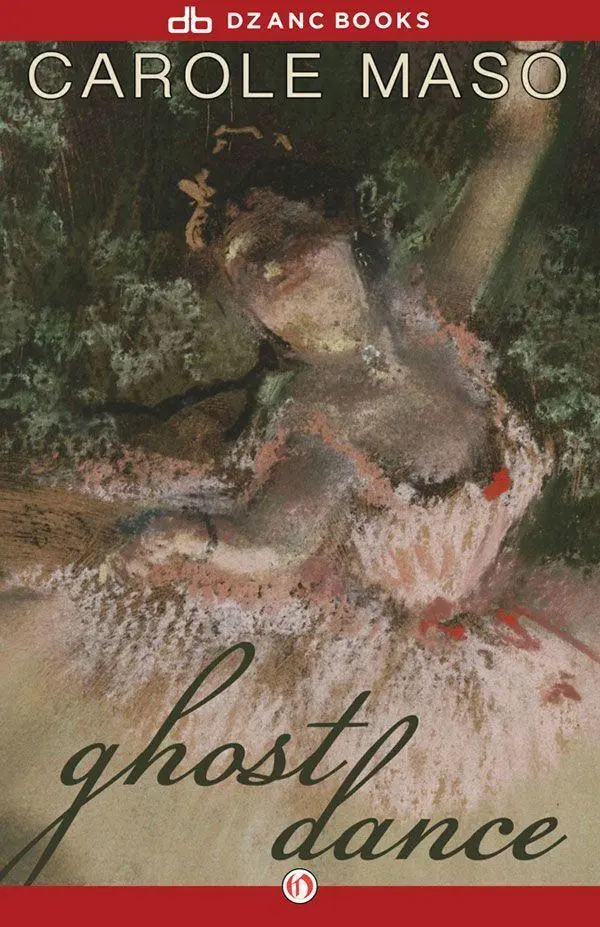
- Название:Ghost Dance
- Автор:
- Издательство:Dzanc Books
- Жанр:
- Год:2013
- ISBN:9781480441897
- Рейтинг книги:5 / 5. Голосов: 1
-
Избранное:Добавить в избранное
- Отзывы:
-
Ваша оценка:
Ghost Dance: краткое содержание, описание и аннотация
Предлагаем к чтению аннотацию, описание, краткое содержание или предисловие (зависит от того, что написал сам автор книги «Ghost Dance»). Если вы не нашли необходимую информацию о книге — напишите в комментариях, мы постараемся отыскать её.
has to offer. Like her artist-protagonists, Maso's subject as well as medium is language, and she is brave and dangerous in her command of it. She abandons traditional narrative forms in favor of a shaped communication resembling Beckett and rivalling his evocative skill. Immersed in dilated and intense prose, the readers view is a privilege one, riding the crest of clear expression as it navigates the tangled terrain of loss and desperate sorrow.
Ghost Dance — читать онлайн бесплатно полную книгу (весь текст) целиком
Ниже представлен текст книги, разбитый по страницам. Система сохранения места последней прочитанной страницы, позволяет с удобством читать онлайн бесплатно книгу «Ghost Dance», без необходимости каждый раз заново искать на чём Вы остановились. Поставьте закладку, и сможете в любой момент перейти на страницу, на которой закончили чтение.
Интервал:
Закладка:
She looked just as she looked in Martas photographs. As in the photos, empty space enveloped her. She looked lonely out there, in need of company.
“Give me a chance,” she said. “Imagine me,” she pleaded, and she stepped closer, “please.”
“Maybe Natalie isn’t dead,” I said, jumping awake. “Maybe she’s still alive. What if she wanted to trick everybody? Escape her parents? Change her life? Start over? Become French or Italian? Change her name? Maybe she arranged it all w ith the man in the phone booth in Nice. Maybe the whole thing was set up somehow.”
“Vanessa,” Marta said slow ly, looking at me with her flickering brown eyes, “you’re so stupid sometimes.” She took my hand. “These are the facts. I loved a strange and beautiful woman. I never understood her. Our time together was short. I was a season’s diversion for her, a plaything — an exotic object from South America for her impressive collection. When she tired of me, she packed up and left. Do not idealize her. She was thoughtless, selfish, and vain. But I loved her anyway. She never really cared about me. She died that cold night in France. She’s dead. I love her still.”
“But, Marta…”
“There are things that can never be explained, Vanessa, things that will never make sense. I’m unlucky, I guess. I can’t get around the facts; they keep coming back. Natalie is dead. She died for nothing. I can never bring her back.”
Mourning clothes weigh far more than regular clothing. They are not only heavier, but they cling close to the body and they do not come off at night. I was not at all surprised by Marta ‘s stooped posture, her rounded shoulders, her slow motion. I was impressed that she could move at all under such a tremendous weight. It must have taken great effort. She barely picked up her feet anymore; they were covered by mourning shoes.
How did we get up to the catwalk of Main those late afternoons where we stood and watched the sun sink like a heart? She could barely walk most days, but we climbed up there somehow. Where was Jennifer, I wondered, as we stared into the pink light and Marta told stories?
“Oh, off on some project, no doubt,” Marta said, with disdain and affection. She laughed, picturing her friend talking in feminist to the Ladies’ Auxiliary Club in Poughkeepsie or negotiating some treaty with the women at Bard College.
“You’ve got to give Jennifer credit,” she said, exhausted just thinking of the piles of leaflets and petitions that covered the floor of her room.
I miss her, this Marta, only because I have seen her shed for a moment her mourning clothes and join some unencumbered present where she comments on a task of Jennifer’s or a particular professor’s eccentricities or reads aloud some ridiculous article from the student newspaper. I wish for this Marta to be with me all the time. But as quickly as she’s surfaced, it seems she sinks again, so heavy in her clothes of death.
I too had grown fonder and fonder of escape. “Where is the needle, Marta?” I asked.
The Chinese are right to make white the mourning color. It is the color of the eyes rolled back in the head, the color of the blank page that is always before my mother. It is the color of cocaine — the color of heroin.
She is baklava sweet in the stale ground.
“She slipped out of the wreckage of our lives casually,” Marta said, falling into sleep, “as if out of a pair of stockings.”
There was no sign of turmoil on Natalie’s face that day as she discussed with her adviser taking the year in France, then wrote to her parents, on vacation in Africa, for money, then made the plane reservations. She felt calm, relieved even, as if some weight had been lifted.
Not even she knew how much damage had been done. The mind can continue for days or months or years sometimes before allowing chaos in. Not everyone falls apart immediately during a crisis. Some grow stronger at first, more beautiful. The men on the plane could not keep their eyes off Natalie. She knew this, and it brought her some small pleasure as she lit a cigarette and unfastened her safety belt. They had no power over her and she enjoyed that, for she could never love a man and their lecherous and forlorn looks made her quite suddenly giddy. She was in control of her life. How easily she had made all the necessary arrangements.
What waited for her in France she was too tired even to conceive. She took from her large leather bag an Italian Vogue , a French dictionary, and some light-blue writing paper, which she quickly put away. She would not look back again. Gray Poughkeepsie was gone. She had made it disappear. She could do anything. Marta, too, was gone. Her French, of course, would need brushing up, she thought. Marta ‘s had always been so pathetic, so horribly Spanish. Natalie loathed imperfection, weakness of any kind. She hated the way Marta groveled. Natalie practiced her cold, hard look on the man across the aisle. He fidgeted in his seat. Marta had become so weak. At the end Natalie could not stand the sight of her. She smiled. She had made her disappear.
I stumbled into the white room. The weather was getting colder and colder now, the mercury falling way below freezing. I hugged my black coat to me. White envelopes fell from my pockets and the package of needles. Jack looked into my eyes, rolled up my sleeves.
“Goddamn it,” he said. “Goddamn it, Vanessa.” He kissed me everywhere as if he might suck the drug from my system. “Goddamn it,” he whispered.
“Don’t do this,” he said. “Save yourself.”
White, too, is the color of snow.
“Crazy Horse was dead. Sitting Bull was soon to die. What Drinks Water dreamt in advance was coming true: ‘they will come and they will build small gray boxes on the land and beside those boxes we shall die.’”
We walked on the farm with Grandfather. He was getting old as he spoke the story. “Let’s sit here,” he said, and we sat in the center of a field of wheat.
“They were being crowded into camps,” Grandpa said. “Their food was being cut off and they were slowly starving to death. The land they loved was being taken away. The white men wanted to buy it. They did not understand that it was not for sale.
“It was the end. The earth was being pulled apart for coal and gold. Every promise was broken. Many, many were killed. There was no hope on earth.”
“It was the end,” Eletcher said. “They could not roam on the land. They were put into camps.”
“But then from the west,” my grandfather said, “came a dream over the plains.” He made a large gesture with his arm. “And the dream was this: Christ had come back to earth as an Indian. Indians from all over went to Nevada to hear the dreamer’s story. ‘The dead will all be alive again,’ Wovoka said. ‘The earth will be green with high grass. The buffalo and elk will return. There will be plenty of food. It will be like old times.’
“They were starving. There was no hope on earth. Crazy Horse was dead,” my grandfather said.
White Feather thought of her son and her heart swelled.
“‘We will walk and talk with our lost ones,’ Wovoka said, ‘if you do the Ghost Dance,’ and he taught them how to do it. ‘Everyone,’ he said, ‘must dance. There will be food and sweet grass. And the white man will become small fish in the rivers. Spread the word.’”
The Indians brought Wovoka’s message back to their tribes, Grandpa told us, and everywhere men and women began dancing the Ghost Dance. They wore the magic Ghost Shirts that were painted with sacred symbols and impenetrable to the bullets of the white man.
There was no hope on earth.
“After doing the dance for a long time, men and women fell into trances. Many saw what had been promised. There was happiness and peace. When they came back from the trances they told their dreams to others. They had seen the dead. In the next spring it was promised there would be no more misery. They danced on and on. The white men ordered the Ghost Dancing to be stopped. Sitting Bull was taken away. But the Indians continued. ‘We shall live again,’ they chanted.”
Читать дальшеИнтервал:
Закладка:
Похожие книги на «Ghost Dance»
Представляем Вашему вниманию похожие книги на «Ghost Dance» списком для выбора. Мы отобрали схожую по названию и смыслу литературу в надежде предоставить читателям больше вариантов отыскать новые, интересные, ещё непрочитанные произведения.





Обсуждение, отзывы о книге «Ghost Dance» и просто собственные мнения читателей. Оставьте ваши комментарии, напишите, что Вы думаете о произведении, его смысле или главных героях. Укажите что конкретно понравилось, а что нет, и почему Вы так считаете.