Carole Maso - Ghost Dance
Здесь есть возможность читать онлайн «Carole Maso - Ghost Dance» весь текст электронной книги совершенно бесплатно (целиком полную версию без сокращений). В некоторых случаях можно слушать аудио, скачать через торрент в формате fb2 и присутствует краткое содержание. Год выпуска: 2013, ISBN: 2013, Издательство: Dzanc Books, Жанр: Современная проза, на английском языке. Описание произведения, (предисловие) а так же отзывы посетителей доступны на портале библиотеки ЛибКат.
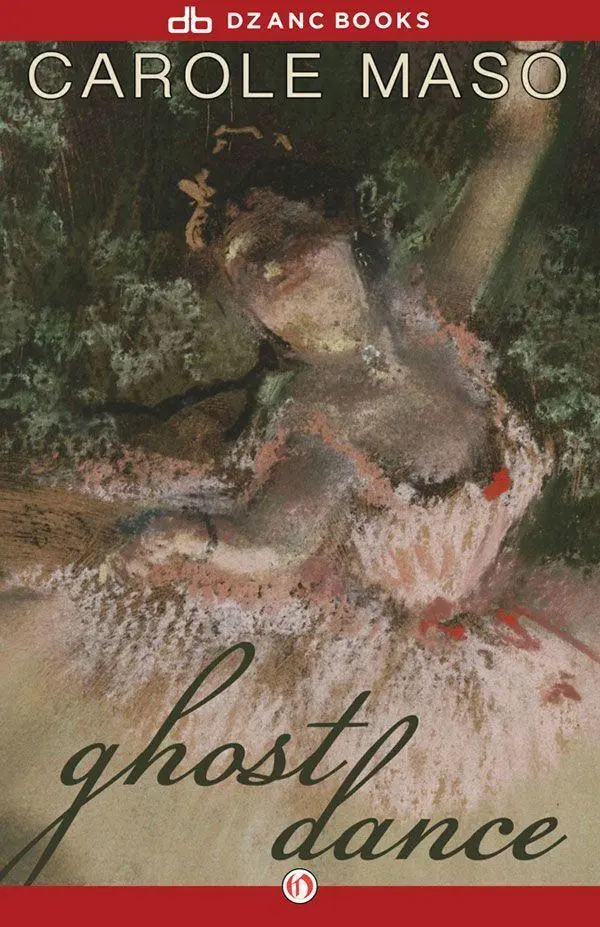
- Название:Ghost Dance
- Автор:
- Издательство:Dzanc Books
- Жанр:
- Год:2013
- ISBN:9781480441897
- Рейтинг книги:5 / 5. Голосов: 1
-
Избранное:Добавить в избранное
- Отзывы:
-
Ваша оценка:
Ghost Dance: краткое содержание, описание и аннотация
Предлагаем к чтению аннотацию, описание, краткое содержание или предисловие (зависит от того, что написал сам автор книги «Ghost Dance»). Если вы не нашли необходимую информацию о книге — напишите в комментариях, мы постараемся отыскать её.
has to offer. Like her artist-protagonists, Maso's subject as well as medium is language, and she is brave and dangerous in her command of it. She abandons traditional narrative forms in favor of a shaped communication resembling Beckett and rivalling his evocative skill. Immersed in dilated and intense prose, the readers view is a privilege one, riding the crest of clear expression as it navigates the tangled terrain of loss and desperate sorrow.
Ghost Dance — читать онлайн бесплатно полную книгу (весь текст) целиком
Ниже представлен текст книги, разбитый по страницам. Система сохранения места последней прочитанной страницы, позволяет с удобством читать онлайн бесплатно книгу «Ghost Dance», без необходимости каждый раз заново искать на чём Вы остановились. Поставьте закладку, и сможете в любой момент перейти на страницу, на которой закончили чтение.
Интервал:
Закладка:
It was 1890 and winter was coming on.
Anne Stafford held her five-year-old son Joshua tightly in her arms as if she might squeeze the life back into him. Her heart ached so that she wished she might die with him. Cholera had broken out all along the Platte River. All day as they traveled westward in their covered wagons, they could see people burying their dead, using the side boards of the wagons to construct coffins.
“You cannot trade the lives of children for handfuls of gold,” Anne cried. “One does not make up for the other.”
After three days Anne’s husband finally pried Joshua away from his wife, took some boards and made the second small coffin of their short voyage. Her arms were now empty of both children. One could hear her piercing cry, like that of the coyote, through the dark nights. In grief she gathered her children’s toys together, glued them to a pail, and painted them blue.
Eva Hauser, sitting up in bed, moved the blue stamp from Germany from the top corner of the canvas down to the bottom. A series of pink stamps from France, cut in half, ran down the left side like a border. She sprinkled a bit of chamomile through the center. Looking at the various scraps of fabrics the women of the sewing circle had left her, she picked one and held it in her hands. She cut out a triangle from a family photograph and placed it carefully to the right. A broken teacup that her grandmother once lovingly put her lips to every day completes the piece.
“I can’t live here anymore,” she sighs over the phone, exhaling cigarette smoke as she tells her parents of her plans. “I can’t even drive.”
“Drive? What do you need to drive for?” her mother, always chauffeured, asks.
“You’ve obviously never come to visit me in Poughkeepsie,” Natalie says. “You obviously don’t know what I’m up against!”
“Your father will get you a car,” her mother says.
“Yes, but I don’t want a car. I want to go back to Europe.”
Marta began to eat only things that crunched: carrots, celery, crackers, popcorn, apples. She did not move. I brought these things to her bed, closed my eyes, and listened to the sound of her jaw coming down on a stalk or a core. She did not speak. She was making sounds the only way she could. No more talk about Natalie’s death — no more talk at all, the crunching went on all day and long into the night.
As I lie alone in my bed in New York now, I hear her crunching again, though I have not seen Marta in such a long time. Now in the middle of this lonely December she hands me a perfect, red apple. “Eat this,” she tells me. “Eat this.” She passes me a carrot next, a cracker, not much, but all she has.
“I miss you, Marta,” I call out in the darkness where only the cat moves.
“I loved her so much,” I hear her say. “It was so hard to try to live without her, to try to live after her.”
She tries to help me now as a light snow begins to fall, and I realize that she has been helping me all along. The room, the candles, the photos, the — it was all part of the rehearsal. She gives me my marks on the stage now, telling me where to stand, my line cues. She hands me a ripe, red apple. “Eat this,” she says, “eat this.”
Before her eyes the highway opened up like a field and slowly filled with snow. She looked up at the white sky; it seemed the snow might never stop. As they neared home in the little red car, the snow fell harder, transforming the landscape.
It was one of those bright, impossibly clear spring days that had become less and less common in New York. Rain had become its weather, gray its color. Ahaze that would not entirely burn off seemed always to envelop the city. We had grown accustomed to it; it was how we lived. So on this day in Central Park the heightened clarity seemed strange, giving us all a sense of unreality-Things this clear did not seem true anymore.
I was unused to such a skyline. It was sharp, pointed. I felt I might pierce my hand on the Chrysler or the Empire State Building; they seemed that defined, that close. I could nearly see into them: the off-hour office scenarios: in one building a band of young lawyers working this Saturday on an antitrust case; in another building a boss taking his secretary onto his lap.
Such clarity provides information we do not know how to take in, how to integrate. Faces are more exposed, we are forced to see the hundred deaths in them. Words are more vulnerable, fragile, sounds are magnified. Everything is exaggerated. Even a piece of paper can have a wounding edge. But this was the day chosen months in advance to celebrate the earth, and on the thousand mouths of those who gathered, the words “perfect,” “beautiful,” “lovely,” “exceptional” rose as they looked to the blue-egg sky.
My mother looked to me, then away, then back again quickly as if she saw some small feature of mine that had been hidden from her for seventeen years. My father studied Fletcher who, chosen by the high school to make a speech this day, was just approaching the podium. It seemed as if Father was seeing Fletcher clearly for the first time, seeing him with new eyes, and with these eyes he glimpsed something he hadn’t been able to see before; something came clear in his own mysterious life. Staring straight ahead, he was not the man who adored my mother and lived in her shadow, he was not the father of two children whose jacket ends were tugged even in sleep. He was not the wayward son, the disappointment. Looking at his own son he was someone else, a man of nature with a destiny, a free will. It welled in his chest and filled him with a great feeling of power and momentum. For a few brief moments I saw my father this way: a free man, an immense, important figure in his own life.
But in less than a minute something happened. The wind changed direction or the public address system hissed and the spell broke. It is I who cannot sustain this vision.
Though my mother’s shoulder touched mine and my father’s shoulder touched my mother’s, I was aware that something was already beginning to divide us, separate us. Fletcher seemed to recede before me, my parents to fall away. “Don’t go,” I said, but no one heard me. I knew that I would have to start talking louder, concentrating harder. Blocks of lucite or some other modern, clear material seemed to be forcing us apart. I feared it would cloud over and distort my eyesight. I feared that soon I would not even be able to shout through it. I should have investigated its terrible proportions more that day, touched its thickness and its edges before it grew monstrous, untouchable, unbreakable, without boundaries. My father, a tall man, found his knees constricted by the invisible slab. They knocked against it. Through it he looked at my mother and, sensing her uneasiness, attempted to calm her with talk. The tiniest details of everyday life could sometimes relax her. They looked at the light fixtures, changed since their last visit to the park. They noted the tourists, guessing their nationalities. They watched the colorful garb of joggers, talked about shoes, followed the horse-drawn carriages as they made their way around the park.
“That horse is so poorly groomed,” my mother said, pointing to a shabby brown one. “An animal like that should be cherished, not made to pull overweight foreigners on concrete.
“Where do they keep the horses at night, Michael?” she asked, and her voice was as high and light as a child’s. Once my mother got hold of an idea, she did not easily let go of it. She moved back and forth slightly in her seat. I knew as my brother neared the podium that she was imagining those old brown horses shifting from one leg to another in their tiny stalls.
“It is no secret,” Fletcher said, and she jumped, looking at me with animal eyes that darted wildly as if there were fire and she was a horse. I took her hand.
Читать дальшеИнтервал:
Закладка:
Похожие книги на «Ghost Dance»
Представляем Вашему вниманию похожие книги на «Ghost Dance» списком для выбора. Мы отобрали схожую по названию и смыслу литературу в надежде предоставить читателям больше вариантов отыскать новые, интересные, ещё непрочитанные произведения.




Обсуждение, отзывы о книге «Ghost Dance» и просто собственные мнения читателей. Оставьте ваши комментарии, напишите, что Вы думаете о произведении, его смысле или главных героях. Укажите что конкретно понравилось, а что нет, и почему Вы так считаете.