Carole Maso - Ghost Dance
Здесь есть возможность читать онлайн «Carole Maso - Ghost Dance» весь текст электронной книги совершенно бесплатно (целиком полную версию без сокращений). В некоторых случаях можно слушать аудио, скачать через торрент в формате fb2 и присутствует краткое содержание. Год выпуска: 2013, ISBN: 2013, Издательство: Dzanc Books, Жанр: Современная проза, на английском языке. Описание произведения, (предисловие) а так же отзывы посетителей доступны на портале библиотеки ЛибКат.
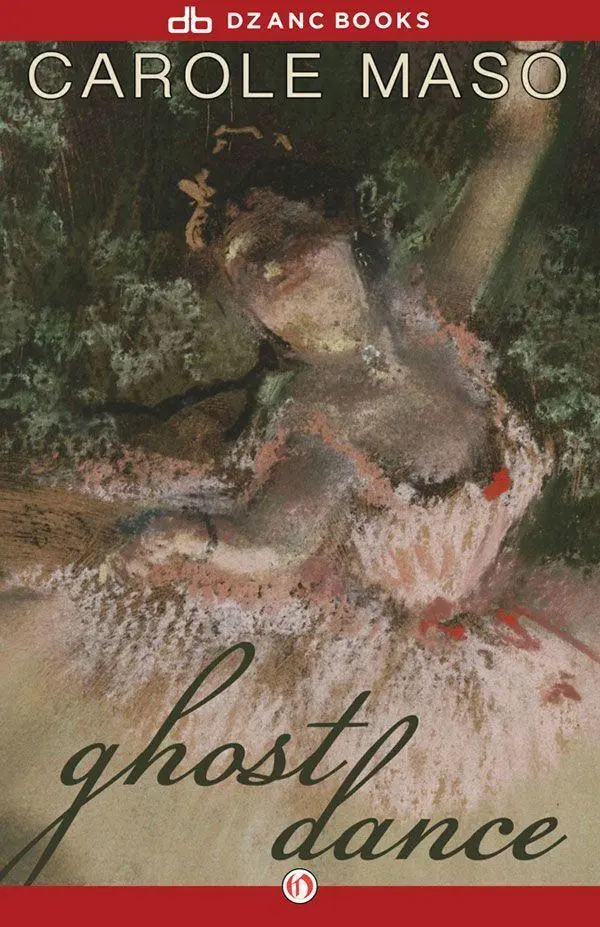
- Название:Ghost Dance
- Автор:
- Издательство:Dzanc Books
- Жанр:
- Год:2013
- ISBN:9781480441897
- Рейтинг книги:5 / 5. Голосов: 1
-
Избранное:Добавить в избранное
- Отзывы:
-
Ваша оценка:
Ghost Dance: краткое содержание, описание и аннотация
Предлагаем к чтению аннотацию, описание, краткое содержание или предисловие (зависит от того, что написал сам автор книги «Ghost Dance»). Если вы не нашли необходимую информацию о книге — напишите в комментариях, мы постараемся отыскать её.
has to offer. Like her artist-protagonists, Maso's subject as well as medium is language, and she is brave and dangerous in her command of it. She abandons traditional narrative forms in favor of a shaped communication resembling Beckett and rivalling his evocative skill. Immersed in dilated and intense prose, the readers view is a privilege one, riding the crest of clear expression as it navigates the tangled terrain of loss and desperate sorrow.
Ghost Dance — читать онлайн бесплатно полную книгу (весь текст) целиком
Ниже представлен текст книги, разбитый по страницам. Система сохранения места последней прочитанной страницы, позволяет с удобством читать онлайн бесплатно книгу «Ghost Dance», без необходимости каждый раз заново искать на чём Вы остановились. Поставьте закладку, и сможете в любой момент перейти на страницу, на которой закончили чтение.
Интервал:
Закладка:
“We used to walk through it like snow. We walked through drifts of it to do our job. Later some of the children got it, too — from playing with our work boots or sitting on our laps.”
From Detroit he sent me a postcard of the Ford plant. Only my address appeared on the back.
The ceremony of burying the dead is ended with tears, wailing, howling, and macerations. They tear the hair, gash the skin.
“Greetings from the Land of Lincoln,” the front of the postcard reads in bright red letters, the famed log cabin in one corner, a dark silhouette in the other. “Dow Chemical,” my brother scrawls. “Much evidence that Dow knew as early as the mid sixties that exposure to dioxin (Agent Orange) might cause serious illness, even death, but withheld this knowledge and continued to sell to the Army and public.”
I have read a hundred times the messages he has scribbled on the backs of these cards. I have looked into the eyes of the fisherman for help, stared at the lobsters he holds to the sky like children. I have read and reread my brother’s long litany of betrayal and pain: DLS, asbestos, Agent Orange; Lilly, Johns-Manville, Dow Chemical. They lie like scars on my tongue. Then silence — nothing more — a horrible stillness.
There in the distance another Fletcher rises out of murky water. He crawls onto the shore clutching a bayonet. He claws his way into the thick bush where he lies shivering. It could be anywhere: Argentina or Chile, Vietnam or Cambodia. He sits up. It’s Fletcher all right. He is hunched over and counting something. Sweat collects on his forehead. He wipes it away with a filthy sleeve. Wasps gather around his head. He tries to bat them away, but they keep coming and coming like helicopters in the endless night. Waves of nausea overcome him. His boots are golden with vomit.
My brother looks so different forced into the brutal postures of war. I barely recognize him at all. He is covered with sores. His legs seem longer, larger somehow. “Best for running, Vanessa,” he whispers through the wide leaves. He tears a handful of leaves from a tree to wipe his mouth and brow. Patches of brow n and gray and green have grown on his arms. His skin looks tough like a lizard’s or snake’s. A second skull has grown around his head, hard as a helmet. His insect eyes bulge red.
He has become the kind of person who wants only to survive, only to stay alive. “Nothing else matters, Vanessa,” he shouts through the thick foliage. A monkey screams. More planes come. A tarantula is stunned motionless on a banana leaf. The air is filled with snakes. He begins to shake uncontrollably. He does not know where he is.
Trees burst into flames as he watches them. He hears drums, he thinks, in the distance, but perhaps it is his own heart he hears. He closes his eyes. His lids are thick. He covers his face. “You could not do it without the drugs,” he says. “No one could.” He thinks someone injects the high white clouds with poison. He tries breathing into his hands to keep out the fumes. The clouds mushroom and explode, red and black, igniting the sky. “The sky is burning, Vanessa,” he says. He laughs hysterically. His shoulders move up and down frantically as if he were shrugging over and over in fast motion. He is drenched in sweat. He turns suddenly. The brow n rice in barrels looks dangerous to him. The sandal of a child makes him weep with fear. Urine flows down his pants leg. “Vanessa,” he says, “help me. The sky is burning.”
“Fletcher, get up,” I try to say. “That lump, over there,” but I cannot get the words out fast enough, “is a grenade.” If a telegram comes I w ill not accept it. If a telegram comes I will tell them to send it elsewhere.
Preferring no thoughts to these, I close my eves, but the fear follows me.
“Fletcher,” my mother calls, wandering into the lining room of our enormous house in Connecticut one July afternoon years ago. She seats herself in the center of the floor. In the silence she feels the room betraying her.
“I think we’d better get rid of all this,” she says miserably and motions to the objects that surround her. It’s so crowded, and everything is always moving. She shows him the melting legs of the coffee table, the heavy curtains rustling in the windless air, the stereo that seems to slip from one radio station to the next without anyone touching it. The lamp and the piano chatter. There’s whispering among the Waterford. Fletcher’s eyes are wide. My mother’s perceptions are so real that my brother actually sees the furniture huddling in collusion. The pillows seem to be breathing, in the shrinking room, before his eyes.
“And this rug, too,” she sighs, “and these vases — I never wanted them.” Now the room seems impossibly cluttered. Fletcher can’t believe we ever lived in it.
“And these paintings,” he shouts, looking at my mother, then back at the heavy brushstrokes.
“And this couch.”
“And the candles,” Fletcher says.
“And all these plants,” my mother says, gasping for air, and my brother, too, begins to cry.
The enemy is everywhere. It is the chaise longue, it is the love seat.
“Help me, someone,” I whisper, closing my eyes in an attempt to dissolve the images with darkness, with words. “Help.”
“Who are you?” I ask, squinting, my head tilted to the side. “Who are you really?”
“Why? What does it matter? How could it help?”
“Because I love you.”
“You love me? Love yourself first.”
“Please, Jack.”
“Don’t cry,” he says. “Keep going. There’s no turning back now.”
She reaches her arm into the present, into my apartment here in New York. “I always knew you were strong, Marta, but this—”
She hands me an apple.
“bat this,” she says. “Eat this.”
“Fool Dog. Three Fingers. Wolf Necklace. Dead Eyes,” my brother writes across the last postcard, which pictures Bear Butte in South Dakota.
“Eight miles from Fort Meade,” the postcard states in fine print, “is Bear Butte. It can be seen from a hundred miles away. The Teton used to camp on this flat-topped mountain to pray. Here they would wail for the dead of whom the stones are tokens.”
The day my mother turned eighteen and was awarded a full scholarship to Vassar College and my Aunt Lucy was more or less settled, having become engaged to the life-insurance salesman and on her way to a career in nursing, was the day that Grandpa Sarkis announced in the gray kitchen that he was going home.
The sisters looked at one another puzzled, pretending they did not know what he was talking about, although they both knew precisely what he meant.
“But you are home, Daddy,” Lucy said, patting him gently on the back and looking around the room with him.
Already he had changed his name back to the real one, the Armenian one, Wingarian — not Frank Wing, the name he used in the mill.
“I’m going home,” Sarkis Wingarian repeated.
But home, the girls knew, was something only in their father’s head. You could not even find it on the map. He was going back to the old country, now many countries strewn across the continent. He was going to a place where, he imagined, his own life and thoughts of his wife might be erased by some greater suffering.
“In this country there is only work. You work your whole life and for what?” he muttered. “For nothing.” He looked at the seat at the kitchen table where his wife used to sit when she was well enough.
My mother would never see her father again. Only once that I know of did she ask him to come back, and that was right after my birth. I cannot really imagine it — how she found him or what she said or what he said back.
But he might very well have said, “In America they will laugh at me, they will call me a fat man, but here my weight is cause for respect. Here I am worth my weight in gold. In America I would look like an old man, but here old men are respected. Old age means wisdom.”
Читать дальшеИнтервал:
Закладка:
Похожие книги на «Ghost Dance»
Представляем Вашему вниманию похожие книги на «Ghost Dance» списком для выбора. Мы отобрали схожую по названию и смыслу литературу в надежде предоставить читателям больше вариантов отыскать новые, интересные, ещё непрочитанные произведения.









Обсуждение, отзывы о книге «Ghost Dance» и просто собственные мнения читателей. Оставьте ваши комментарии, напишите, что Вы думаете о произведении, его смысле или главных героях. Укажите что конкретно понравилось, а что нет, и почему Вы так считаете.