Carole Maso - Ghost Dance
Здесь есть возможность читать онлайн «Carole Maso - Ghost Dance» весь текст электронной книги совершенно бесплатно (целиком полную версию без сокращений). В некоторых случаях можно слушать аудио, скачать через торрент в формате fb2 и присутствует краткое содержание. Год выпуска: 2013, ISBN: 2013, Издательство: Dzanc Books, Жанр: Современная проза, на английском языке. Описание произведения, (предисловие) а так же отзывы посетителей доступны на портале библиотеки ЛибКат.
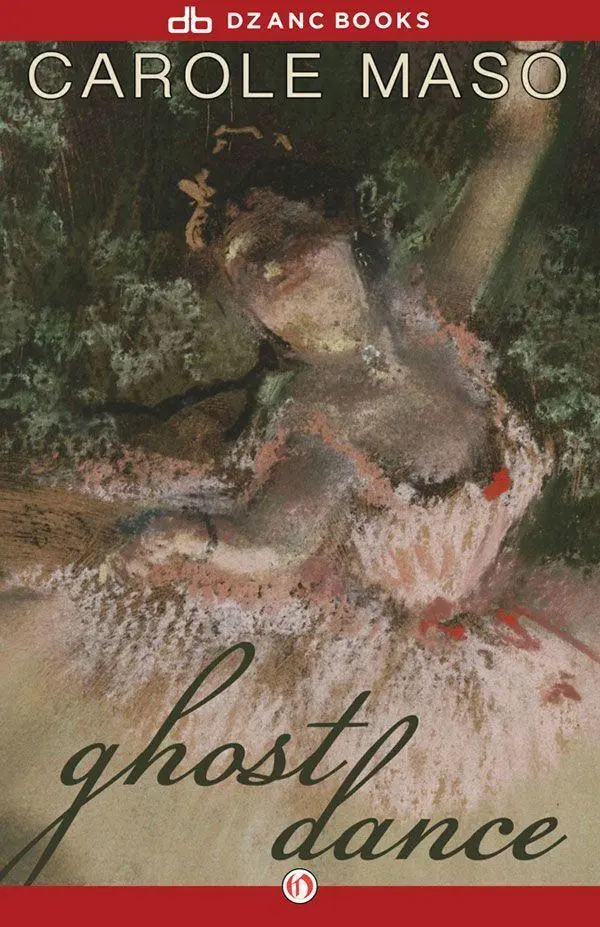
- Название:Ghost Dance
- Автор:
- Издательство:Dzanc Books
- Жанр:
- Год:2013
- ISBN:9781480441897
- Рейтинг книги:5 / 5. Голосов: 1
-
Избранное:Добавить в избранное
- Отзывы:
-
Ваша оценка:
Ghost Dance: краткое содержание, описание и аннотация
Предлагаем к чтению аннотацию, описание, краткое содержание или предисловие (зависит от того, что написал сам автор книги «Ghost Dance»). Если вы не нашли необходимую информацию о книге — напишите в комментариях, мы постараемся отыскать её.
has to offer. Like her artist-protagonists, Maso's subject as well as medium is language, and she is brave and dangerous in her command of it. She abandons traditional narrative forms in favor of a shaped communication resembling Beckett and rivalling his evocative skill. Immersed in dilated and intense prose, the readers view is a privilege one, riding the crest of clear expression as it navigates the tangled terrain of loss and desperate sorrow.
Ghost Dance — читать онлайн бесплатно полную книгу (весь текст) целиком
Ниже представлен текст книги, разбитый по страницам. Система сохранения места последней прочитанной страницы, позволяет с удобством читать онлайн бесплатно книгу «Ghost Dance», без необходимости каждый раз заново искать на чём Вы остановились. Поставьте закладку, и сможете в любой момент перейти на страницу, на которой закончили чтение.
Интервал:
Закладка:
My grandfather knew, too, after that day that despite evervthing, all the dance lessons at the Y, all the trips to Atlantic City, all his encouragement, that there would be no Rockette to dance through his old age, no high kicks, no lifted bosom, no spangles or sequins to relieve sadness.
When my mother was eighteen and her sister Lucy was seventeen and their mother had been dead many years already, my grandfather left his daughters, every American hope dashed, every bloated dream deflated. The movies had tricked him. No quiet, beautiful daughter had ever resisted stardom in them. No wife died of a rheumatic heart at the age of thirty-five. No family was broken into pieces.
Does he show a photo of his American daughter in a square in Russia, in a desert in Syria, as he looks everywhere for his old Armenia? No telling. Does he dream her over? In his mind, does she dance through the sorrowful landscape, Ginger Rogers, Ann Miller, full screen, larger than life?
Does he hold her photo up to the Turks? I wonder. Can she alter the bloody past for him — my beautiful, stubborn mother? A defense against the death force? A survivor? Transformed now — proof of something.
Now you move westward, Fletcher, leaving this old life far behind, as if it were possible to do so, and for you, even now, I would like to believe that it might be. Months ago your angry messages scrawled across picture postcards of Massachusetts, of Michigan, of West Virginia stopped coming. Did your anger end finally or only change form, become wordless, incommunicable? I must say it straight out — I am lonely for you. Write to me if you still can.
I always wanted to believe you, Hetcher, wanted to think that somehow we could live side by side with the sadness. It was your example I tried to follow: you, with your blue blanket slung around your shoulders, dreaming of flight; you, fast asleep on top of your leaflets, your thousand prayers for the earth; you of the civil rights rally, the peace march; your armbands, your food for the poor, vour large, burning heart.
Today you burn with a different fire, and everything you see as you cross the country burns in it. You level the land with your stare. You turn forests into ash, cities into ash, even houses where people live, even yourself.
This cannot go on, Fletcher — you, an old man carrying your bitter root across the country in a jute sack. Let it go. Bury it deep in the sand. Let it grow downward into darkness now as it curls from the bag into your arms and crawls onto your back, as it wraps all around you. I always believed you, Fletcher: that somehow we might forgive them. Now you face your greatest test, to take that faith of yours when you need it most, and use it.
Last I heard from my father he was nearing some neutral country like Sweden or Norway where they are just about to enter their season of darkness. Anyone who knows him would hope a Vivaldi concerto or a Bach fugue still runs through his head.
“…there’d been the biggest motorcade from the airport. Hot. Wild. Like Mexico and Vienna. The sun was so strong in our faces. I couldn’t put on sunglasses.…Then we saw this tunnel ahead, I thought it would be cool in the tunnel, I thought if you were on the left the sun wouldn’t get into your eyes.
“They were gunning the motorcycles. There were these little backfires. There was one noise like that. I thought it was a backfire. Then next I saw Connally grabbing his arms and saying no, no, no, no, no, with his fist beating. Then Jack turned and I turned. All I remember was a blue-gray building up ahead. Then Jack turned back so neatly, his last expression was so neat…you know, that wonderful expression he had when they’d ask him a question about one of the ten million pieces they have in a rocket, just before he’d answer. He looked puzzled, then he slumped forward. He was holding out his hand…. I could see a piece of his skull coming off It was flesh-colored, not white — he was holding out his hand…. I can see this perfectly clean piece detaching itself from his head. Then he slumped in my lap, his blood and his brains were in my lap…Then Clint Hill [the Secret Service man], he loved us, he made my life so easy, he w as the first man in the car…. We all lay down in the car…. And I kept saying, Jack, Jack, Jack, and someone was yelling he’s dead, he’s dead. All the ride to the hospital I kept bending over him, saying Jack, Jack, can you hear me, I love you, Jack. I kept holding the top of his head down, trying to keep the brains in.”
Jacqueline Kennedy
“This is black cornmeal,” he said, lifting the first bag up. “After my death, pass it around your head four times and cast it aw av. This makes the road dark so as to prevent dream visits by the spirit. Don’t follow me,” my grandfather said, “no matter how much I beg.
“The white cornmeal comes next,” he said, and he pointed to the second bag. “Take the white cornmeal in the right hand and sprinkle it, saying, ‘May you offer us your good wishes. May we be safe. May our lives be fulfilled.’ Please don’t follow me, no matter what.
“Now, children,” his voice grew softer, “on the fourth morning after my death, leave the windows and doors open so that my spirit can leave the house for good. There,” he said, pointing to the third bag — pine resin incense. “Burn this on the fourth day.”
It’s December. And gradually now I feel it coming on. The mildness breaks. Drafts of cold air move down from Canada. This will be the harshest winter in decades, meteorologists say.
He heard the gray screech owl and knew the cold was coming. He looked into the sky and began to count the stars, despite the legend that said to count even one would surely mean his death. He did not care. He thought he saw a great gourd of ashes in the sky about to spill over. Still counting he took the golden-haired child and pierced arrows through her eyes, then took off her scalp. It was the end.
“I know nothing about you, Jack.”
“Oh, Vanessa,” he sighed. “You know all that is necessary,” he whispered.
“I know nothing.”
“Would it help? Do you think it would really help?” He smiled.
“I don’t know.”
“What would you like to know?” he asked. “Where I grew up? Something like that?”
“Yes,” I said.
“Detroit. I grew up in Detroit. Does that help you at all? Does that change anything that will happen here? I don’t think so, Vanessa.” He smiled, put on his wire-rimmed glasses, and studied my face. “Oh, love,” he said, “it won’t help us.”
When my brother was in Detroit he sent me a postcard of the Ford Motor Company plant. Only my name and address appeared on the back.
I stumbled into the white room. The mercury fell. I hugged my black coat to me. White envelopes fell from my pockets and the package of needles. Jack looked into my eyes.
“Can’t you do anything,” he cried, “but surrender?”
When I think of Detroit, I do not think of the men who pull themselves from their beds each gray day to hug fender after fender until their backs curve like wheels into retirement; I think of you, Jack, just a boy surrounded by books in your father’s library. You’ve read there all day and now your eyes are beginning to hurt. You take off your glasses and watch the afternoon as it slowly surrenders its light. I wonder where your father is — probably working on some difficult equation in another part of the house. You set up the chess set and wait for him. You have just finished reading The Rise and Pall of the Third Reich and wonder what it is all about. You’ve never heard it mentioned before, not even in passing. You punch out numbers on your father’s calculator and try to count up the dead, as if you could. Is this why your father’s head always seems to be bowed? Why no one speaks German in your house anymore, not Father, not Mother, not Use? Not the eldest Uncle Werner or the youngest cousin Christa? And Wagner, once Grandfather’s favorite composer, is missing from the shelves of records now. Why? You would ask your father these questions but sense that you should not, that it would draw you even further apart. Besides this, chess requires great concentration and you must not speak. When he walks into the room you stand. His wire-rimmed glasses seem to shine in the failing light. You wonder how the equation is going but do not ask; it would be an indiscretion. Sometimes you wish you could see his brain. It must be a wonderful thing.
Читать дальшеИнтервал:
Закладка:
Похожие книги на «Ghost Dance»
Представляем Вашему вниманию похожие книги на «Ghost Dance» списком для выбора. Мы отобрали схожую по названию и смыслу литературу в надежде предоставить читателям больше вариантов отыскать новые, интересные, ещё непрочитанные произведения.






Обсуждение, отзывы о книге «Ghost Dance» и просто собственные мнения читателей. Оставьте ваши комментарии, напишите, что Вы думаете о произведении, его смысле или главных героях. Укажите что конкретно понравилось, а что нет, и почему Вы так считаете.