Carole Maso - Ghost Dance
Здесь есть возможность читать онлайн «Carole Maso - Ghost Dance» весь текст электронной книги совершенно бесплатно (целиком полную версию без сокращений). В некоторых случаях можно слушать аудио, скачать через торрент в формате fb2 и присутствует краткое содержание. Год выпуска: 2013, ISBN: 2013, Издательство: Dzanc Books, Жанр: Современная проза, на английском языке. Описание произведения, (предисловие) а так же отзывы посетителей доступны на портале библиотеки ЛибКат.
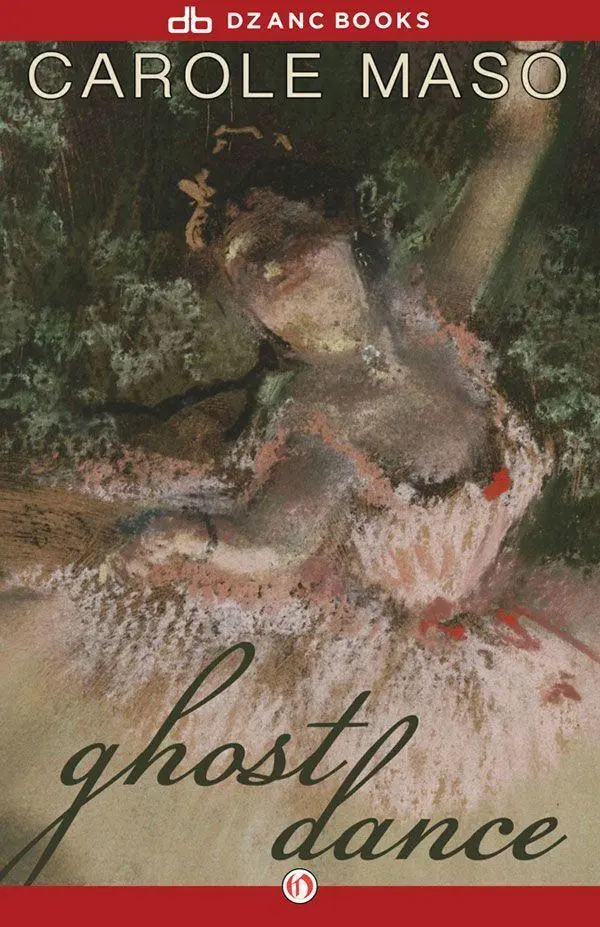
- Название:Ghost Dance
- Автор:
- Издательство:Dzanc Books
- Жанр:
- Год:2013
- ISBN:9781480441897
- Рейтинг книги:5 / 5. Голосов: 1
-
Избранное:Добавить в избранное
- Отзывы:
-
Ваша оценка:
Ghost Dance: краткое содержание, описание и аннотация
Предлагаем к чтению аннотацию, описание, краткое содержание или предисловие (зависит от того, что написал сам автор книги «Ghost Dance»). Если вы не нашли необходимую информацию о книге — напишите в комментариях, мы постараемся отыскать её.
has to offer. Like her artist-protagonists, Maso's subject as well as medium is language, and she is brave and dangerous in her command of it. She abandons traditional narrative forms in favor of a shaped communication resembling Beckett and rivalling his evocative skill. Immersed in dilated and intense prose, the readers view is a privilege one, riding the crest of clear expression as it navigates the tangled terrain of loss and desperate sorrow.
Ghost Dance — читать онлайн бесплатно полную книгу (весь текст) целиком
Ниже представлен текст книги, разбитый по страницам. Система сохранения места последней прочитанной страницы, позволяет с удобством читать онлайн бесплатно книгу «Ghost Dance», без необходимости каждый раз заново искать на чём Вы остановились. Поставьте закладку, и сможете в любой момент перейти на страницу, на которой закончили чтение.
Интервал:
Закладка:
The locusts grow louder and louder. It means more hot weather.
That is not living at all, Grandma.
We get the white cups down from the top shelf, fold the red cloth napkins. I place the fork on the left, the knife and spoon on the right. I take the pitcher from the refrigerator. My grandmother pinches some mint from the plant on the windowsill and puts it in the tea. It floats on the top. Because of the heat we wait to put out the butter, and we put the tea back in the refrigerator. We sit at the table and wait for the chicken to finish cooking. Her hands rest in her lap. They do not fly unexpectedly like frightened birds when the light in the room changes or a small breeze blows from the back of the house. My own hands are cold, even in this weather. “It’s my circulatory system,” I tell her. She smiles. I’m smart for my age. The sunlight pours in the kitchen window, making us think that it is earlier than it really is. Tomorrow I’ll be back on the train to Connecticut.
“How pretty you are,” she says sweetly. My grandmother looks so nice sitting there. I wish I could be more like her. She wipes her brow and leaves me seated alone. When she opens the oven, the heat is unbearable. The chicken is done. It falls apart on our forks. She stares at me from across the large pine table, which used to be an appropriate place to eat when the whole family was together.
What’s wrong? I wonder. She stares at me through the pitcher of iced tea. Do I eat too fast? Is my hair not neat enough? She keeps looking at me. Grandma, don’t, I say under my breath. She looks at me as if with enough concentration she could pass her brain into mine. “Grandma, don’t.”
She asks that I cut myself out from her, like a cookie from dough, like a dress from cloth, and that I be grown up about it and sensible and that I go quietly. She offers her hands in the well-lit kitchen, and to anyone it would look like a small gesture of love, a Mother’s Day card, a painting by Cassatt, a simple movement that any grandmother might make toward her grandchild. She offers her hands like two white loaves — something good, something nourishing, necessary to accept. She offers her hands in the well-lit kitchen among the thick white cups, the fruit balanced safely on the wallpaper.
“Be mine,” she whispers. “Be mine.”
But she’s underestimated me.
“Don’t leave me. Don’t. Don’t go,” she says quietly over and over in a voice so casual, so offhand that you might think the weather is the subject. And when we look to the sky the low clouds have begun to form, the storm not as far off as I once thought, already gathering force.
“They came in wagons — hundreds of them. They covered the land like terrible shadows. Many were sick. There were graves all along the way — white people’s graves everywhere. They brought their darkness. They made us sick with their diseases. They infected us with their lies, with the way they lived. They wanted to tear apart the graves of Indians for minerals, for gold. They would pull apart their own parents. There is nothing they would not do.
“The sun seemed to be going out. They came, hundreds of them, in covered wagons. They dug under the face of my father. They made my mother’s body sore. They think they can own the land. There is nothing they would not do. You cannot trade the lives of people for handfuls of gold. They came in wagons. They came to claim the land.
“But how dare they dig under my father’s skin for gold? How dare they cut my mother’s hair?”
Mary, I love your apple face — round and broad, smooth and shining on this late-fall afternoon. I can’t stay long — this old car is not mine and I’ve got to get it back to the college by dark.
“Ah, yes, the college,” she nods, trying to see it in her mind.
“This will be the last picking,” she tells me, bending and stretching — reaching, reaching. I follow her, cherishing the movements our bodies make in their last harvest dance. We hear apples like heartbeats, falling from all parts of the orchard, the only sound. “They are picking themselves,” her husband Donald laughs.
“The last time for the year,” she repeats. Donald has agreed, it is time to move inside. Let the remaining fruit go untouched. Let the children come and take it for nothing. The earth gives of itself freely; it asks nothing in return. It is time to collect the wood and enter the small house, fragrant with apples at the foot of the orchard. It is time for the final weatherproofing.
She stumbles down the hill in the dusk. Her eyes are as heavy and generous as apple trees. Her apron is filled with the fruits she’ll use for cider, for applesauce. Her rounded arms reach out to her husband for help. Apples dangle from his beard. Apples color the sound of his speech, his concerns. When will the trucks show up for a pickup? How many hundreds of bushels have been left behind?
I want to follow her into her kitchen, settle in next to the wood-burning stove, drink Gertrude Ford tea with her, separate the pumpkin from its seeds, read the Poughkeepsie Journal , its early snow reports, and drift into winter.
White light, bluejav, bear-sleep, split wood, apple wine, baked apple: bruised, I want to be with her now, to pass the days in her warmth, to sleep soundly through the bitter nights and dream of no one and nothing but apples.
“I can hardly find your vein,” Marta said. “You’ve gotten so skinny.”
“Please don’t,” I said. But I gave her my arms and, after those veins collapsed, I took off my socks and we examined the places between my toes. “Please don’t,” I whispered, offering her the back of my leg.
I missed her terribly even before she had gone away. I missed her as I watched her writing. I could tell she was so far away that nothing could bring her back. Watching her some nights, stretched out on the couch reading or dozing off, I missed her even then.
“Help yourself,” Jack said, wiping my brow, stroking my hair.
“I’m trying,” I said. “But I can’t seem to get myself any further.”
“Come on,” Jack said. “Try harder.”
I shivered. The weather turned colder.
I reach for her arm and she is strong, stronger than I could have imagined.
“Vanessa,” she says.
“You’ve remembered my name!” I smile.
“Of course I have,” Grandma Alice says. She lifts me up. “Everything’s going to be all right. I promise.”
“Anza-Borrego State Park in California,” he reads, “claims two unusual features: a limitless carpet of wildflowers and elusive bands of bighorn sheep.
“California,” he muses. “Disneyland,” he says dreamily. “A castle for my princesses.”
Grandpa Sarkis, born in the year of the ox, had big plans for my mother. Prom the first moment he saw her behind glass in the infant nursery, he knew there was something different, something special about his daughter. Girl babies in the old country were nothing to dance about, but he danced at the birth of my mother. Through drifts of cigar smoke in the maternity wing of St. Joseph’s Hospital, he danced, he sang. She was beautiful; she was special. He was sure of it. Without knowing anything about the Topaz Bird, he knew. She w as the most perfect creature he had ever laid his eyes on or ever would. And best of all she was his .
She would bring him luck. “My tamarind seed, my goat’s tooth,” he said to her and smiled. He was proud of her light hair that waved. He had made an American girl, with her blue eyes like the Pacific, her long graceful body — California. He had made a real American beauty. As unhkelv as it seemed, he had had a part in this. His brooding dark good looks had combined w ith those of his frail American wife and from this hard-fought union Christine had been born.
Читать дальшеИнтервал:
Закладка:
Похожие книги на «Ghost Dance»
Представляем Вашему вниманию похожие книги на «Ghost Dance» списком для выбора. Мы отобрали схожую по названию и смыслу литературу в надежде предоставить читателям больше вариантов отыскать новые, интересные, ещё непрочитанные произведения.





Обсуждение, отзывы о книге «Ghost Dance» и просто собственные мнения читателей. Оставьте ваши комментарии, напишите, что Вы думаете о произведении, его смысле или главных героях. Укажите что конкретно понравилось, а что нет, и почему Вы так считаете.