Carole Maso - Ghost Dance
Здесь есть возможность читать онлайн «Carole Maso - Ghost Dance» весь текст электронной книги совершенно бесплатно (целиком полную версию без сокращений). В некоторых случаях можно слушать аудио, скачать через торрент в формате fb2 и присутствует краткое содержание. Год выпуска: 2013, ISBN: 2013, Издательство: Dzanc Books, Жанр: Современная проза, на английском языке. Описание произведения, (предисловие) а так же отзывы посетителей доступны на портале библиотеки ЛибКат.
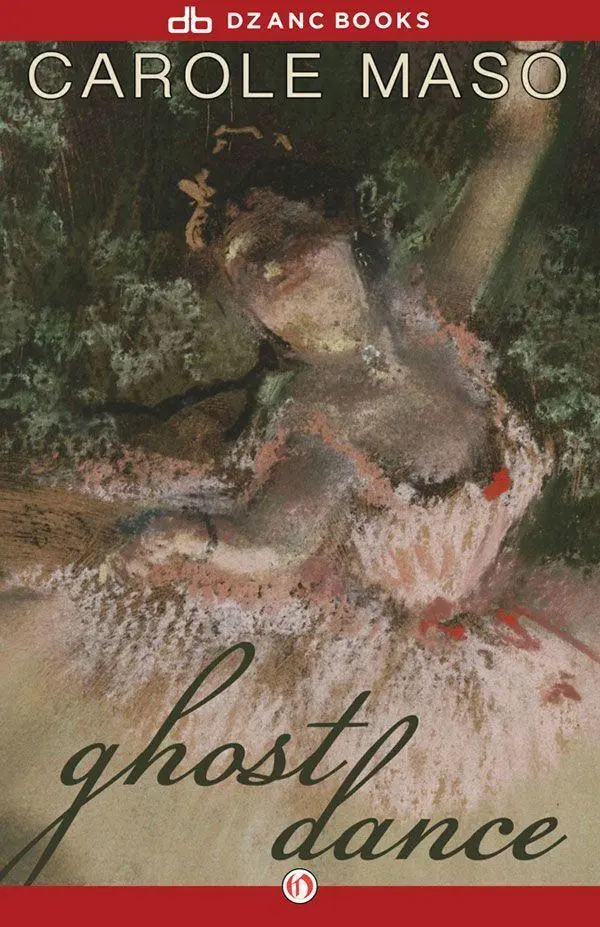
- Название:Ghost Dance
- Автор:
- Издательство:Dzanc Books
- Жанр:
- Год:2013
- ISBN:9781480441897
- Рейтинг книги:5 / 5. Голосов: 1
-
Избранное:Добавить в избранное
- Отзывы:
-
Ваша оценка:
Ghost Dance: краткое содержание, описание и аннотация
Предлагаем к чтению аннотацию, описание, краткое содержание или предисловие (зависит от того, что написал сам автор книги «Ghost Dance»). Если вы не нашли необходимую информацию о книге — напишите в комментариях, мы постараемся отыскать её.
has to offer. Like her artist-protagonists, Maso's subject as well as medium is language, and she is brave and dangerous in her command of it. She abandons traditional narrative forms in favor of a shaped communication resembling Beckett and rivalling his evocative skill. Immersed in dilated and intense prose, the readers view is a privilege one, riding the crest of clear expression as it navigates the tangled terrain of loss and desperate sorrow.
Ghost Dance — читать онлайн бесплатно полную книгу (весь текст) целиком
Ниже представлен текст книги, разбитый по страницам. Система сохранения места последней прочитанной страницы, позволяет с удобством читать онлайн бесплатно книгу «Ghost Dance», без необходимости каждый раз заново искать на чём Вы остановились. Поставьте закладку, и сможете в любой момент перейти на страницу, на которой закончили чтение.
Интервал:
Закладка:
But Natalie had already stepped onto another continent, her arms outstretched, her doomed hands open, before Marta realized the truth etched in her palm, and by that time it was too late.
Pamela Stafford, second aunt of Jennifer Stafford, but only a wisp of a child at the time, stepped tentatively in front of the camera for her screen test at the MGM studios. She looked back at her new friend for luck and smiled. Her straight hair, which had been set on hard rollers all night, had already lost its curl. Her pink dress puffed out from the waist made her look like the most fragile of flowers.
“Go on,” the smiling man coaxed. “Go on, sweetheart.”
“Moon River,” she sang softly off key,
“Wider than the Nile,
“I’m crossing you in style
“Someday.”
She cleared her throat.
“Oh, dream maker, you heartbreaker,
“Wherever you’re going,
“I’m going your way.”
“What are we going to see, Dad?” we screamed.
“It’s called It’s a Mad Mad Mad Mad World,” he said dreamily. “It’s in Cinerama, with the screen so big that it wraps around you.” He paused for a long time. “Cinerama,” he murmured. “You’ve never seen anything like it.”
On the book jacket of To Vanessa is my favorite picture of my mother. She is in profile and she looks as serene as I have ever seen her — content, happy. The light is beautiful and she is smiling. I would have stopped her in my mind in this position forever if I could have, but that is the photographer’s art, not the daughter’s. My mother cannot stay still in my mind. A lovely profile turns full face, slowly the smile dissolves, and the vision breaks. Her hair grays, then changes back. She grows young, wanders through the quiet house of her childhood in Paterson, New Jersey, a little girl on tiptoe, looking in on her own sleeping mother or sitting in the dark listening to the Sunday stories of her father. I look again at her smiling profile on the back of To Vanessa , my book. She will not hold still for me.
“Disney land!” Grandpa Sarkis said. “Would you look at that?”
“The Magic Kingdom!”
“Look at that castle!” my mother cried.
“A castle for my little princesses in California!” their father said, patting their heads.
“Here’s Niagara Palls!” Lucy said.
“Where lovers go!” my mother sighed.
“Listen to this,” Lucy said. “About four million gallons of water per minute thunder over the lip of the falls into the Maid-of-Mist Pool!”
“Four million gallons!” my mother said.
“Per minute!” Lucy added.
My father sings loudly over the rushing water along with Louis Armstrong:
“Two drifters, off to see the world
There’s such a lot of world to see.
We’re after the same
Rainbow’s end
Waiting round the bend,
My huckleberry friend,
Moon River and me.”
He raises a shiny trumpet to his lips, bends his knees, and blows. Beads of sweat fall down his face. He wipes his brow with an imaginary rag.
Part Four
I expect there’ll be rain today,” she says, flexing her arthritic fingers as we look out the back window onto the smoldering landscape.
“Oh, I don’t know, Grandma.” I smile at her. To me the farm sky looks like it’s going to hold back, going to deny the open-throated hens, the crippled corn, the old women.
“We’ll see,” she says, her eyes closed. It looks as if she’s trying to gather the strength to go on. In the darkness she pictures three white pillars. She opens her eyes, forcing herself back to the scene, back to the breeze and its empty promise, back to the weeping willows sucking stones from dirt, the panting dogs, the neighbor’s slow gaze, the memory of water lulling everything to sleep. She clears her throat, opens and shuts her hands. It’s as if those bony fingers extend out past the glass onto the earth as row s of crops. If she could only do something — she draws her fingers in, folds her hands, and puts them in her lap. The tomatoes bleed into the ground. The basil dries on its stalk. Peas shrivel. Trees shrink to shrubs. The scorpion moves in, the tortoise, the lizard glitters in the sun. Humps grow on the backs of dogs until they are camels. When I turn around, the soil has turned to sand. When I turn again, the rosebush is a cactus.
“It’s so hot, Grandma. If I was a snake I’d leave my skin.”
“Be sensible,” she says. Her voice is as old as the sand. Her throat is the bark of oaks.
“I think I’d like to take a long, cool bath”—water gushing up to the top of the tub, overflowing when I reach for the soap; water hitting my thighs, circling my knees.
“Grandma, it’s so hot. I think I’d like to go to the grocery store and stand next to the frozen foods for a while. I wish I was a TV dinner! I wish I was a fish stick!”
“Vanessa, be sensible,” she says. It sounds like a plea.
My grandmother was all good sense. A beautiful plant flowered at the base of her brain: broad-leaved, hardy, dark green. If she could have seen it, it would have pleased her, but of course she could not. She did not have the eyes for it. Only at the end was it replaced by something else — something more dense, rounded, almost luminous, something harder. I watched it happen: the flower fold into itself, the leaves curl back into the seed, the seed explode. Then my grandmother, strong willed, confident, grew backward into some tentative future and was frightened. But that was only much later.
“It’s too hot to argue with you today, Vanessa.”
But I could not think of a time when we had argued. Our conversations usually consisted of two or three sentences, a statement by one of us and response by the other, all of which was repeated a few times over. The rest of the argument must have gone on in my grandmother’s head. She always seemed more angry with me than her words had indicated.
Because I needed my grandmother most in spring, I rarely spoke to her at all then, out of fear that I might upset or alienate her. In that watery, unstable season when the whole world seemed to be changing, she did not. She was always the same: a silhouette, a dark triangle, carrying eggs and milk and wood back and forth between the barn and the house. She was a place for the wandering eye to rest. As the dogwood exploded around my head and, under my feet, seedlings sighed and gasped for air, I followed her along her hypnotic path and attempted to focus my attention, instead of letting it run on endlessly here, there, until inevitable exhaustion and then depression set in. What I was looking for was an order, and somehow I knew even then that order was the product of a self-conscious effort, it was a man-made thing imposed on the universe and involving constant exclusions. But as hard as I tried, as much as I concentrated on the print in my grandmother’s dress or the gray strands in her hair, I could not forget the complex texture of the evening or the sound of the ground breaking apart. And though the transparency of spring frightened me — the chloroplasts I could see in the leaves, the worms moving underneath the dirt, and the human body looking like the plastic models in science class — I kept it all: the exposed heart, the miles and miles of purple and blue veins everywhere; I think I had no choice.
I remember how the animals howled, not just at night but all day long, too — high pitched, at the edge of control. Sex turned their bodies liquid. They seemed to swim inside each other, with their curving backs and gleaming eyes. Could you see it in me, Grandma? The sex of animals? The fur on my arms? The hair standing straight up on the back of my neck? The swollen glands? The friction under my skin? I frightened myself. But you kept walking; the chores kept you busy — the hens, the hogs. You were tireless, your head bent, your arms overflowing, insisting in your every action that life made sense, life made good sense. I thought it was wonderful that someone who had lived as long as she could still believe that. But when she was seventy, I was only twelve and just learning how the bed could float around under my hands. I noticed the sweating men in the market, their thick arms, their large muddy hands. They began to stare at me. How beautiful a young girl’s neck can be, one whispered, how smooth her skin. I fingered my lower lip and pretended I did not hear. At night I could feel the weight of those words like hands all over me. Is that why she disliked me? Could she tell that one day my eyes would be able to make anyone melt? That freely, and without guilt, I’d open myself to them?
Читать дальшеИнтервал:
Закладка:
Похожие книги на «Ghost Dance»
Представляем Вашему вниманию похожие книги на «Ghost Dance» списком для выбора. Мы отобрали схожую по названию и смыслу литературу в надежде предоставить читателям больше вариантов отыскать новые, интересные, ещё непрочитанные произведения.






Обсуждение, отзывы о книге «Ghost Dance» и просто собственные мнения читателей. Оставьте ваши комментарии, напишите, что Вы думаете о произведении, его смысле или главных героях. Укажите что конкретно понравилось, а что нет, и почему Вы так считаете.