Carole Maso - Ghost Dance
Здесь есть возможность читать онлайн «Carole Maso - Ghost Dance» весь текст электронной книги совершенно бесплатно (целиком полную версию без сокращений). В некоторых случаях можно слушать аудио, скачать через торрент в формате fb2 и присутствует краткое содержание. Год выпуска: 2013, ISBN: 2013, Издательство: Dzanc Books, Жанр: Современная проза, на английском языке. Описание произведения, (предисловие) а так же отзывы посетителей доступны на портале библиотеки ЛибКат.
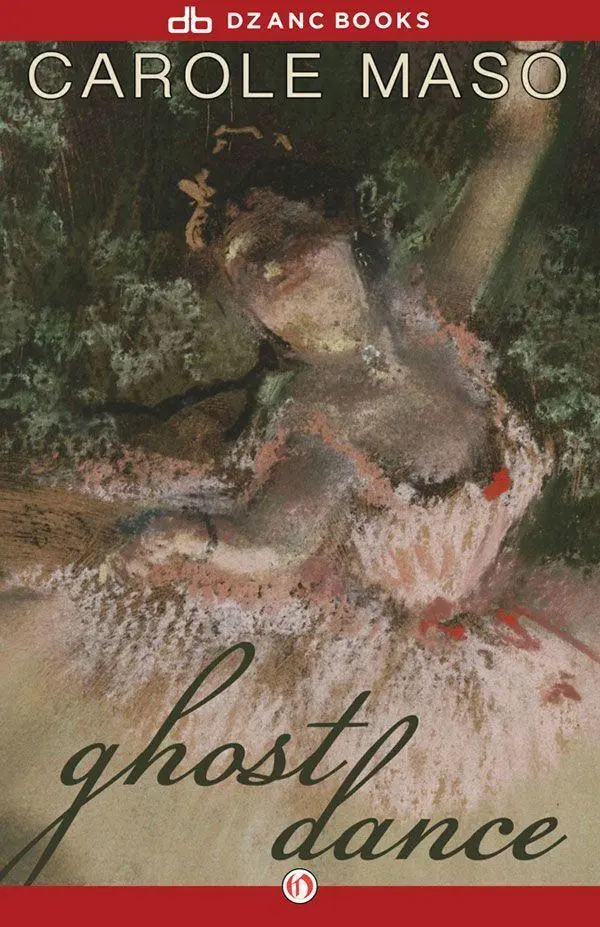
- Название:Ghost Dance
- Автор:
- Издательство:Dzanc Books
- Жанр:
- Год:2013
- ISBN:9781480441897
- Рейтинг книги:5 / 5. Голосов: 1
-
Избранное:Добавить в избранное
- Отзывы:
-
Ваша оценка:
Ghost Dance: краткое содержание, описание и аннотация
Предлагаем к чтению аннотацию, описание, краткое содержание или предисловие (зависит от того, что написал сам автор книги «Ghost Dance»). Если вы не нашли необходимую информацию о книге — напишите в комментариях, мы постараемся отыскать её.
has to offer. Like her artist-protagonists, Maso's subject as well as medium is language, and she is brave and dangerous in her command of it. She abandons traditional narrative forms in favor of a shaped communication resembling Beckett and rivalling his evocative skill. Immersed in dilated and intense prose, the readers view is a privilege one, riding the crest of clear expression as it navigates the tangled terrain of loss and desperate sorrow.
Ghost Dance — читать онлайн бесплатно полную книгу (весь текст) целиком
Ниже представлен текст книги, разбитый по страницам. Система сохранения места последней прочитанной страницы, позволяет с удобством читать онлайн бесплатно книгу «Ghost Dance», без необходимости каждый раз заново искать на чём Вы остановились. Поставьте закладку, и сможете в любой момент перейти на страницу, на которой закончили чтение.
Интервал:
Закладка:
People didn’t disappear that way — the final message left on the mouth of a man in a phone booth in Nice, a man with a voice easy not to believe’.
Her parents are sitting suspended in air, somewhere here between New York and Paris, eating the darkness, swallowing it vv hole, counting the miles to the man, the phone booth, rewinding the years, never once sensing something in their daughter having gone a long way off.
People didn’t die that wav — nothing left behind: no Calvin Klein shirts, no Kenzo dresses; no Dior, no Estée Lauder, no Mary Quant; no Shiseido, no Nina Simone, no Gato Barbieri, no Yves St. Laurent.
They tell us she has already forgotten her entire life. We are chewing on the sharp edges of empty space. We are calling home our truant feelings.
People didn’t disappear like that — no bulge in the ground, no stone to throw roses at. People that disappeared that way always came back.
My mother winds the black phone cord around her hand. She clears her throat and puts on her phone voice, the one she feels is decipherable to the real world, the world of numbers and phones, the one operators can hear. As soon as she gets Sabine on the other end her phone voice melts. “Sabine,” she sighs, and her language changes.
I have heard this conversation many times. Again tonight, my mother worries. I translate the French as best I can. “I am exceptional only in appearance, only in charm,” is what I think she says. I can’t hear what Sabine says but whatever it is it calms my mother slightly.
“I am a coward,” my mother says as she steps into her pumps, and she believes it. “I will never be good enough.” She kisses the receiver twice and hangs up. I sit at her feet. “My beauty,” she whispers, hugging me to her, and she begins to cry.
How she hesitated those nights she was to be at one party or another.
My mother could not understand why she caused such a commotion in people. The mere suggestion that she might attend a certain party would turn it into an event. She hated this; it baffled her, for she distrusted those who would so readily attach themselves to her.
“Clearly no one in this room understands or has even read one line of my work,” she’d say after three or four drinks.
Beauty is a trap; it is its own art form. To be beautiful, it is said, is enough.
On her worst days she thought people admired her work because of her beauty, because of the person she was at cocktail parties: witty, charming, seductive, caustic, dangerous — beautiful. But it is not enough.
The centerpiece — let them have what they wanted, she thought. Let them take what was least important to her. She didn’t mind. It meant nothing to her — the shape of her face, her blue eyes, her bare shoulders.
“No,” she said, she was not a decoration. She did not simply sparkle. “Don’t prettify me,” I heard her say once to a well-dressed man at one of those parties. “Don’t do it.”
It was the work that shaped her life, that gave her her intense radiance and beauty. She did not want them to take that.
She was too polite, she thought. Politely she had accepted compliments, politely she had bowed her head, letting those who needed get a glimpse of her neck. “No more,” she said on her thirty-fifth birthday. “Let them stare elsewhere.” It had never been flattering, she had simply endured it, for reasons even she must not have been clear about.
My mother was always angry with the way she was presented to the world. “The beautiful Christine Wing will read from her newest collection at eight,” she read aloud from the newspaper’s society column. “As if that makes the poems any better,” she’d scowl, “or any easier to write.” After an interview for Time she found herself on the cover of that magazine with the caption “The Beautiful Poet.” And when we opened to the article we found it began with two long, elaborate paragraphs describing her appearance.
She is dressed in royal blue taffeta. She looks at the young man, who stares at her, and her laugh is impossibly high. He blushes. He is very young. “My daughter,” she says, introducing me, never taking her eyes from his soft mouth. “You’re so handsome. What’s your name again?” She turns away. “I’ll be back,” she promises, taking me by the hand. She looks at him again, saying nothing. Even her silences are beautiful, not at all awkward. I watch him through the night. He does not venture far from his spot on the floor.
I have seen my mother paranoid. “It’s a trap, Vanessa,” she’d tell me, “all the laughter, all the handsome men and women. They want me to stop writing. All of them do. Don’t trust them,” she hissed. “Be careful.”
“There’s been too much talking tonight,” she’d say sometimes in the middle of a sentence, in the middle of a dinner party, and then excuse herself in a way no one but she could. But often she did not move when she might have, did not leave her throne, took in the praise, talked about nothing, gave all her profile. A slightly fearful look would pass over her face on those nights. I knew what she was thinking just by a glance or a sigh, w hen I was finally old enough to accompany her to those parties. Some nights she’d nod w hen I’d suggest we leave, as if she were just about to suggest the same thing, and she would get up shakily. But other nights she’d look at me as if I was crazy and say, “Oh, not ver, Vanessa,” in a giddy flirtatious voice. “Please,” she’d beg like a child, “not yet.”
What I see sometimes is my real mother peering out from behind her illness, and she is fine. She is not crazy at all. “Don’t let them put me here,” she pleads, but there is no convincing them. The doctors come with their hypodermic needles, wrapped in cloth so that she cannot see them in advance. They are taking away her belts and necklaces, and we leave her standing there, sobbing, in her underwear.
The sky puts on the darkening blue coat
held for it by a row of ancient trees;
you watch: and the land grows distant in your sight,
one journeying to heaven, one that falls;
and leave you, not at home in either one,
not quite so still and dark as the darkened houses,
not calling to eternitv with the passion
of what becomes a star each night, and rises;
and leave you (inexpressibly to unravel)
your life, with its immensity and fear,
so that now bounded, now immeasurable,
it is alternately stone in you and star.
“Evening” by Ramer Maria Rilke
The large, white hull of the oceanliner moves through ice. The other passengers have retired for the night: no stars tonight. My father stands on the deck and stares ahead at the land. He lifts his immense fist, which rises into the sky then sinks into the sea. “Why?” he asks over and over. The word is a jagged rock in the freezing sea. “Why?” he asks again. And the rock stands alone.
“Where did Mom go?” I ask Sabine from across the ocean. Silence wraps around the receiver.
“I don’t know, Vanessa,” she says finally. “Nobody knows the real answer to that.”
“Sabine,” I say, “you must know. Please don’t lie to me.” She says nothing.
My voice does not sail like my mother’s once did. And the ocean crashes in my ears.
Marta lifted the domed cover from the silver server and watched Natalie closely through the steam: her eyes, their deep blue color, each eyelash — she could count them — her beautiful, regal nose, but most of all her mouth; she concentrated on it, waiting for her next words. She hung on these words, she lived for them, anticipated them through the delicious, steamy haze.
“I adore you,” Natalie said emphatically, stretched out on the huge bed, unreal in her beauty. “I adore you.” Marta reached out her hand but then stopped; she wanted to prolong this moment, wanted nothing to change it.
Читать дальшеИнтервал:
Закладка:
Похожие книги на «Ghost Dance»
Представляем Вашему вниманию похожие книги на «Ghost Dance» списком для выбора. Мы отобрали схожую по названию и смыслу литературу в надежде предоставить читателям больше вариантов отыскать новые, интересные, ещё непрочитанные произведения.






Обсуждение, отзывы о книге «Ghost Dance» и просто собственные мнения читателей. Оставьте ваши комментарии, напишите, что Вы думаете о произведении, его смысле или главных героях. Укажите что конкретно понравилось, а что нет, и почему Вы так считаете.