Carole Maso - Ghost Dance
Здесь есть возможность читать онлайн «Carole Maso - Ghost Dance» весь текст электронной книги совершенно бесплатно (целиком полную версию без сокращений). В некоторых случаях можно слушать аудио, скачать через торрент в формате fb2 и присутствует краткое содержание. Год выпуска: 2013, ISBN: 2013, Издательство: Dzanc Books, Жанр: Современная проза, на английском языке. Описание произведения, (предисловие) а так же отзывы посетителей доступны на портале библиотеки ЛибКат.
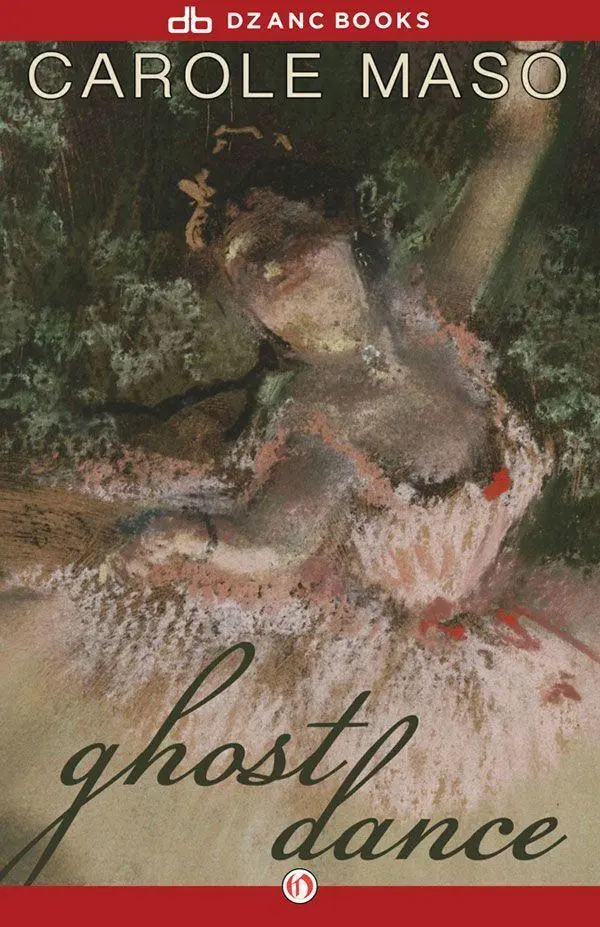
- Название:Ghost Dance
- Автор:
- Издательство:Dzanc Books
- Жанр:
- Год:2013
- ISBN:9781480441897
- Рейтинг книги:5 / 5. Голосов: 1
-
Избранное:Добавить в избранное
- Отзывы:
-
Ваша оценка:
Ghost Dance: краткое содержание, описание и аннотация
Предлагаем к чтению аннотацию, описание, краткое содержание или предисловие (зависит от того, что написал сам автор книги «Ghost Dance»). Если вы не нашли необходимую информацию о книге — напишите в комментариях, мы постараемся отыскать её.
has to offer. Like her artist-protagonists, Maso's subject as well as medium is language, and she is brave and dangerous in her command of it. She abandons traditional narrative forms in favor of a shaped communication resembling Beckett and rivalling his evocative skill. Immersed in dilated and intense prose, the readers view is a privilege one, riding the crest of clear expression as it navigates the tangled terrain of loss and desperate sorrow.
Ghost Dance — читать онлайн бесплатно полную книгу (весь текст) целиком
Ниже представлен текст книги, разбитый по страницам. Система сохранения места последней прочитанной страницы, позволяет с удобством читать онлайн бесплатно книгу «Ghost Dance», без необходимости каждый раз заново искать на чём Вы остановились. Поставьте закладку, и сможете в любой момент перейти на страницу, на которой закончили чтение.
Интервал:
Закладка:
They had made my mother feel less fearful. She seemed happier when she was with them, not as alone in the world. Years after she left college she would still visit with them, sit in their houses, drink with them, and relish their intricate, intelligent stories. As a famous person, my mother had met many such women living in college towns all across the country, throwing parties for Byron’s birthday, dancing in spring at bacchanalias, reading Emily Dickinson by a fire. They were obsessive, unpredictable, exacting. When I got to college I recognized them immediately.
I loved them for the way they made my mother feel. All these years they had made her feel safe. What they told her was this: “Take refuge.” “Step into your talent.” “Apologize to no one.” “Life is perplexing. Your imagination is your gift.” “Do what you must.” They were islands of comfort. She had swum out to them and rested on their wonderful shores.
The associate professor of English, carrying an armful of books, smiles. I pass her on the library steps. “Take refuge,” she says.
“Come now, Christine,” she says softly, offering her hand. “You’re going to be all right. I promise.”
My mother stands up and allows herself to be helped out of the ditch by the woman who is so kind. She has a long, gray braid down her back. “I promise,” she says again, speaking softly to her grown daughter. They turn from the ditch. It is Grandma Alice. She hugs my mother. “Everything’s going to be all right.”
Marta, walking through the library, no interest in books, recognized me against the high, pine window where I still sat gazing at the many faces of my mother. She looked from the photos to me but made no connection as far as I could tell. I collected the books and put them in a pile as if I might protect my mother from Marta in this way. Though it seemed to me that Marta lived a dangerous life, something my mother had once recommended, I was doubtful that this was what she had had in mind.
I did not expect Marta to recognize me. She had barely seen me the previous night in Jennifer’s room, I thought. She had barely known that I was there at all. And though she had at one point actually described my face, lingered over my features, it had not seemed to me an accurate portrait.
“Forget a face like that?” Marta laughed, tipping my head up and putting her thumb and forefinger on my chin. “No chance.” I caught a glimmer of what might have been the old Marta, the Marta before Natalie, the one who laughed and wanted, without hesitation, faces like mine.
“Have you seen Jennifer?” she asked, as if we had known each other a long time, as if the face she could not forget exhausted her, bored her.
“I don’t know who Jennifer is.”
She looked at me as if she wondered what it would be like to be able to say that.
“You haven’t met her yet?”
“No.”
Marta had lost track of the days. How many had passed, she wondered, since I had arrived holding that little note?
“Well, won’t that be something?” she smiled. She looked like a mischievous child: the grin, the sneakers, the mass of dark curls, the papers she held in her hand, crumpled, tear-stained.
She put her hand on my shoulder. Her touch was like no other, firm but gentle, hard but yielding, and it brought me immediately back to the night before. She was drawing me at a tremendous speed into intimacy. There was no time to waste.
“I’ve got a dog,” she said. She was still a child to me.
“Oh?” I said.
“She’s really only a puppy. I live in Gushing. She’s in my room. Do you want to see her?”
“Sure,” I said.
I put the books back on the shelf. On another day I would be able to find them easily, I said to myself.
“Come on,” she said.
I knew what Marta wanted. It was easy to see. We left the library. I turned to look at the librarian and watched her grow small as we walked toward Marta ‘s dormitory.
“This is it,” she said as we stood in front of a large house made completely, it seemed, of gingerbread.
“This is it?” I said.
She nodded. “This way,” she smiled. And I followed her up the winding stairs to the tiny room where the dead girl lived.
Each night was the same. She wore the same clothes, the black pants she had gotten in Mykonos and the cotton T-shirt of Natalie’s. Every night she rubbed her cheek against her shoulder, closed her eyes, and sniffed the shirt as if fabric, like the heart, could hold a person long after they were gone, in its weave.
Two eight-by-ten black-and-white photographs of Natalie were propped on the bureau and illuminated by candles. Every night we toasted those photos of her and listened to the records of Billie Holiday. Wherever we were, if we sat in her room or if we went to classes or to the dining hall, Billie Holiday seemed to follow us. She sang as I studied those pictures of Natalie. The straight blonde hair, the long, elegant nose, the lips — too thin, I thought, cruel, somehow.
“She was a complete mystery to me, Vanessa,” Marta said.
I nodded, engrossed in the photographs. Natalie seemed terrified to me, alone in that frame against a black background, lost. She carefully held the poses of a self-conscious child, though the poses, a hand on a hip, a cigarette poised between beautiful fingers, were meant to convey the opposite impression: sophistication, worldliness, maturity — Natalie in her leather pants, Natalie clutching an Italian Vogue . What did she see, as she looked into the glassy eye of the camera, that frightened her so?
There were pictures everywhere, propped on trunks and tables, taped to the walls, lying on top of books. In each photo she looked just as lonely, just as scared — her face always the same. There could be no touching her. She just stared. When you thought you were safe, there was always another photo; when you thought you were out of the range of her gave, you would turn suddenly and she would be watching.
“Isn’t she beautiful?” Marta said. And it was true; she was.
After many nights spent in that room with Marta I would finally dare to touch those photos, putting them together in different ways, in an attempt to animate her, to watch her move, watch her light her cigarette, watch her walk in her spiked heels, her Stetson hat, her fur coat. I wanted to see her look at Marta, then look away, watch her leave for France, try to understand what made her this way.
“To Natalie,” Marta said, barely able to lift her glass at all by midnight, a toast, I imagined, that Natalie, lit by candles, being worshipped, would appreciate.
“Tell me more and more and then some,” Billie Holiday sang.
“It didn’t happen the wav they said,” Marta whispered. “Natalie did not want to die. I’m going to go there. I’m going to find out w hat really happened. People don’t disappear like that. I never spoke with her parents. I couldn’t find them anyway here. People don’t just disappear like that.”
Every night I listened to the stories, drank Scotch, and watched Marta toast the photos of the dead girl until they dissolved and disappeared.
“Natalie would never have killed herself,” she said. Her brown eves were black. “It couldn’t have happened the way they said.”
“Tell me more,” I murmured. “Tell me more and more,” I sang, until the candles burned out.
She had lived everywhere here. She hail done everything. Her father was a diplomat and she had grown up a golden girl, gleaning beauty from all the great cities of the world.
People didn’t disappear like that: off the edge of some foreign country, at the phone number just beyond the reach of the voice, some operator insisting in French over and over that she has dialed correctly.
Читать дальшеИнтервал:
Закладка:
Похожие книги на «Ghost Dance»
Представляем Вашему вниманию похожие книги на «Ghost Dance» списком для выбора. Мы отобрали схожую по названию и смыслу литературу в надежде предоставить читателям больше вариантов отыскать новые, интересные, ещё непрочитанные произведения.







Обсуждение, отзывы о книге «Ghost Dance» и просто собственные мнения читателей. Оставьте ваши комментарии, напишите, что Вы думаете о произведении, его смысле или главных героях. Укажите что конкретно понравилось, а что нет, и почему Вы так считаете.