Carole Maso - Ghost Dance
Здесь есть возможность читать онлайн «Carole Maso - Ghost Dance» весь текст электронной книги совершенно бесплатно (целиком полную версию без сокращений). В некоторых случаях можно слушать аудио, скачать через торрент в формате fb2 и присутствует краткое содержание. Год выпуска: 2013, ISBN: 2013, Издательство: Dzanc Books, Жанр: Современная проза, на английском языке. Описание произведения, (предисловие) а так же отзывы посетителей доступны на портале библиотеки ЛибКат.
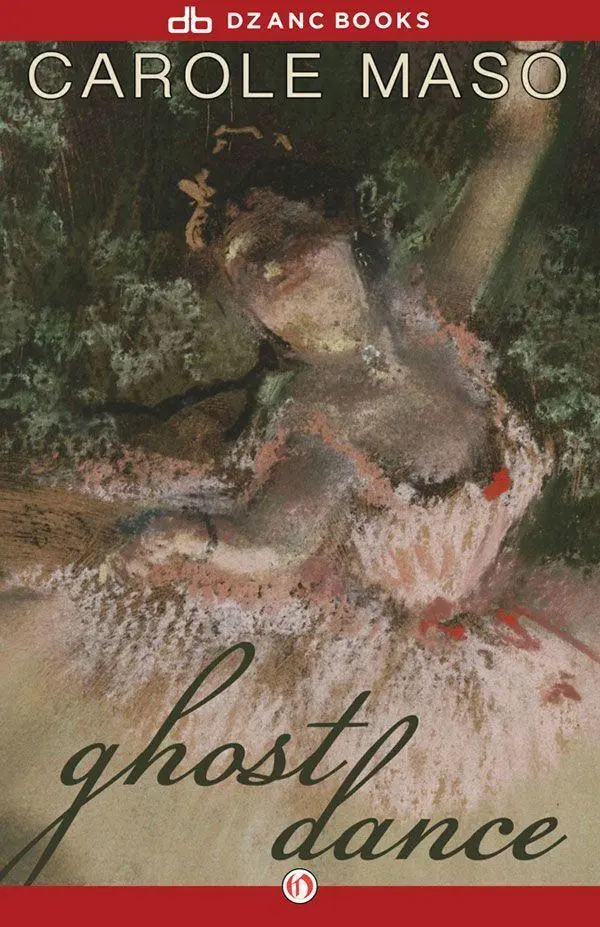
- Название:Ghost Dance
- Автор:
- Издательство:Dzanc Books
- Жанр:
- Год:2013
- ISBN:9781480441897
- Рейтинг книги:5 / 5. Голосов: 1
-
Избранное:Добавить в избранное
- Отзывы:
-
Ваша оценка:
Ghost Dance: краткое содержание, описание и аннотация
Предлагаем к чтению аннотацию, описание, краткое содержание или предисловие (зависит от того, что написал сам автор книги «Ghost Dance»). Если вы не нашли необходимую информацию о книге — напишите в комментариях, мы постараемся отыскать её.
has to offer. Like her artist-protagonists, Maso's subject as well as medium is language, and she is brave and dangerous in her command of it. She abandons traditional narrative forms in favor of a shaped communication resembling Beckett and rivalling his evocative skill. Immersed in dilated and intense prose, the readers view is a privilege one, riding the crest of clear expression as it navigates the tangled terrain of loss and desperate sorrow.
Ghost Dance — читать онлайн бесплатно полную книгу (весь текст) целиком
Ниже представлен текст книги, разбитый по страницам. Система сохранения места последней прочитанной страницы, позволяет с удобством читать онлайн бесплатно книгу «Ghost Dance», без необходимости каждый раз заново искать на чём Вы остановились. Поставьте закладку, и сможете в любой момент перейти на страницу, на которой закончили чтение.
Интервал:
Закладка:
“Come in,” she said.
Walking into that room was like moving from one life into another, light into dark, air into water. With my first look inside I could already feel myself adapting, always the survivor. My body grew sleeker, my hands broader, best for swimming. My lungs expanded. I felt as if my eyes were becoming bluer so as to fathom the depths, my heart stronger because I sensed it needed to be.
The demands of this dark, vaguely sweet-smelling room were great. It asked even of its most casual visitors what no room, no place should have been able to ask of anyone. To enter the room was to surrender something, to give something up.
She seemed to be crying.
“Jennifer,” I said quickly. “Maybe it’s a mistake. I got this in my mailbox today. I don’t know if—”
“Please,” she said, as if she could not keep up with my speech. “Please, I’m not Jennifer, I don’t live here, and I don’t want to hear about it. Really.” She read Jennifer’s note, holding it up close to her eyes as if she found the size of the handwriting ridiculous. “But you’ve got a little note here,” she smiled sarcastically, “so please come in.
“As you can see,” she said, motioning around the bare room, “Jennifer has a rather modest conception of her own needs.” On the floor was a mattress, a desk lamp, and a record player. In the hallway the dresser, the desk, and the bedframe stood with a note like mine on an index card to the maintenance people, asking that these items be put in storage for the year.
“She’s doing her thesis now on the history of the women of her family, starting with her long-lost relative Sarah Stafford, who came over on the Godspeed or one of those. I think she’s trying to get a little bit of the Pilgrim ship ambiance in here.” She laughed and her laugh echoed in the empty, angular room.
“She doesn’t ask much anymore,” this strange woman said, looking directly at me, “just to be left alone.”
“Perhaps I should leave,” I said.
She shrugged, lighting a joint. “Regardless of its rather austere appearance, this is a room you will soon find you cannot leave,” she exhaled, “ever.”
I accepted the joint, but it felt like I was accepting much more. She smiled at me, knowing that already I was becoming a part of this thing.
“I think you’ll probably like it here,” she said.
“I don’t know what you mean,” I answered, but already I felt as though I was a bowl or an urn in this dark still life.
“Who are you, then?” I asked shyly.
“Oh, where are my manners?” she asked, again with great sarcasm. “Forgive me. My name is Marta Arenelle and today I commence my fourth and presumably final year at this hallowed institution where I am,” she paused, “of course,” she paused again, “a drama major.” She smiled at her own good sense of timing. “Let me redeem myself. Here, have a drink,” she said, getting me a glass from the closet and filling it with Scotch.
“Yes, but still, you say, who is this Jennifer Stafford and where is she anyway? And above all what does she want from me?” “Well, let’s see. She’s our resident feminist, Women’s Center, Women’s Studies student par excellence, and I don’t know what she wants from you but I can certainly guess. She’s in the bathtub right now.” Marta laughed and shook her head. “If you want to be near Jennifer, you must be resigned to the fact that half the time you will spend submerged underwater.” She laughed but the laughter went nowhere. It was a dense laugh, heavy with gloom. Like certain fogs, it felt as if it might never lift.
Billie Holiday’s voice slurred through the empty room — the sad, eerie, off-key voice I would come to associate forever with this day and with Marta, w ho retreated into the song with her bottle of Scotch. The voice deepened the darkness, intensified it. It was difficult to breathe such mournful air.
“Dreaming, I was only dreaming,” Billie Holiday sang, agonizing toward her final death. “I wake and I find you asleep in the deep of my heart, dear.”
She was singing to someone Marta could see standing in front of her. Marta had made the song hers, personalized it so that it was almost unbearable to listen to.
“Darling, I hope that my dream never haunted you. My heart is telling you how much I wanted you.” The song articulated her sorrow, validated it. She sank into its lowest registers. Tears filled her eyes; they would not fall.
“Please pardon my sentimentality,” she said, reaching for a small bag of hashish and covering my hand with hers.
“We’ve been waiting for you,” she whispered. “We’ve been waiting a long time for you.” Her hand was large and strong. I did not dare look at her.
I knew some further definition of myself lay here in this room, something I had previously only glimpsed, a suggestion lost before in a change of light or a conversation that took a different direction — lost at the last minute because I had turned away in a failure of nerve or a change of heart. What was here that promised to change everything now? I wondered.
I suppose it would be easy to be carried away by the voluptuousness of the scene — the velvety darkness, the ruined voice, the sweet smell of hashish, Jennifer’s conspicuous absence, and the lost person breathing shapes into Mar-ta’s full mouth. She looked at me through her tears, forcing my chin up so she could study my face.
“Why, you’re just a kid!” she cried. “You’re just a child!” she laughed. “What a joke!” She fell silent. It was Marta’s enormous capacity for hope that had made me seem for a moment to be someone I was not. She wanted so much to believe that I, dressed in white, knocking on the door, was her angel, her miracle, but now in a moment of clear-eyed scrutiny she saw me as I must have really looked: ridiculous, silly, eighteen.
“I’m sorry,” I whispered. She raised her head slowly and looked at me with contempt.
“Don’t apologize to me,” she said. “What do you have to be sorry about?” At that time I had never seen anyone like her — paralyzed with grief, every word colored by it, every movement determined, defined, by its cruel properties.
I could still feel myself moving in and out of the scene, one moment being able to see myself and Marta objectively, like some omniscient narrator: “Two women, one dressed in black, one in white, sat in the corner like a symbol.” But the next moment I was locked inextricably in her gaze, caught in the hundreds of black curls that framed her tortured face.
“You’d never understand,” she whispered, “not in a million years,” but she reached for my hand and her body leaned forward and I could feel the brutal muscles of her heart contracting around me. “You’d never understand. How could you?”
“Try me,” I said. I felt brave suddenly. She was driving her nails into me but I did not struggle to get free. She put her head on my shoulder and in a second my shirt was soaked. “Don’t cry,” I said, and I felt my courage disappear. “Can I do something?”
“No,” she sighed, “unless of course you can bring back the dead.”
If at that moment I had told Marta that I was capable of that feat, I think she would have believed me: she wanted so badly to believe. Desire was like magic; love was a kind of magic. The hopeless love magic the most — for a person to be sawed in half and come out whole, for black mice to disappear. “Please,” she whispered.
She hardly looked up now. I think she feared what she might see in the suggestive air, though when she closed her eyes or looked out the window or glared at me, she saw the same thing, always the same thing. It was the magic of the dead: they could do anything, they could be anywhere.
Читать дальшеИнтервал:
Закладка:
Похожие книги на «Ghost Dance»
Представляем Вашему вниманию похожие книги на «Ghost Dance» списком для выбора. Мы отобрали схожую по названию и смыслу литературу в надежде предоставить читателям больше вариантов отыскать новые, интересные, ещё непрочитанные произведения.






Обсуждение, отзывы о книге «Ghost Dance» и просто собственные мнения читателей. Оставьте ваши комментарии, напишите, что Вы думаете о произведении, его смысле или главных героях. Укажите что конкретно понравилось, а что нет, и почему Вы так считаете.