Carole Maso - Ghost Dance
Здесь есть возможность читать онлайн «Carole Maso - Ghost Dance» весь текст электронной книги совершенно бесплатно (целиком полную версию без сокращений). В некоторых случаях можно слушать аудио, скачать через торрент в формате fb2 и присутствует краткое содержание. Год выпуска: 2013, ISBN: 2013, Издательство: Dzanc Books, Жанр: Современная проза, на английском языке. Описание произведения, (предисловие) а так же отзывы посетителей доступны на портале библиотеки ЛибКат.
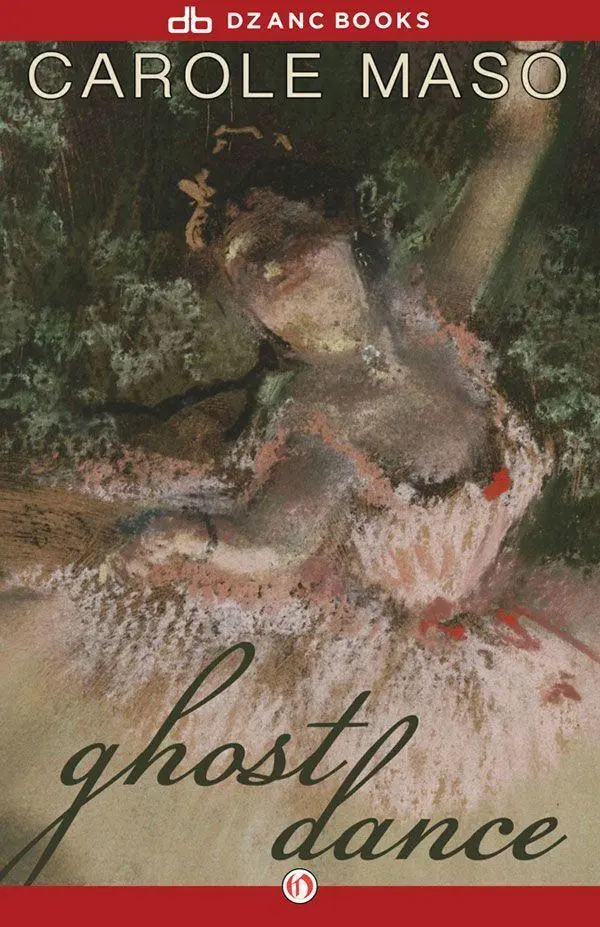
- Название:Ghost Dance
- Автор:
- Издательство:Dzanc Books
- Жанр:
- Год:2013
- ISBN:9781480441897
- Рейтинг книги:5 / 5. Голосов: 1
-
Избранное:Добавить в избранное
- Отзывы:
-
Ваша оценка:
Ghost Dance: краткое содержание, описание и аннотация
Предлагаем к чтению аннотацию, описание, краткое содержание или предисловие (зависит от того, что написал сам автор книги «Ghost Dance»). Если вы не нашли необходимую информацию о книге — напишите в комментариях, мы постараемся отыскать её.
has to offer. Like her artist-protagonists, Maso's subject as well as medium is language, and she is brave and dangerous in her command of it. She abandons traditional narrative forms in favor of a shaped communication resembling Beckett and rivalling his evocative skill. Immersed in dilated and intense prose, the readers view is a privilege one, riding the crest of clear expression as it navigates the tangled terrain of loss and desperate sorrow.
Ghost Dance — читать онлайн бесплатно полную книгу (весь текст) целиком
Ниже представлен текст книги, разбитый по страницам. Система сохранения места последней прочитанной страницы, позволяет с удобством читать онлайн бесплатно книгу «Ghost Dance», без необходимости каждый раз заново искать на чём Вы остановились. Поставьте закладку, и сможете в любой момент перейти на страницу, на которой закончили чтение.
Интервал:
Закладка:
My grandfather smiled weakly. He tried to lift a finger up from the bed to Fletcher but he couldn’t. His fingernails were luminous, white. His hands were a deep brown.
“Don’t forget about the soul, Fletcher,” he whispered. Grandmother walked in. How often she had caught us standing on chairs following the flight of the soul from the body in rehearsal. “Don’t forget the soul,” he said again.
She shook her head. “All right, children. That’s enough. Now let your grandfather get some rest.”
“But, Maria,” he whispered.
“Oh, no,” she said, “it’s time for you to rest now.”
“Please, Maria. Observe a dying man’s last request,” and he smiled slightly.
“Be sensible, Angelo, please.”
“I’m dying,” he whispered.
“Oh, Angelo, do you really think you’re just going to turn over and close your eyes and die? Do you really think it’s that easy?”
“I’m telling you, Maria.” She turned her face away from him toward the bright window and looked at the hay he had just stacked a few days before.
“Oh, Angelo,” she sighed as she had sighed so many times before. “Be sensible.” She put her hand on his cheek. “Please,” she said. “This is no time for games.”
Be sensible, she said, but this time it was Grandma who was not being sensible. In less than an hour, as he had predicted, Grandpa would be dead. She left the room. We listened to her heavy, black shoes going down the hallway — their denial of death.
“Take care of her,” he said, looking to me. “She needs you.”
I nodded.
Fletcher could not stand the formality of this ending. He tried to stop it with the power of his love.
“Grandpa,” he said, “don’t die yet.” He got into the bed next to him and hugged his shrinking body.
“You’re a good boy, Fletcher,” Grandpa said, and he closed his eyes and watched Fletcher grow up there, the growing up he would not be alive to witness. “You’re a fine young man,” he said.
“Remember the shrinking story, Grandpa?” Fletcher said. “Could you tell us that story again?”
“Oh, yes, I remember — the shrinking story.” He spoke slowly. “It’s true. Ask your grandmother someday.” He told this story now once more, for us. He saw the panic in our faces. He saw our fear. He was our friend. He was our ally; he never wanted to scare us. Don’t leave us here alone, I said to myself.
The only times I ever saw my grandfather look like an old man were when he thought about us being alone, when he thought about how our parents ignored us, how strange they were, how silent. This in itself had prolonged his life, I thought. But he could hold on no longer now. His hand was smooth on the bed, a part of it.
“Yes,” he said. “It’s true. I used to be tall, oh, a long time ago, way before you were born. It was even before your father was born. Tall,” he said, and he looked up to the ceiling, “tall as Abraham Lincoln,” and his hand lifted from the bed for the first time. He was only five-foot-six now. “Old people shrink. It’s a fact. We shrink. It’s how everybody else gets used to the idea of us not being around anymore. I’m shrinking right now under the covers,” he whispered.
“I’m afraid,” I said.
“There’s nothing to be afraid of, really,” he said with his kind, kind voice. “It feels good to be so little and light, not so attached to the world anymore and the things we love. It makes it easier for me, too.”
“Tall as Abraham Lincoln?”
“Yep. Ask your grandmother. She’ll remember.”
“It feels good to be so light?”
“Uh-huh.”
“It’s to help us get used to the idea?”
My grandfather nodded.
But my grandfather was wrong about that. Whenever I think of his shrinking story, think of him shrinking into nothingness before my eyes, I do not feel better or miss him less. I have never gotten used to the idea.
We were surrounded by silence and in that silence each of his words stood out: difficult, precious, discrete.
“Is it hard to die, Grandpa?” I asked.
“Look at me, children,” he whispered. “Imagine,” he said slowly, “never to smell the spring again or feel the silky hair of corn, never to hear your sweet voices. Yes,” he said, “it’s very hard.”
Grandma walked into the room and toward the bed and took my grandfather’s hand. They were saying good-bye. He whispered something I had never heard before. I had never seen his mouth form such shapes. It was Italian. He was talking in the forbidden language; the language he had given up in this country now came streaming back. My grandmother squeezed his hand. She talked back to him. He responded again. He looked at her and rubbed his face against her strong but trembling hand.
“It’s got a strange, sweet taste, Maria,” he said finally in Lnglish, “this dying.” And he licked his lips and sucked in the sweetness as if someone had placed candy in his last mouth.
“Take care of her, Vanessa.”
“I will, Grandpa.”
“Don’t forget about the shoebox,” he said to Fletcher. “Don’t forget to do everything I told you. It’s important.”
“I won’t forget, Grandpa.”
“Promise me you won’t forget.”
“We won’t forget.”
“Good,” he smiled. “Good,” he sighed.
It was time now. He looked out the window into the bright sunlight and his eyes grew wide. He pointed to something. “Look,” he sputtered. “Look.” What did he see there in the sun in these last seconds?
“Look!” he gasped. We stared into the sun, then back at him, then into the sun again, and in one moment I saw his look change, in a turn of my head, from wonder to horror. What rushed before him?
Instead of the past, the future must have flashed before his eyes. Instead of his whole life, our lives, the ones yet to come, appeared before him.
“My God,” he gasped. “Dear God.”
“What is it, Grandpa?”
We held onto his hands. “Oh,” he sighed. We were losing him in light.
“My God,” he cried.
“What is it, Grandpa?”
“Try to forgive them,” he whispered.
He shook his head and looked at us.
“Try to forgive them — as I have tried.”
My father walks down the crooked lanes, past squares. In this light the tall, gabled houses, the steeples, look eerie, bizarre. Torches are lit. He can’t bear to look at them — or any fire; he turns away. A fierce wind blows off the bay.
“Try to forgive them,” I whisper to my father, but he’s so far away — Denmark or Sweden, or maybe Norway.
“Fly me to the moon,” my father sings, “and let me swing upon the stars. Let me know what spring is like on Jupiter and Mars. In other words, hold my hand.” The Frank Sinatra record is on. “In other words, darling, kiss me.”
My grandfather’s dream of water was not far away now.
“That fair made him crazy,” my grandmother said. “He snapped there. There was too much rain or excitement or something. There’s no doubt about it.”
My brothers, the Indians, must always be remembered in this land. Out of our languages we have given names to many beautiful things which will always speak of us. Minnehaha will laugh of us, Seneca will shine in our image, Mississippi will murmur our woes. The broad Iowa and the rolling Dakota and the fertile Michigan will whisper our names to the sun that kisses them. The roaring Niagara, the sighing Illinois, the singing Delaware, will chant unceasingly our Dta-wa-e [Death Song].
My brethren, among the legends of my people it is told how a chief, leading the remnant of his people, crossed a great river, and, striking his tepee-stake upon the ground, exclaimed, “A-la-ba-ma!” This in our language means “here we may rest!” But he saw not the future. The white man came: he and his people could not rest there; they were driven out, and in a dark swamp they were thrust down into the slime and killed. The word he spoke has given a name to one of the white man’s states. There is no spot under those stars that now smile upon us, where the Indian can plant his foot and sigh, “A-la-ba-ma.” It may be that Wakada will grant us such a place. But it seems that it will be only at His side.
Читать дальшеИнтервал:
Закладка:
Похожие книги на «Ghost Dance»
Представляем Вашему вниманию похожие книги на «Ghost Dance» списком для выбора. Мы отобрали схожую по названию и смыслу литературу в надежде предоставить читателям больше вариантов отыскать новые, интересные, ещё непрочитанные произведения.






Обсуждение, отзывы о книге «Ghost Dance» и просто собственные мнения читателей. Оставьте ваши комментарии, напишите, что Вы думаете о произведении, его смысле или главных героях. Укажите что конкретно понравилось, а что нет, и почему Вы так считаете.