Carole Maso - Ghost Dance
Здесь есть возможность читать онлайн «Carole Maso - Ghost Dance» весь текст электронной книги совершенно бесплатно (целиком полную версию без сокращений). В некоторых случаях можно слушать аудио, скачать через торрент в формате fb2 и присутствует краткое содержание. Год выпуска: 2013, ISBN: 2013, Издательство: Dzanc Books, Жанр: Современная проза, на английском языке. Описание произведения, (предисловие) а так же отзывы посетителей доступны на портале библиотеки ЛибКат.
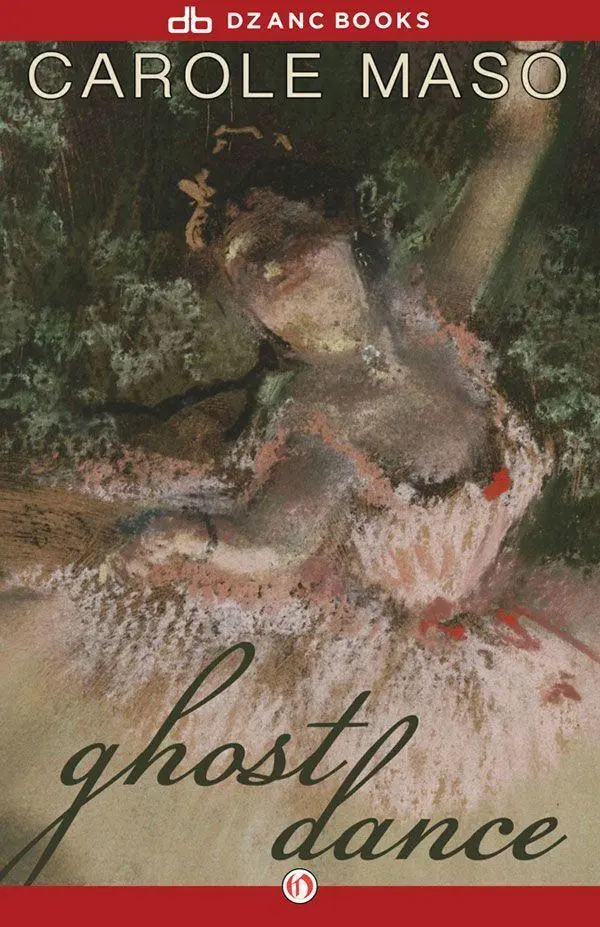
- Название:Ghost Dance
- Автор:
- Издательство:Dzanc Books
- Жанр:
- Год:2013
- ISBN:9781480441897
- Рейтинг книги:5 / 5. Голосов: 1
-
Избранное:Добавить в избранное
- Отзывы:
-
Ваша оценка:
Ghost Dance: краткое содержание, описание и аннотация
Предлагаем к чтению аннотацию, описание, краткое содержание или предисловие (зависит от того, что написал сам автор книги «Ghost Dance»). Если вы не нашли необходимую информацию о книге — напишите в комментариях, мы постараемся отыскать её.
has to offer. Like her artist-protagonists, Maso's subject as well as medium is language, and she is brave and dangerous in her command of it. She abandons traditional narrative forms in favor of a shaped communication resembling Beckett and rivalling his evocative skill. Immersed in dilated and intense prose, the readers view is a privilege one, riding the crest of clear expression as it navigates the tangled terrain of loss and desperate sorrow.
Ghost Dance — читать онлайн бесплатно полную книгу (весь текст) целиком
Ниже представлен текст книги, разбитый по страницам. Система сохранения места последней прочитанной страницы, позволяет с удобством читать онлайн бесплатно книгу «Ghost Dance», без необходимости каждый раз заново искать на чём Вы остановились. Поставьте закладку, и сможете в любой момент перейти на страницу, на которой закончили чтение.
Интервал:
Закладка:
“I have seen many wars,” he said. “White men in gray coats and white men in blue coats will kill each other. And a terrible war will be fought under a black and red symbol of the rising sun.” Falling Water looked straight ahead. He did not flinch; he did not look away.
“I see one last thing.”
“No, Falling Water, say that is all.”
“It is said by the Great Spirit that if a gourd of ashes is dropped upon the earth, then the most hideous of all events will occur. I have seen the gourd suspended in the blue sky, tilted, about to spill over. I was once the eyes of my people. But now I can see nothing beyond that great gourd.
“I am old and tired. This was once my home. But now I go to a different place, far south, into the grandfathers’ country, where I will leave my good breath. Do not forget what I have told you.”
Fletcher became, as he grew up, our ambassador from the outside world, and he traveled a long way back into the shadows to bring us news. Mother would listen for hours, asking endless questions, engrossed, it seemed, in the details of residential zoning or a new mash being fed farm animals or the latest dance steps or the infant mortality rate in the inner city. She watched him like a tourist, trying to hold onto the dizzying ride of another language, breathless, her eyes wide. I imagine that my face looked the same. We both held on tightly to Fletcher’s stories, held on for life.
Father never shared the outside world with us. I imagine he walked through the world of stocks and bonds painfully. He was so vague when it came to his workday that I often wondered whether he really went to a job at all. I could never visualize him there. He could not possibly have chatted with other people on the train or had drinks at lunch with his fellow stockbrokers. Perhaps he did what he did at home — drew endless lines on graph paper alone in a dark room with the radio playing. He never spoke of his office or what he did there. That world must have seemed nonexistent, unreal, when he walked in the door at the end of the day and saw my mother. Everything next to her must have been pale to him, unmentionable.
But, like some foreign correspondent, Fletcher reported everything to us. He lingered on every detail and we would drift in and out of his wonderful stories and their implicit message; everything he said indicated it: the truth was something you could get at. The pursuit of it was a noble ambition. The world was a good enough place to live. Anything was possible.
Yes, anything might be possible, we thought — with hard work, with faith like Fletcher’s, with love. Rivers could be cleaned up. Whales might survive. Children might sleep in warm beds having eaten a decent meal. Each house, every apartment in New York might have a warm glow. The children of Vietnam might walk straight and live. Shrapnel would be dug from their legs and they might get up and run. It did not seem so impossible.
Yes, I thought, looking at his face. The smallest efforts made out of love every day mattered. Fletcher was proof of it. He spoke softly and slowly. I listened carefully. He was the crystal in a brooding, murky family. He was my clearing in the woods, my friend, my great friend.
“Talk to me, Vanessa,” he would say, even w hen he was busy designing banners, looking up addresses in the phone book. “Come on,” he’d say. He would not allow me to become completely like Mom and Dad. We would talk. We would not lose each other.
My tenacious brother.
“How beautiful the birds must sound to one another,” he said, taking a deep breath one afternoon as we walked by the lake. What a lovely day it was. I looked out onto the shining water where it seemed to me that the flat bodies of lily pads or angels floated, giving off their pale light. Fletcher looked out, too. “Vanessa,” he said, shaking his head.
“What is it?” I asked, but he was already knee-deep in water, spouting blue and gold and green: my marble boy, my fountain of light.
“Hey, come here,” he shouted, and in his hands he held something that glittered; his whole body seemed to glow.
They were fish. Hundreds of them floating on the calm surface. “Sewage overflow,” he said. “That’s what’s killing them.” He piled them into my arms. “Hold these,” he said. He filled his arms, too, his jacket, his pockets. “Let’s go,” he said.
“Where?” I asked, though I should have known.
We carried those fish through the center of tow n and over to the mayor’s office. People joined us along the way. “Come,” he said, “come on, everyone. Look what’s happening,” he shouted through the fish stench of death.
My dramatic brother.
“This is our fault,” he said to those who looked on. The rotting, open-eyed fish clung to my body, changing me, the shape of my arms, making me understand: it was my fault, too.
“This is what we’re up against,” he said, coming into my bedroom late one night when he could not sleep and showing me what I could not help but see ahead of time in his eyes: a fox, a bear, a dog, a raccoon, their legs in steel-jawed traps. Some of them had died there finally. Others had gnawed off their own legs to get free. He made me look at every picture.
“This can be stopped,” he said. That he believed so fervently that it could be stopped prevented him from being consumed with rage. “It will stop because it must,” he whispered. My just brother — my restless brother.
Each day Fletcher lived life with the strange urgency of someone about to leave it forever. It should have exhausted him, but he seemed only to grow stronger. My diligent, my hard-working brother — he never rested.
If college gives you direction and confidence, then Fletcher did not need it. If it keeps you sealed off from the rest of the world, then he did not want it. And when he looked into colleges he could not find one he might be interested in that did not own stock in South Africa.
Fletcher finished high school in three years and so he and I graduated together. I chose to go to my mother’s college, and Fletcher that year moved into a special residence, not far from the house, where he worked with the emotionally disturbed who had been released from a nearby institution.
“I am more happy here than I can say,” he wrote to me that fall at college. These are the words I love to hear — my loving brother, my patient, happy brother.
“The soul,” my grandfather said, and we smiled, hoping that soon we’d be standing on chairs up near the ceiling. “The soul,” he whispered. “To help make the soul pure and the body, too, the Indians have something that they call the sweat lodge ritual. Heat and steam are made by sprinkling water on huge white-hot rocks.
“They laughed when I went into one for the first time and told me stories of other white men who had stopped the ritual by standing up and tearing off the top of the lodge or by running away because of the heat.
“‘Now don’t run away on us, little white man,’ Two Bears laughed.
“Even before the water is sprinkled on the rocks it’s so hot in there. It’s impossible to lean back without burning yourself. Even as the first rock was put in, I was sweating a lot. Imagine being in there with thirty or forty of these enormous rocks.
“‘Sit by the door, little white man,’ Lone Star said, ‘so you can get out in a hurry if you have to.’ The other Indians, sitting straight up with their eyes closed, chuckled.
“‘Too hot,’ Running Antelope said, water flowing from his body as the rocks were handed in.
“Once the door is flapped closed, everything is dark except the light that comes from the rocks. I sat there with them, sweating, and they took me into their prayers. The sacred person prayed to the spirits of people who had died, of animals, of birds, calling everyone Tunkasila, Grandfather. He prayed for his people, for his family, for health, and for important decisions that had to be made with President Nixon. And he prayed for me — that I might go back home and speak the truth about what I had seen and done. ‘Help the man who sits with us holding in his heart the whole burden of his race,’ they chanted.
Читать дальшеИнтервал:
Закладка:
Похожие книги на «Ghost Dance»
Представляем Вашему вниманию похожие книги на «Ghost Dance» списком для выбора. Мы отобрали схожую по названию и смыслу литературу в надежде предоставить читателям больше вариантов отыскать новые, интересные, ещё непрочитанные произведения.







Обсуждение, отзывы о книге «Ghost Dance» и просто собственные мнения читателей. Оставьте ваши комментарии, напишите, что Вы думаете о произведении, его смысле или главных героях. Укажите что конкретно понравилось, а что нет, и почему Вы так считаете.