Carole Maso - Ghost Dance
Здесь есть возможность читать онлайн «Carole Maso - Ghost Dance» весь текст электронной книги совершенно бесплатно (целиком полную версию без сокращений). В некоторых случаях можно слушать аудио, скачать через торрент в формате fb2 и присутствует краткое содержание. Год выпуска: 2013, ISBN: 2013, Издательство: Dzanc Books, Жанр: Современная проза, на английском языке. Описание произведения, (предисловие) а так же отзывы посетителей доступны на портале библиотеки ЛибКат.
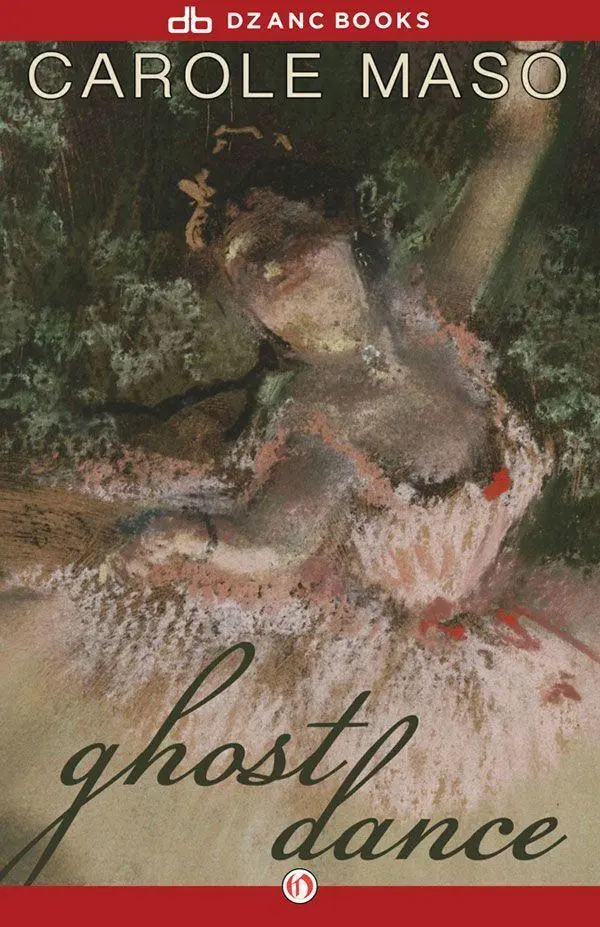
- Название:Ghost Dance
- Автор:
- Издательство:Dzanc Books
- Жанр:
- Год:2013
- ISBN:9781480441897
- Рейтинг книги:5 / 5. Голосов: 1
-
Избранное:Добавить в избранное
- Отзывы:
-
Ваша оценка:
Ghost Dance: краткое содержание, описание и аннотация
Предлагаем к чтению аннотацию, описание, краткое содержание или предисловие (зависит от того, что написал сам автор книги «Ghost Dance»). Если вы не нашли необходимую информацию о книге — напишите в комментариях, мы постараемся отыскать её.
has to offer. Like her artist-protagonists, Maso's subject as well as medium is language, and she is brave and dangerous in her command of it. She abandons traditional narrative forms in favor of a shaped communication resembling Beckett and rivalling his evocative skill. Immersed in dilated and intense prose, the readers view is a privilege one, riding the crest of clear expression as it navigates the tangled terrain of loss and desperate sorrow.
Ghost Dance — читать онлайн бесплатно полную книгу (весь текст) целиком
Ниже представлен текст книги, разбитый по страницам. Система сохранения места последней прочитанной страницы, позволяет с удобством читать онлайн бесплатно книгу «Ghost Dance», без необходимости каждый раз заново искать на чём Вы остановились. Поставьте закладку, и сможете в любой момент перейти на страницу, на которой закончили чтение.
Интервал:
Закладка:
“But, Dad!” Fletcher said, pointing to things so new he had no names for them yet: spheres, domes, disks, cubes, pylons.
“Oh, we’re just going for a short walk, Michael,” my grandfather said, running off with Fletcher.
“Meet us back at the Vatican Pavilion,” my father yelled to them. “Don’t forget!”
“We won’t,” they said, disappearing. “We won’t forget.”
My father and I spent the whole rainy morning in front of that sad sculpture. My mother, after two viewings, drifted through the fair alone. I would have joined her had she asked me, but she didn’t. She had been quiet the whole trip and, though I sat most of the ride with my head on her pink shoulder or my arm around her arm, she was miles away; it was like holding onto outer space.
I wonder what became of Grandma in those hours. I would like to think that she enjoyed the fair, that she bought a sombrero, that she ate moussaka, that she went to the Clairol Pavilion and saw herself as a blonde or a redhead, but I suppose it’s quite unlikely.
I know, though, exactly what my grandfather and Fletcher did after leaving Father and me. Sometimes I think my brother told that story too many times. Sometimes I feel it is too big to live next to. This is how it goes. In the rain, Fletcher and Grandpa watched the opening day parade go by: governors and beauty queens passed them; a steel band, African drummers, Spaniards with guitars; hula dancers shivering on the Hawaiian float; Miss Louisiana in a soaked sequined gown; Montana cowboys and the University of Pennsylvania band, the governor’s daughter bravely holding the U. They saw Miss America, Miss USA, Miss Alaska, Joan of Arc on a white horse, one hundred Japanese girls in silk kimonos, and marching red umbrellas. The Watusi royal dancers danced by, and the Lippizaner stallions.
When the parade ended they walked down the Avenue of Research where GE was putting on a illusion display. They passed Indira Gandhi who was presiding over the opening of her country’s modern two-story rectangular stone building. They stopped every few feet and witnessed some other miracle, each seemingly greater than the one before: they saw water screens and shadow boxes, undulating roofs, floating cement carpets — until something broke that dream. All of a sudden they saw in Iront of them a two-hundred-and-fifty-pound black man being lifted by two police officers into a van. The man spoke as he was being carried away. That man was James Farmer, the man whose voice had come from the center of the car and had followed my grandfather into sleep as he waited for the fair gates to open.
“Be gentle with him,” my grandfather said out loud, and Fletcher looked up.
“What did he do?” Fletcher asked my grandfather, and my grandfather, who always had an answer to everything, even if it was made up, held my brother’s hand tighter and whispered back, not taking his eyes from the scene, “I don’t know, Fletcher.” And he knelt down so as to look into my little brother’s eves and said again, “I don’t know what that man did.”
They continued on. They passed pavilions shaped like butterfly wings, like hats, like eggs. They saw the Santa Maria, they saw a gigantic electric map put up by the Equitable Life Insurance Company that lit up every time someone was born or died in the United States. They saw Burundi drummers who had never seen stairs before, let alone stairs that moved, travel them, lying down. They tasted English teas and sushi.
But they could not entirely forget the sight of that enormous black man being lifted into the police wagon. The unlikely image had attached itself to the back of their brains; the sound of that deep, passionate voice clung to their hearts and would not let go.
“Freedom now” was the call through the fair, as my grandfather and Fletcher watched demonstrators dragged through the mud by the legs or the arms or the hair. They were lying in front of buildings and blocking stairways.
“It is a symbolic act,” my grandfather explained. “They are blocking the doors in the same way Negroes are being blocked from jobs and houses and schools.” And Fletcher nodded.
It must have seemed to my grandfather that he had conjured, through his musings, Abraham Lincoln when he suddenly saw him standing on a stage, large as life. He must have seemed like some hallucination brought about by thinking too long and hard about the Negro man. My grandfather pointed speechless at the tall, brave president from Illinois. “Look,” he said finally, hoping that at least Fletcher saw him, too.
At that very moment, a voice over a loudspeaker said that this was a mechanical effigy of Abraham Lincoln, “an audio animatronic” made by Walt Disney, and that when the electronics were working Mr. Lincoln would walk and talk, would deliver the Gettysburg Address, and even give a flesh-warm handshake. But that day the great emancipator refused to move or talk. Mechanical types were fidgeting with him and with an electronic control board. But Lincoln just stood there, still as a statue, with a look of grave disappointment on his face.
“Come along, Fletcher,” Grandpa said hurriedly, walking very quickly now as if he knew exactly where he was going. Nearing the Ford Pavilion he saw-that it had been closed by a sit-in. My grandfather watched the small crowd of people who sat on the floor in front of the two escalators that led to Ford’s Progressland.
“We want freedom,” they shouted.
“When?”
“Now!”
“We want to see the show,” the visitors shouted back.
“When?”
“Now!”
“You struggle all you want, you sons of bitches,” a fat man in a cowboy hat with two children said.
“Ship ‘em back to Africa,” a woman sucking on a cigarette shouted.
“It’s horrible,” another woman about my grandfather’s age said, “that something the whole world is looking at today has to be spoiled like this.”
And then the cry that propelled my grandfather forward rose high above the crowd. “Get the gas ovens ready!” it shouted. And the whole group cheered. My grandfather felt a wave of sickness pass through him. “No,” he said, shaking his head back and forth in disbelief and looking at the ground in shame. “No,” he said, holding my brother’s tiny hand, and he suddenly felt the need to disassociate himself from the people he stood with and, still holding my brother’s hand, he crossed the line and lay down with the demonstrators.
“Freedom now,” he shouted.
Freedom now.
It must have been a curious sight. Even the demonstrators must have been suspicious of this unlikely pair: a bow-tied grandfather and his little accomplice.
A young woman and her child came forward, trying to pass the demonstrators. “When I say step on them, I mean step on them,” she said, scolding the child. And the little girl gingerly put her patent-leather shoe on my grandfather’s chest. Fletcher began to cry. “Don’t cry, Fletcher, it doesn’t hurt,” my grandfather whispered. “Please don’t cry.”
“You should be ashamed of yourself,” the woman said to my grandfather. “And involving that little boy in this, too! You should be locked up!”
“We are not ashamed,” my grandfather said.
“What are you? Nigger-lovers, is that what you are?”
“Nigger-lovers,” the visitors shouted to my grandfather and Fletcher. “Those two are nigger-lovers,” and they laughed.
The newspapers would read, “The oldest and the youngest to be arrested at the civil rights demonstration on the opening day of the New York World’s Fair were from the same family. Pictured here, Angelo Turin, 67, and his grandson Fletcher, j, being taken away by police.”
“Careful with the kid and the old man,” one policeman said, shaking his head as he put them into the paddy wagon, as my grandfather called it. “You feel OK, Pop? You know what you’re doing?”
Читать дальшеИнтервал:
Закладка:
Похожие книги на «Ghost Dance»
Представляем Вашему вниманию похожие книги на «Ghost Dance» списком для выбора. Мы отобрали схожую по названию и смыслу литературу в надежде предоставить читателям больше вариантов отыскать новые, интересные, ещё непрочитанные произведения.






Обсуждение, отзывы о книге «Ghost Dance» и просто собственные мнения читателей. Оставьте ваши комментарии, напишите, что Вы думаете о произведении, его смысле или главных героях. Укажите что конкретно понравилось, а что нет, и почему Вы так считаете.