Carole Maso - Ghost Dance
Здесь есть возможность читать онлайн «Carole Maso - Ghost Dance» весь текст электронной книги совершенно бесплатно (целиком полную версию без сокращений). В некоторых случаях можно слушать аудио, скачать через торрент в формате fb2 и присутствует краткое содержание. Год выпуска: 2013, ISBN: 2013, Издательство: Dzanc Books, Жанр: Современная проза, на английском языке. Описание произведения, (предисловие) а так же отзывы посетителей доступны на портале библиотеки ЛибКат.
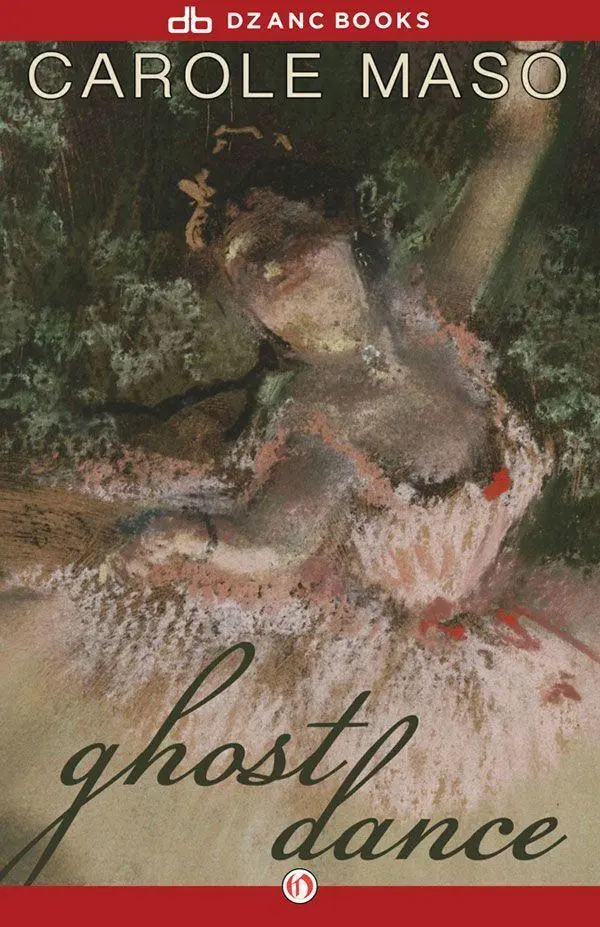
- Название:Ghost Dance
- Автор:
- Издательство:Dzanc Books
- Жанр:
- Год:2013
- ISBN:9781480441897
- Рейтинг книги:5 / 5. Голосов: 1
-
Избранное:Добавить в избранное
- Отзывы:
-
Ваша оценка:
Ghost Dance: краткое содержание, описание и аннотация
Предлагаем к чтению аннотацию, описание, краткое содержание или предисловие (зависит от того, что написал сам автор книги «Ghost Dance»). Если вы не нашли необходимую информацию о книге — напишите в комментариях, мы постараемся отыскать её.
has to offer. Like her artist-protagonists, Maso's subject as well as medium is language, and she is brave and dangerous in her command of it. She abandons traditional narrative forms in favor of a shaped communication resembling Beckett and rivalling his evocative skill. Immersed in dilated and intense prose, the readers view is a privilege one, riding the crest of clear expression as it navigates the tangled terrain of loss and desperate sorrow.
Ghost Dance — читать онлайн бесплатно полную книгу (весь текст) целиком
Ниже представлен текст книги, разбитый по страницам. Система сохранения места последней прочитанной страницы, позволяет с удобством читать онлайн бесплатно книгу «Ghost Dance», без необходимости каждый раз заново искать на чём Вы остановились. Поставьте закладку, и сможете в любой момент перейти на страницу, на которой закончили чтение.
Интервал:
Закладка:
“A Rome newspaper is urging the Vatican not to send the fterá,” he told me.
“The Pietà has been successfully moved from its pedestal to a packing case,” and he showed me a picture of Christ up to the waist in little styrofoam pieces.
“The Pietà leaves the Vatican and arrives in Naples.”
“The Pietà is placed in a watertight steel container and lashed to the deck of a ship.”
“The Pietà will be unveiled Thursday.”
And now it was Thursday. It would be bathed in blue. It would change our lives.
He turned on the radio and the back seat jumped awake. The sky was growing light. “Goddammit,” my father, who never swore, said, “we should have started earlier.” Someone on the radio was saying that massive traffic tie-ups were expected on all major routes to the World’s Fair. A stall-in initiated by the Congress on Racial Equality meant to dramatize the Negroes’ dissatisfaction with the pace of civil rights progress was planned, despite a court injunction.
“The stall-in is on!” declared a deep, resonant black voice from w hat seemed the center of the Oldsmobile. I did not so much understand the words as the tone. It was angry and sad, energetic and weary, loving and hostile, all at the same time. “Brutality, segregation, discrimination, neglect,” the voice said. It was a call for fairness. “We are responsible,” the voice bellowed. “We have a right to protest. What happens to us is unimportant. The stall-in is on!” We listened closely and looked out the windows.
My grandmother closed her eyes and put her hand on her forehead as if she already had a masshe headache. My grandfather and Fletcher sat straight up at attention. “The World’s Fair?!” Fletcher screamed with glee. “We’re going to the World’s Fair!?”
“In the rain?” my grandmother said. “Why are we going to the World’s Fair in the rain, Michael?”
“Mother, please,” my father said.
“I was at the 1959 World’s Fair!” my grandfather cried. And his thoughts raced ahead of his words. “I remember Big Joe,” he said, “the giant steel guy who stood for Soviet man! I ate caviar and drank vodka! I saw television for the first time. Television didn’t exist before that fair! I saw a collapsible piano made for a yacht! And they put a time capsule in the ground right here in New York! And these,” my grandfather said, plucking my grandmother’s stockings from her legs, “I saw these invented!”
“Stop, Angelo!” my grandmother shouted, slapping his hands.
“They put all kinds of things in that time capsule — nylons, for instance,” and he pulled my grandmother’s stockings again, “a can opener, a hat, cigarettes. It’s supposed to be opened in the year 6000 as a record of our time.”
“Six thousand!” we shouted. “But it’s 1964 now.”
“One thousand nine hundred and sixty-four,” my father said.
“Oh!”
“One thousand, two thousand, three thousand,” Fletcher counted.
“And I remember a row of beautiful women dancing a fan dance,” my grandfather continued.
My grandmother shook her head.
“Four thousand, five thousand, six thousand.”
“And another girl wearing the tiniest bathing suit I’ve ever seen was put inside a block of solid ice!”
“There will be no girls in ice this time,” Father said sternly. My father was the first feminist I ever met.
“Why must we go in the rain, in a civil rights demonstration?” my grandmother asked.
“Maria!” my grandfather shouted.
My mother was not sleeping but her voice was muffled, as if she spoke from some distance. “Please don’t fight,” she said, “there will be enough of that when we get there.”
My father looked at her.
“It will be OK,” he said. “Don’t worry.”
My mother smiled one of her wise smiles. “Fletcher,” she said, “there’s so much sun around you this morning, I think you may just clear away the rain for us.” My brother blushed.
When we got to the highways that were to be choked with cars, there were no cars, just large expanses of gray and long white lines. Father had set aside many hours for sitting in traffic and without it we found we were in Flushing, Queens, just after sunrise, hours before the fair was to open.
When we passed Shea Stadium and my father did not so much as turn his head toward it, as other fathers would have, I knew that we would never be the kind of family that followed baseball scores and owned dogs and went on vacation to Florida. I would like to have asked him just once, when I was eighteen, how the Yankees were doing this year and he in some chummy, sporty sort of way would say, “Well, you know, they’re slow starters, but September is their month.” But this, of course, would never be.
We parked the car in the vast World’s Fair lot and listened to the rain that was beating harder now on the car roof.
“Well, we’ll just have to nap a bit,” my father said, “and then when we get up it will be time to go in.”
“Oh, boy,” my grandmother said, closing her eyes.
Who can know what each of us dreamt that early morning in the World’s Fair parking lot? I can guess. My father — that’s easy: in his dream a grieving mother cradled her dead son’s body in silence. It was one constant image, like a slide on a gigantic screen that kept coming into sharper and sharper focus.
My brother must have dreamt of great inventions — weather or time machines, space ships blasting into the black sky, or capsules being plunged into the damp earth.
Grandfather shifted around a lot that morning in the back seat: his long dream of the fair of 1939 suddenly broken by the deep voice from the car radio, taking shape in his sleep.
My grandmother insisted she never dreamed, but I saw her as she slept swatting the air as if shooing away flies, or swatting at my grandfather who she thought still plucked at her brand-new nylons.
It was my mother’s dreams that were impossible to know. They were so tangled. When I would try to comb them, they would cascade like her hair, folding and unfolding and folding again, w rapping around each other in complicated tendrils. Does my mother drift through the rain of her dreams until she finally reaches shelter? Do her eyes fix on some simple object, something I’d never think of, a window or a wheel — or some other shape where she finds some psychic comfort? I do not know.
In the middle of his blue dream of bones, my father suddenly woke up and nudged me. “It’s almost time, Vanessa,” he whispered. He looked feverish and pink, and when I put my small hand to his forehead in what I had seen as adult behavior, it was burning.
“Just wait, just wait,” he said to me quickly in a rasping voice.
I looked back and noticed my grandfather, too, was now awake. He looked at me and shrugged his shoulders. Italy did not interest my grandfather any more, not even Michelangelo and his Pietà; America was everything now, but he had never seen my father so consumed. “Dad,” my father said, “just wait.”
We were nearly the first ones into the fair, and there was no line when we got to the Vatican Pavilion. “This is important,” I kept thinking to myself as Father handed us our tickets. My mother took a deep breath, Grandma grimaced, and Grandpa stared straight ahead. “This is important,” I thought, “this means something,” but I could not for the life of me figure out what about this large sculpture, behind glass, lit in blue, moved my father to tears that day, standing between his parents, hugging them to his side on the moving conveyor belt we all stood on. My father was not, as far as I knew, a religious man. He had hardly ever stepped into a church. But this was important to him, and for no real reason I felt Father’s tears in my eyes. My father whispered when we got outside that he would like to view the Pietà “a few more times” and then we could head back home.
Читать дальшеИнтервал:
Закладка:
Похожие книги на «Ghost Dance»
Представляем Вашему вниманию похожие книги на «Ghost Dance» списком для выбора. Мы отобрали схожую по названию и смыслу литературу в надежде предоставить читателям больше вариантов отыскать новые, интересные, ещё непрочитанные произведения.






Обсуждение, отзывы о книге «Ghost Dance» и просто собственные мнения читателей. Оставьте ваши комментарии, напишите, что Вы думаете о произведении, его смысле или главных героях. Укажите что конкретно понравилось, а что нет, и почему Вы так считаете.