Carole Maso - Ghost Dance
Здесь есть возможность читать онлайн «Carole Maso - Ghost Dance» весь текст электронной книги совершенно бесплатно (целиком полную версию без сокращений). В некоторых случаях можно слушать аудио, скачать через торрент в формате fb2 и присутствует краткое содержание. Год выпуска: 2013, ISBN: 2013, Издательство: Dzanc Books, Жанр: Современная проза, на английском языке. Описание произведения, (предисловие) а так же отзывы посетителей доступны на портале библиотеки ЛибКат.
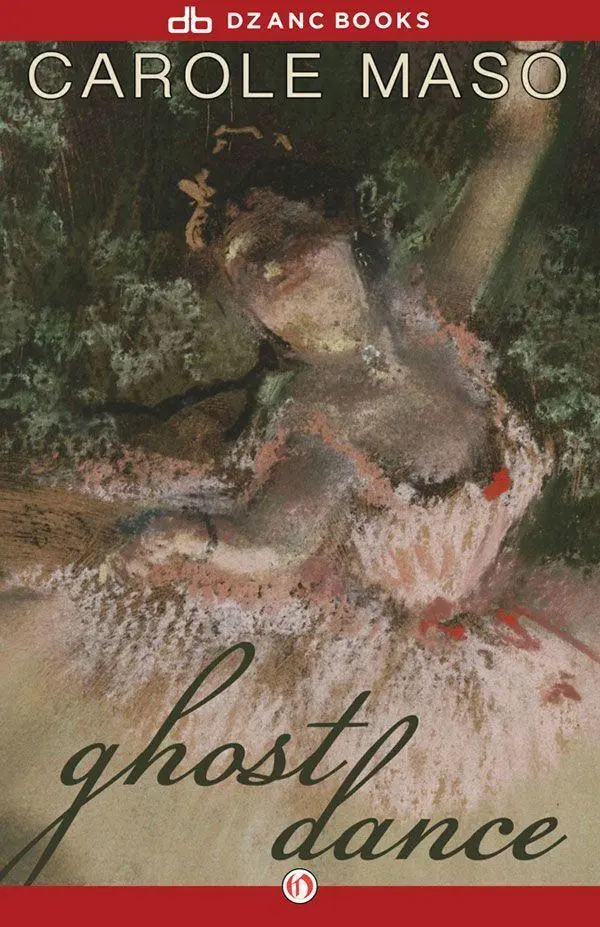
- Название:Ghost Dance
- Автор:
- Издательство:Dzanc Books
- Жанр:
- Год:2013
- ISBN:9781480441897
- Рейтинг книги:5 / 5. Голосов: 1
-
Избранное:Добавить в избранное
- Отзывы:
-
Ваша оценка:
Ghost Dance: краткое содержание, описание и аннотация
Предлагаем к чтению аннотацию, описание, краткое содержание или предисловие (зависит от того, что написал сам автор книги «Ghost Dance»). Если вы не нашли необходимую информацию о книге — напишите в комментариях, мы постараемся отыскать её.
has to offer. Like her artist-protagonists, Maso's subject as well as medium is language, and she is brave and dangerous in her command of it. She abandons traditional narrative forms in favor of a shaped communication resembling Beckett and rivalling his evocative skill. Immersed in dilated and intense prose, the readers view is a privilege one, riding the crest of clear expression as it navigates the tangled terrain of loss and desperate sorrow.
Ghost Dance — читать онлайн бесплатно полную книгу (весь текст) целиком
Ниже представлен текст книги, разбитый по страницам. Система сохранения места последней прочитанной страницы, позволяет с удобством читать онлайн бесплатно книгу «Ghost Dance», без необходимости каждый раз заново искать на чём Вы остановились. Поставьте закладку, и сможете в любой момент перейти на страницу, на которой закончили чтение.
Интервал:
Закладка:
“This is no time for jokes, Lucy,” my mother yelled. She sat at the edge of the bathtub and wept. Blood ran down the inside of her thighs. Bright red blood fell to the tiled floor, flowing harder, the harder my mother cried. Her sister sat on the edge of the tub and began wrapping toilet paper into a little pad which she put in a clean pair of underwear to absorb the blood.
“Here, put this on,” she said. “Don’t worry. I’ll think of something.”
But secretly Lucy was worried indeed. She looked up blood in the encyclopedia. She looked up cut, bruise, scrape. She looked up every possible spelling of rheumatic but found nothing. Maybe it was true: they were marked for death in advance, as Christine said.
“Mother!” Lucy said, growing impatient, stomping her feet on the street and looking up into the sky. “Tell us what is happening!”
But their mother was dead now and she had been too ill to hold the words of life in her mouth that would have prevented this scene.
Wandering desperately through the drugstore, trying to find the courage to approach the pharmacist who had known their mother so well and to tell him the terrible news, Lucy found the clue she was looking for on a box. The box was lavender and had flowers on it and a woman about the age of their mother smiling. Another box was pink with a sunset and a bird flying across it.
“You’re men-stroo-ate-ing,” my aunt said proudly.
“That sounds bad,” my mother said softly. “How long do I have?”
“No, you don’t understand. It is supposed to happen. And everyone is smiling on the boxes like they have a secret.”
“What boxes?”
“The napkin boxes.”
“The napkin boxes?”
“Sanitary napkins.” And Lucy presented Christine with her own box. “They catch the blood.”
“Did Mother have this, too?”
“Yes, I think she did.”
“Everybody gets it?”
“Only girls do, when they become women.”
“I’m a woman?”
“I guess so.”
My mother cried with relief. But she also cried, I think, because she was a woman and she did not want to be one yet. For some reason she knew that a woman’s life would not be an easy one. Her mother, the only woman she really knew, was dead; she did not know where to turn. Lucy, soon to be a woman too, began to find consolation in boys who, by some predictably fitting quirk of fate, did not have to be men when girls had to be women.
Soon Lucy would never be home anymore either. She would get a job in the drugstore selling Hazel Bishop lipsticks behind the cosmetics counter, the same drugstore where she had discovered, not so long before, the secret of menstruation. The rest of her time she would spend at the local soda fountain or “having adventures” as she liked to call them. She would be a wild teenager, riding motorcycles with boys in leather jackets, jumping from planes in parachutes, teetering on the edge of the Great Paterson Falls. What was my aunt wishing as she looked down at the jagged rocks, the rushing water? I don’t know what would have happened to her had the man in the suit and tie carrying the briefcase not shown up and offered his hand and said in his optimistic way, “I hope you have a good life plan, young lady.”
“Huh?” Aunt Lucy must have said.
“I said you should be protected by a comprehensive life-insurance policy,” he shouted over the water.
“Life insurance!” she said to the man. “Life insurance?” She was only sixteen.
When Philippe Petit, a celebrated tightrope walker and bon vivant, would cross the falls in the early 1970s, Aunt Lucy, in her nurse’s uniform, taking the afternoon off from St. Joseph’s hospital, would be in the front row with Uncle
Alex, her neck craned, pointing, closing her eyes, visualizing herself up there, too, next to Philippe, umbrella in hand, remembering her own days of daring at the edge of these same falls.
The insurance salesman proposed marriage when Aunt Lucy was seventeen, and that year she entered nursing school and put her old life behind her. She would learn what made her mother so sick in the first place and why nothing could be done about it. I can see her today. When my brave aunt puts a steady hand on a patient’s forehead in Beekman General in Hartford, Connecticut, or speaks softly to a sick child, or cradles a postoperative woman in her arms, I know it is really her mother she hugs and whispers comfort to, her mother’s forehead she touches. Daily she saves Grandma Alice’s life as she checks a pulse, measures temperature, takes blood pressure. Over and over again for thirty years — she continues even now.
And what of Christine, my mother, a young woman left all alone in that silent house? Motorcycles, parachutes, souped-up sports cars — these things frightened her. All the risks my mother took were mental. Her high dives, her balancing acts, her fiery leaps were in the imagination. Every day of her teenage life she tried to imagine her way free — to find somehow the shining door inside her that would provide the escape from this Paterson and their poor life and no mother. Escape it with words; change it with words. Words — she looked tirelessly for the words that might bring back her mother if only momentarily or the words that might make some sense of things. She invented the versions, pictured the scenes where her mother still lived, finding a way to continue.
She looks still, wherever she is, I’m sure of it. She searches for that pale quiet woman, wrapped in blankets. She writes, helping her up from the bed. She writes, getting her back, recovering her from the dark.
This is their favorite day of the week. The children sit quietly in the room and wait for their father to come home. The mother, who is so sick, sleeps, preparing for his arrival, too. When he comes in at twelve from a morning of overtime, he will have with him flat bread and poppy-seed buns from the Armenian bakery, and the Sunday paper. They will sit together in the bedroom and all afternoon he will read to them of exotic places from the paper’s travel section.
“Where are we going today?” Mother asks. She has not left her bed in weeks.
“Let’s see,” Father says. “How about Savannah?”
“Oh, yes,” little Christine says. “Let’s go there!” Savannah — they all sigh and he begins to read. He reads to them all afternoon. Savannah first, then Niagara Falls, then Taos, then San Francisco, then Savannah again, until the sky grows dark.
“It’s pitch black out!” Lucy says.
“We could be anywhere!” Christine whispers.
As they grow sleepy in the scent of Savannah, of jasmine, of magnolia, Father flips to his favorite section — sports, where he reads the horse-racing results out loud.
“They run fast as the wind,” Lucy says.
“Like the wind,” Mother says, and her voice wavers, “the wind.”
“Yes,” Father says, “as fast as the wind.” And with those words they are asleep. Her father closes the paper and leaves the house for the night shift.
She could dream of petting one. She could dream of running her hand down its smooth, broad nose, between the large, brown eyes — the gentlest of all eyes. She could touch its coarse mane, put her arms around its tremendous neck. She could hear its heart, its loud, huge heart, kept in the wide silky box of its chest.
She watches it play in a field of sweet clover — its rounded haunches, its curving neck, in the golden light of day. She says the word graze; it sounds good to her.
If she had one she would offer it apples and feel its square nose flatten her hand. She would make it a soft bed of hay. She would cover it w ith a red blanket, put fresh water in the drinking trough, put feed in a jute and burlap sack.
At night she would stay with it in its stall. If she saw an animal like that she would never leave its side. She could feel its large, warm breath in the dark, making a veil of protection, a home of breath. She would put her mother in that safe, warm tent where she might live forever.
Читать дальшеИнтервал:
Закладка:
Похожие книги на «Ghost Dance»
Представляем Вашему вниманию похожие книги на «Ghost Dance» списком для выбора. Мы отобрали схожую по названию и смыслу литературу в надежде предоставить читателям больше вариантов отыскать новые, интересные, ещё непрочитанные произведения.





Обсуждение, отзывы о книге «Ghost Dance» и просто собственные мнения читателей. Оставьте ваши комментарии, напишите, что Вы думаете о произведении, его смысле или главных героях. Укажите что конкретно понравилось, а что нет, и почему Вы так считаете.