Carole Maso - Ghost Dance
Здесь есть возможность читать онлайн «Carole Maso - Ghost Dance» весь текст электронной книги совершенно бесплатно (целиком полную версию без сокращений). В некоторых случаях можно слушать аудио, скачать через торрент в формате fb2 и присутствует краткое содержание. Год выпуска: 2013, ISBN: 2013, Издательство: Dzanc Books, Жанр: Современная проза, на английском языке. Описание произведения, (предисловие) а так же отзывы посетителей доступны на портале библиотеки ЛибКат.
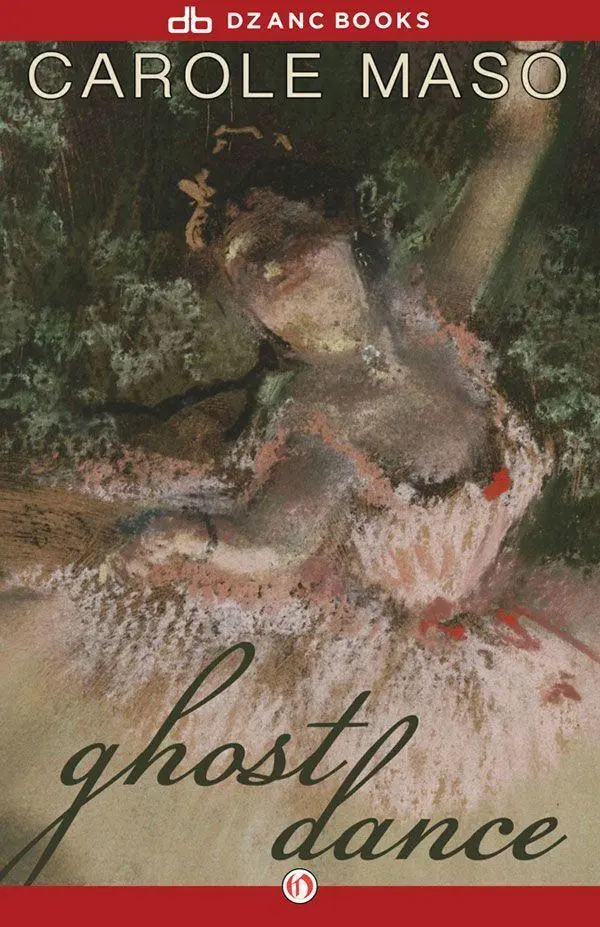
- Название:Ghost Dance
- Автор:
- Издательство:Dzanc Books
- Жанр:
- Год:2013
- ISBN:9781480441897
- Рейтинг книги:5 / 5. Голосов: 1
-
Избранное:Добавить в избранное
- Отзывы:
-
Ваша оценка:
Ghost Dance: краткое содержание, описание и аннотация
Предлагаем к чтению аннотацию, описание, краткое содержание или предисловие (зависит от того, что написал сам автор книги «Ghost Dance»). Если вы не нашли необходимую информацию о книге — напишите в комментариях, мы постараемся отыскать её.
has to offer. Like her artist-protagonists, Maso's subject as well as medium is language, and she is brave and dangerous in her command of it. She abandons traditional narrative forms in favor of a shaped communication resembling Beckett and rivalling his evocative skill. Immersed in dilated and intense prose, the readers view is a privilege one, riding the crest of clear expression as it navigates the tangled terrain of loss and desperate sorrow.
Ghost Dance — читать онлайн бесплатно полную книгу (весь текст) целиком
Ниже представлен текст книги, разбитый по страницам. Система сохранения места последней прочитанной страницы, позволяет с удобством читать онлайн бесплатно книгу «Ghost Dance», без необходимости каждый раз заново искать на чём Вы остановились. Поставьте закладку, и сможете в любой момент перейти на страницу, на которой закончили чтение.
Интервал:
Закладка:
My mother walks slowly, dropping her gloves, catching a falling scarf, stalling for time. Beautiful, vibrant Paris turns to watercolor sadness.
“Don’t worry,” Sabine pouts, “one day when we are old we’ll Join traveling circus and be together lower They mbrace, kiss good-bye lor the thousandth time.
“Au revoir, ma Pans. Au revoir, ma Sabine,” Christine say. She walks slow ly, turns once more.
“We’ll be tightrope walkers,” Sabine says.
My mother smiles and waxes good-bye.
She is dozing off now with the other little girl, her sister, in the cramped room. The tat man reads about New Orleans to them trom the newspaper’s travel section.
“New Orleans — that sounds, that sounds,” she murmurs, tailing asleep. What she means to say, what she would have said, was “that sounds so nice.”
In her dreams the notes of saxophone slide out of the windows &she is sure she has never heard anything like it before.
Creoles — was that those people were called? There are feathers and fans, men dressed as women, women dressed as lizards and birds, laughter, and a drink called bourbon. All of it follows her into her dreams.
And the fat man, too, leaving for work, dreams his wav into the dark mill.
“The rainbow-colored Painted Desert of Arizona sweeps in a great crescent from the Grand Canyon southeast along the Colorado River to the Petrified Forest.”
“The Petrified Forest!” Lucy cries.
“Go now,” my mother says. “There is no other way.”
The apartment is warm and dark. I turn in bed toward the wall and hug the cat. “But Mother,” I say.
“Go,” she urges me.
But I hesitate here. I would prefer to forget.
“There is no other way,” she says.
And so I go, in my mind, back to college where I will spend a little more than one semester. First to that strange, sad room, then to the beautiful library, and then beyond that, too.
“It‘s time,” she says. And I know she is right.
Part Three
I decided to forgo all the initiation rites of freshmen and went instead to the library. Eleanor Cove, the librarian, in response to my question, lifted her arm, pointed to the stacks on the second floor, and looked up. In her raised face I saw what I had seen so often in my mother. Here was a lover of books, a woman dizzied by them, transformed in some way. She smiled. Quietly she explained to me how things were arranged, where the periodicals were located and the reference room. I thanked her and climbed the stairs.
The library was empty. Classes had not yet begun and people were still stuck somewhere in summer, I assumed — on the wavy lake or the tennis court with its green hum.
It was cool and dark and I felt safe here. In the context of such coolness and sense and order it seemed that the events of the night before could not have happened; walking to the shelves I telt strangely free of them: that odd room on the top floor, Marta and her sad, sad story, and the needle I watched sink into my arm. I had changed into a long-sleeved shirt before going to the library, hoping to disown that arm somehow.
I loved the order of libraries. I felt at ease here among the old and new books, lined and numbered on the shelves. I found what I was looking for easily. When I was done I would put those books back in the same place, and on another day I would be able to find them again. Most people would think little of such a simple thing, but this afternoon the thought of every book having its place and no book being lost gave me an overwhelming sense of pleasure.
It was the pleasure of square dancing with my brother at the Blue Goose in Moose Point, Massachusetts. We loved the reliability of it, the certainty. We knew when we unlocked hands to allemande left or turned our backs on each other to honor our corners and do-si-do we were not losing each other; wewould reunite in the end — it was in the design of the call — and it made letting go possible. We always knew that for the final promenade we would be together.
I lined up the books on the table, starting with the earliest — the first book on the left and, six books later, the last one on the right. I turned them all over so that I could see the photographs of the writer, my mother. Watching my mother slowly age on the back of her books always had a calming effect on me. I wanted to linger this afternoon at each stage, tracing the shape of the years. I had studied these photos often, but now, missing her more than I ever had, I wondered what secret her face might give up. She had always left me —trips to France, summers in Maine, readings all over the country — but this time I was the one who had driven away, and it was she who stood at the edge of the driveway, stationary, growing smaller and smaller, and it made my longing more acute. Over the years I had stayed home from school often, not wanting to leave her. And when the young teachers came, as they inevitably did, I would run and hide.
“Vanessa?” my mother would say to those earnest women, “why, Vanessa could be anywhere. I can’t keep track of her.” And then she’d whisper, “She’s like the air, you know,” and motion out into the world and laugh her long lovely laugh.
The photo of my mother on the back of her first book remains the most constant in my mind. It is the one least altered by memory for I cannot ever remember my mother looking the way she does there. I love to look at her at twenty-three: the yellow-blonde hair, the smooth egg of a forehead, the softness of her face which, at this age, still seems to be forming. She looks like someone else almost, a young beauty, an actress perhaps, caught strangely off guard in the moment before she raises her hand to block her face from the camera or to put on sunglasses, shielding herself from a demanding public. She looks unfocused, nervous, as if she has already lost her way, though she has just barely begun. She seems to be moving slightly in the frame, but she does not know where she is going or why.
At times when I look at that photo of my mother on the back of Winter , her first book of poems, I think I can see Sabine, who took that picture, reflected in my mother’s eyes. “Smile,” Sabine is saying. “Don’t be so hard on yourself. This won’t hurt at all.” I imagine she lifts her polka-dotted dress to her thighs, bends her knees slightly, and does a little dance for my mother. Other times when I look at this photograph I think I can see a shadowy figure, quite small, standing behind my mother, caressing her shoulders, dark eyes lowered; and that, too, is Sabine.
Every time I look at this picture of my young mother I see what drew people to her and held them so long. Looking at her that afternoon in the library, I thought, we’re nearly the same age — and I studied her closely, as if with enough concentration I might see what to do next.
The second portrait of my mother is the most troubled. She is thirty-two here and it has been a long time between books. In that time Fletcher and I have been born. She carries our births in her face in baffled, dramatic lines. I know just by looking at her here that loving us was never easy for my mother. In this photograph, though it ends at the shoulders, I see Fletcher asleep in her arms and myself curled around her leg like a cat. My mother looks impatient, her eyes are more heavily lidded than before, and her face is strained. She could never have guessed that it would take so long to go such a short distance. As a child, this is the face I memorized. I knew every line, the way her hair curved around her face, the eyes, always dissatisfied, and the pale color of despair that, no matter how much praise she received or how many awards she won, never left her. In her poems she was interested only in saying what could not be said. “There must be a way,” I would hear her say to Sabine long distance, half in English, half in French.
Читать дальшеИнтервал:
Закладка:
Похожие книги на «Ghost Dance»
Представляем Вашему вниманию похожие книги на «Ghost Dance» списком для выбора. Мы отобрали схожую по названию и смыслу литературу в надежде предоставить читателям больше вариантов отыскать новые, интересные, ещё непрочитанные произведения.





Обсуждение, отзывы о книге «Ghost Dance» и просто собственные мнения читателей. Оставьте ваши комментарии, напишите, что Вы думаете о произведении, его смысле или главных героях. Укажите что конкретно понравилось, а что нет, и почему Вы так считаете.