Carole Maso - Ghost Dance
Здесь есть возможность читать онлайн «Carole Maso - Ghost Dance» весь текст электронной книги совершенно бесплатно (целиком полную версию без сокращений). В некоторых случаях можно слушать аудио, скачать через торрент в формате fb2 и присутствует краткое содержание. Год выпуска: 2013, ISBN: 2013, Издательство: Dzanc Books, Жанр: Современная проза, на английском языке. Описание произведения, (предисловие) а так же отзывы посетителей доступны на портале библиотеки ЛибКат.
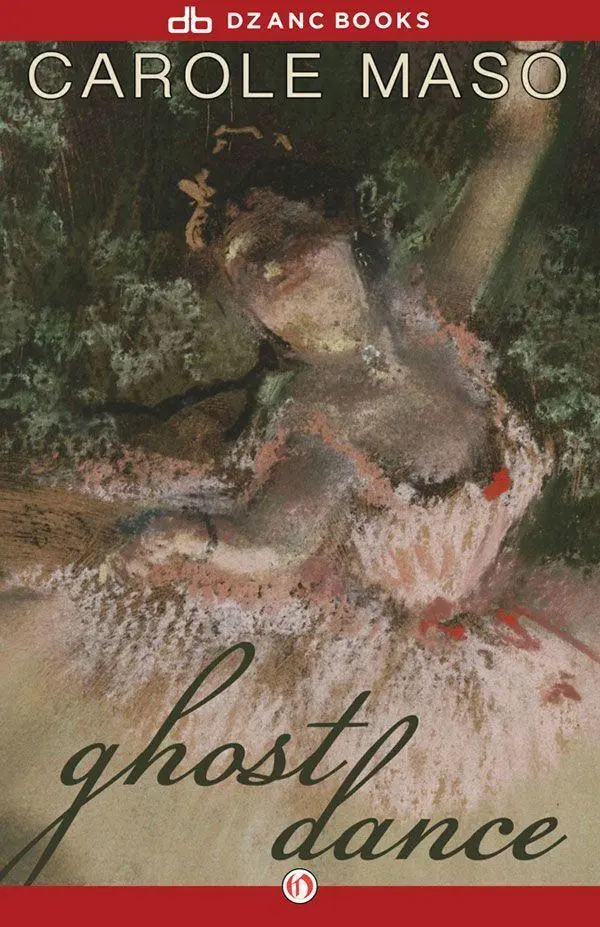
- Название:Ghost Dance
- Автор:
- Издательство:Dzanc Books
- Жанр:
- Год:2013
- ISBN:9781480441897
- Рейтинг книги:5 / 5. Голосов: 1
-
Избранное:Добавить в избранное
- Отзывы:
-
Ваша оценка:
Ghost Dance: краткое содержание, описание и аннотация
Предлагаем к чтению аннотацию, описание, краткое содержание или предисловие (зависит от того, что написал сам автор книги «Ghost Dance»). Если вы не нашли необходимую информацию о книге — напишите в комментариях, мы постараемся отыскать её.
has to offer. Like her artist-protagonists, Maso's subject as well as medium is language, and she is brave and dangerous in her command of it. She abandons traditional narrative forms in favor of a shaped communication resembling Beckett and rivalling his evocative skill. Immersed in dilated and intense prose, the readers view is a privilege one, riding the crest of clear expression as it navigates the tangled terrain of loss and desperate sorrow.
Ghost Dance — читать онлайн бесплатно полную книгу (весь текст) целиком
Ниже представлен текст книги, разбитый по страницам. Система сохранения места последней прочитанной страницы, позволяет с удобством читать онлайн бесплатно книгу «Ghost Dance», без необходимости каждый раз заново искать на чём Вы остановились. Поставьте закладку, и сможете в любой момент перейти на страницу, на которой закончили чтение.
Интервал:
Закладка:
“We sang many songs,” my grandfather said. “I grew large like an Indian in the steam. I sang out my sadness. Then Running Antelope sang — then Two Bears.” Help the little white man, they chanted, through the unbearable heat.
Fletcher once thought he might rescue my mother from that vast country that she wandered through if he learned how to predict the weather. He did not know that, even then, years before he was grown, it was already too late.
The day the thermometer and barometer came, wrapped in brown paper from Dayton, Ohio, Fletcher stared at the package a long time, not opening it, not touching it, just staring. It seemed unlikely to me that this small brown package could change the course of mv mother’s life, but Fletcher was convinced that, with some personal knowledge of the weather, life would be more reliable, the element of surprise would diminish, plans could be made.
He’s not made for this weather. A man like that sweats through his clothes in summer in less than an hour or two. His heart strains in his chest. It’s too much.
He is bent over a counter in his small shop. He sweats. The large slow fan hanging from the ceiling is not enough. He is clumsy in such a confining space.
A man his size in New York is always doomed to be uncomfortable — small theaters, small restaurants, narrow streets, subways. It’s a city of few Checker cabs, few Madison Square Gardens.
I dream that his thick fingers would know just how to touch me and that he would enter me skillfully. He is someone who is well aware of the texture and shape of muscle, the placement of bones, the flesh that surrounds them, the body’s cavities. He holds the entire body of a deer in his arms, draining the blood. He knows just where to cut, just where to hold. He turns deer into venison, pig into pork, cow to beef. He cuts his brothers into pieces in order to live.
Blood covers his apron. His arms to the elbow are smeared with it. He’s a little shy, but so capable, so handsome. His hair is short, much shorter than is the style of the time — anything to keep cool. He washes before coming to the front room of the shop, but under his nails I can see the browning blood still. He wipes his brow. He can’t go on. It’s too much.
A man as hot as that gives in easily. All you would have to do is brush against his hand when paying for veal or sweetbreads — or whisper to him, “how much,” or “I need two pounds, please.” Let him watch you wipe sweat from your own brow, show him your shoulder, or rub the calf of your leg. Call him by name: say, “Thank you, Jack.” Invite him to your apartment just down the street — so close by, surely he’ll come. He’ll stoop at the doorway. He’ll wipe his face on his sleeve.
My mother always looked exhausted to me. Some nights I massaged her neck for a long time just to watch those great lids of hers lower for a while. Other nights she would come to me in my bedroom, brush and hairpins in hand, and say, “Vanessa, darling, would you make me a hairdo?” It was strange to hear the word hairdo coming from my mother’s mouth. It sticks in my mind — her saying hairdo, me dividing the hair on the sides of her head into three equal parts, braiding them and tying them on the top of her head. I can’t decide now whether her hair felt heavy or light in my hands. It was wonderful hair, though, coarse and golden. It stayed exactly where I arranged it; I remember it perfectly. “Oh, another one, please,” she would always say after I had finished one and she had admired it in the mirror for a long time. “It feels so good,” she would say. My mother loved to feel my hands running through her hair, and I loved to see her relax there with me for a moment.
Her smile, her whole body wavers. Her eyes seem about to go out, to extinguish themselves. She looks from person to person. “You’re exquisite!” she gasps, looking at a woman only a few years older than I am. “You’re lovely,” she whispers. She laughs her high laugh and tosses her head back confidently.
“It is not enough, Vanessa,” Jack says. “A daughter combing her mother’s long hair, a brother who saves animals — all these sweet memories. They are not enough. This mildness will kill you.”
He hugs me close. “Don’t be afraid,” he says. “Try not to be afraid. There is no wav to stay safe.”
We walked silently on the turning earth with our grandfather. “Look,” he said, pointing to the sky. “Look,” he cried, “over there! Eagles!”
We looked up. I looked at my father’s pained face.
“Those aren’t eagles, Dad,” my father said quietly. “Those are just barn swallows.”
My grandfather’s eves widened. In his sky there were eagles.
“Barn swallows,” my father whispered, “that’s all.”
In the dream the snake entered through White Feather’s ear and came out her mouth. She awoke to a wailing that seemed to rise out of the earth itself. Now she could not help but hear it. It was as clear to her as if it were Dark Horse, lying next to her, who was wailing.
She rose and walked down to the brook where she sat for a while. She felt a pain in her left breast. Her son was not going to come back alive; she could see a man in a blue jacket pressing a bullet into his head. The brook flowed red. The earth’s wailing rose into her mouth and filled it and became her own.
The postcards from Fletcher have stopped coming. My brother has traveled deep into the center of the country where I can no longer touch him, deep into the center of silence.
“Anza-Borrego Desert State Park in California,” the fat man reads, “claims two unusual features: a limitless carpet of wildflowers and elusive bands of bighorn sheep. The wildflowers bloom in spring, drawing thousands of flower-sniffers, as the residents call the springtime tourist invasion. The wild sheep inhabit remote canyons and crags, their buff coloring blending with the landscape and making them difficult to spot.”
“Look, here’s a picture of them!” Christine giggles, passing the newspaper to her mother.
“Where is this?” the mother asks.
“California,” Christine says.
Gershwin, Ives, Cage, Glass.
We could feel great silence moving in, and we spoke little words trying to break it.
“Does the second planting start today, Grandpa? Do you think Maizy will have her kittens soon?”
We were deep in spring and our words got caught in trees thick with bird song, in pockets of billowing clouds. Almost as soon as we spoke them, our words seemed to be absorbed by the plumpness of the vernal earth and all was quiet again. There was no dispelling the silence. Grandpa heard it best of all — it was coming for him.
I tried bigger words, greater ones, to try to break the heart of it.
“Are you dying, Grandpa?” I asked. He had not gotten out of bed for two days. “Are you going to die now?” This would scare death off, I thought — to point a finger at it, to name it.
But it did not dispel it. “Yes, Vanessa,” he said, “I think I am.” And as soon as we heard him say it, we knew it was true.
“Oh, it’s a lovely day to die,” my grandfather said. He hated to see us upset. “The weather is clear, the trip will be easy.” He paused. “A cinch,” he smiled.
“Don’t die today,” Fletcher said. His head was resting on the bedspread. He did not look at my grandfather. “Please don’t die, Grandpa.”
“It is not such a bad day to die,” my grandfather said, turning his head toward the window.
He spoke slowly against the silence and we felt the terrible friction in his voice. It must have weighed down on him hard now. Still his voice rose. “It is not such a bad day to die, Fletcher. Everybody has to die someday.”
“Please don’t,” Fletcher said.
Читать дальшеИнтервал:
Закладка:
Похожие книги на «Ghost Dance»
Представляем Вашему вниманию похожие книги на «Ghost Dance» списком для выбора. Мы отобрали схожую по названию и смыслу литературу в надежде предоставить читателям больше вариантов отыскать новые, интересные, ещё непрочитанные произведения.






Обсуждение, отзывы о книге «Ghost Dance» и просто собственные мнения читателей. Оставьте ваши комментарии, напишите, что Вы думаете о произведении, его смысле или главных героях. Укажите что конкретно понравилось, а что нет, и почему Вы так считаете.