Carole Maso - Ghost Dance
Здесь есть возможность читать онлайн «Carole Maso - Ghost Dance» весь текст электронной книги совершенно бесплатно (целиком полную версию без сокращений). В некоторых случаях можно слушать аудио, скачать через торрент в формате fb2 и присутствует краткое содержание. Год выпуска: 2013, ISBN: 2013, Издательство: Dzanc Books, Жанр: Современная проза, на английском языке. Описание произведения, (предисловие) а так же отзывы посетителей доступны на портале библиотеки ЛибКат.
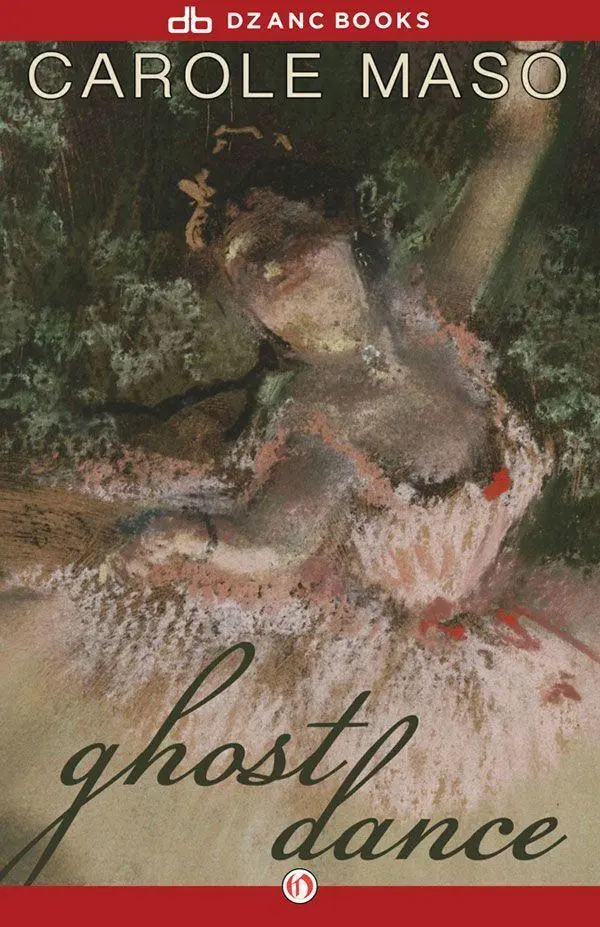
- Название:Ghost Dance
- Автор:
- Издательство:Dzanc Books
- Жанр:
- Год:2013
- ISBN:9781480441897
- Рейтинг книги:5 / 5. Голосов: 1
-
Избранное:Добавить в избранное
- Отзывы:
-
Ваша оценка:
Ghost Dance: краткое содержание, описание и аннотация
Предлагаем к чтению аннотацию, описание, краткое содержание или предисловие (зависит от того, что написал сам автор книги «Ghost Dance»). Если вы не нашли необходимую информацию о книге — напишите в комментариях, мы постараемся отыскать её.
has to offer. Like her artist-protagonists, Maso's subject as well as medium is language, and she is brave and dangerous in her command of it. She abandons traditional narrative forms in favor of a shaped communication resembling Beckett and rivalling his evocative skill. Immersed in dilated and intense prose, the readers view is a privilege one, riding the crest of clear expression as it navigates the tangled terrain of loss and desperate sorrow.
Ghost Dance — читать онлайн бесплатно полную книгу (весь текст) целиком
Ниже представлен текст книги, разбитый по страницам. Система сохранения места последней прочитанной страницы, позволяет с удобством читать онлайн бесплатно книгу «Ghost Dance», без необходимости каждый раз заново искать на чём Вы остановились. Поставьте закладку, и сможете в любой момент перейти на страницу, на которой закончили чтение.
Интервал:
Закладка:
“Perhaps I should leave you alone,” I said. “I feel like an intruder. I should leave you.”
“No,” she said, getting up slowly — although to her it must have seemed quickly—“please. Don’t leave.” In her voice I recognized my own, many years ago, begging my mother not to leave my darkened room. “Please, don’t go,” she said.
“Love will make you drink and gamble,” she sang, taking a large bag of cocaine from her jacket, “love will make you stay out all night long. Love will make you drink and gamble; love will make you stay out all night long.” She was struggling to hold onto the melody. “Love will make you do things that you know are wrong.” She smiled.
“From Venezuela,” she said, holding the plastic bag in front of my eyes. “I live there.”
In a minute’s time Marta was back on that South American coastline. She had slipped out of her clothes. The sun beat on her body. She began to sweat. She took a deep breath and her lungs filled with the salt of the ocean. She swayed slightly as she spoke. Small salamanders darted along the sill. “Venezuela,” she said, holding the words of home in her mouth a long time. “If it got too hot on the beach I could always move to the cool, blue ceramic tiles of the beach house. I loved that house. There was such peace there, such quiet. And eating fruit there,” she said and licked her lips, “is like tasting it for the first time.” I looked at her pink, tropical mouth.
“Mangoes,” she sighed, “papaya.” She was covering a mirror with long lines of cocaine. “Guava,” she said. “There’s nothing like it.
“But I was never really happy there,” she said, snorting up the white powder. “Come on, don’t be shy.” She waited for me to inhale it. “Only my mother is Venezuelan. My father is American. He went down there at your age, just a boy dreaming of making a fortune in pearls, and sitting in the sun. But he never stopped talking about America. And it sounded so good when he talked about it.” She inhaled again.
“I used to dream about coming to the States, where I could buy the Beatles albums as soon as they came out.” She laughed. “You know, I thought I’d get to see the baseball players on the street. What a jerk I was.
“Please excuse all this,” she said, disgusted with herself. She knocked over the glass of Scotch and we watched it soak into the mattress. “But w hen I finally did get here and met Natalie, all I wanted to do was to go to Europe. Natalie had lived in Lurope. Her father was a diplomat. She was very jet set. She said it was the only place to live.”
Marta sighed. The cocaine had made her energetic, but thinking about her life made her weary. She snorted more off the floor.
“To make a short story shorter, the gringo left us for diamonds in Africa. He always promised to send for me. I learned everything there was to know about the place. Fauna, flowers, exports, climate, gross national product. What would you like to know?”
“Did you ever get there?”
She laughed. “What do you think?”
“Where is he now?”
She shrugged, “Who knows? I’ve spent my whole life wanting to be somewhere I wasn’t. It’s really quite a pathetic story. Now all I want to do is die and, look, still I am alive. Though,” she added, “there are some rather uncharitable people at this school who would like to dispute it. I swear I’m not high anymore,” Marta said. “Let’s do just a little more, OK?”
She dumped the whole bag out on the floor and then got up and went into the closet where I could hear her dialing the phone and ordering another bottle of Scotch.
“They deliver,” she said from inside the closet. “They’re very accommodating.”
When she returned she held something wrapped in a white cloth. Slowly she unwrapped it. It was a hypodermic needle. “Cocaine,” she whispered, “was not meant to be snorted. Believe me. I know.”
Who had once lain in the cavity under Marta’s arm? Her body draped in black looked so strong. Her dark arms were smooth, muscular. They looked like the arms of an athlete, a bearer of torches, a person no one could hurt. Who could reduce her to this? She had tried her hardest, she had done her best, only now to have Natalie — that was the word she was saying softly to herself over and over: Natalie, Natalie, Natalie.…
In her voice I could hear the bones of their embrace being broken apart and strewn about the room. They were everywhere — bones in the closet, bones piled up against the door.
“Make a fist,” she said. She tied my arm with a rubber tube.
I shivered. Marta put the needle in my arm. The room turned blue.
“Once it goes in,” she said quietly, “it never really comes out.”
I imagined Jennifer who, having closed her eyes for a moment, now opened them and added more hot water to the tub.
Blood stained the window shades. Long strands of hair slept in the bed. The bones piled higher and higher.
“Marta,” I said, shaking her, “I’m scared.”
“Don’t cry.”
“I’m afraid.”
“Don’t be afraid.”
“I think I should go now,” I said, moving to the door. My legs swayed under me.
“You’re my thrill,” Billie Holiday sang, “you do something to me. You send chills right through me.” My hand slipped from the doorknob. I turned to Marta.
“Come here,” she said.
“Don’t cry. Please don’t cry. I can’t stand to see girls cry,” she said. If she had looked in her own mirror, it would have broken her heart.
“I’m scared,” I said, collapsing to the floor. “I’m afraid.”
“What do you have to be afraid of?” she said, but then looked away, caught in the sorrow that would not let her go. “Why? Why did she have to die? Why?” she said over and over, but the more she said the word, the more senseless it became — just a sound and no way in.
She surrendered to the question and it drove her to the ground. “Why?” she asked, bringing me down with her, shaking me, staring into the wideness of my eyes as if the body when challenged would reveal its ancient, mortal secret. “Why?” she said, pressing hard for an answer.
I was afraid of her but I extended my arm anyway and touched her lightly on the shoulder. She shuddered.
I did not know why.
And great tears fell from her eyes. All was silent, dark. Finally, after many hours, she stood up.
“Would you like to dance?” she whispers.
“What?” I say.
“Would you like to dance?” she asks again politely, lowering her eyes, bowing slightly, and offering me her hand.
“The orchestra,” she says, “is so lovely. Listen.” She strains to hear the opening notes — the oboe, the French horn. “And your dress is exquisite.”
“Yes, oh, yes,” I say. “The ballroom is gigantic!”
“And the chandelier,” she says, pointing to the ceiling.
“Where are we, Marta?” I gasp.
“It’s Vienna. It’s Bavaria. It’s Port-au-Prince, Haiti,” she says. I had not heard such tenderness in a human voice before.
And for a minute I almost believe it: Somewhere we are dressed in linens and silks. Somewhere our hair is piled ludicrously on the tops of our heads and the dance steps have all been planned hundreds of years in advance for us. Somewhere we are safe in a box step, in the reliable timing of the waltz. Somewhere we are out of danger.
“It’s Mvkonos,” she whispers. “It’s Nice.” Her eves are closed; when she opens them, she is far away.
“Natalie?” she sighs. “Is that you?” She leans heavily on me. It is a terrible weight; it is the weight of the whole world. “It‘s Mvkonos. It’s Nice.”
We could barely pick up our feet. “Marta,” I say.
“It’s Nice,” she answers.
Читать дальшеИнтервал:
Закладка:
Похожие книги на «Ghost Dance»
Представляем Вашему вниманию похожие книги на «Ghost Dance» списком для выбора. Мы отобрали схожую по названию и смыслу литературу в надежде предоставить читателям больше вариантов отыскать новые, интересные, ещё непрочитанные произведения.





Обсуждение, отзывы о книге «Ghost Dance» и просто собственные мнения читателей. Оставьте ваши комментарии, напишите, что Вы думаете о произведении, его смысле или главных героях. Укажите что конкретно понравилось, а что нет, и почему Вы так считаете.