Carole Maso - Ghost Dance
Здесь есть возможность читать онлайн «Carole Maso - Ghost Dance» весь текст электронной книги совершенно бесплатно (целиком полную версию без сокращений). В некоторых случаях можно слушать аудио, скачать через торрент в формате fb2 и присутствует краткое содержание. Год выпуска: 2013, ISBN: 2013, Издательство: Dzanc Books, Жанр: Современная проза, на английском языке. Описание произведения, (предисловие) а так же отзывы посетителей доступны на портале библиотеки ЛибКат.
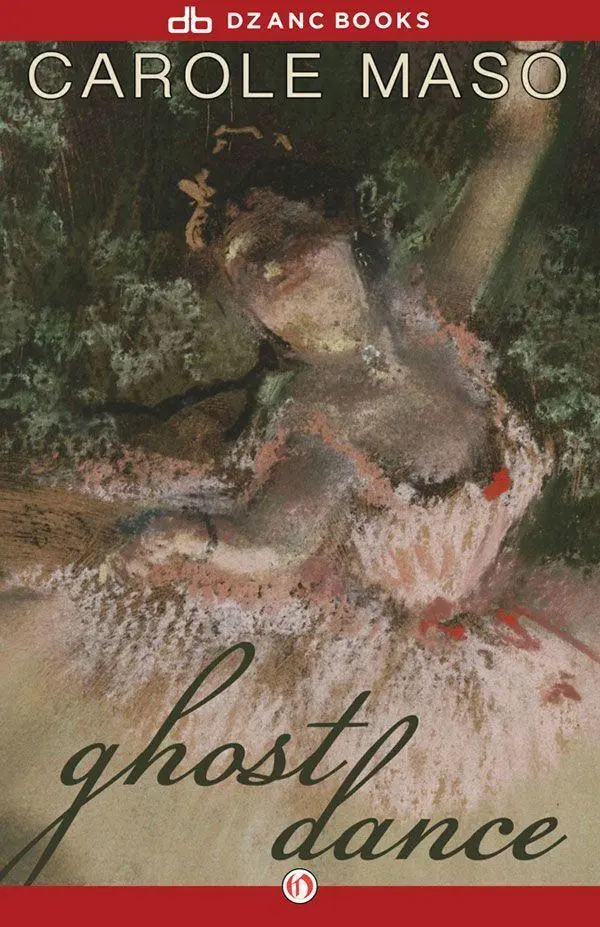
- Название:Ghost Dance
- Автор:
- Издательство:Dzanc Books
- Жанр:
- Год:2013
- ISBN:9781480441897
- Рейтинг книги:5 / 5. Голосов: 1
-
Избранное:Добавить в избранное
- Отзывы:
-
Ваша оценка:
Ghost Dance: краткое содержание, описание и аннотация
Предлагаем к чтению аннотацию, описание, краткое содержание или предисловие (зависит от того, что написал сам автор книги «Ghost Dance»). Если вы не нашли необходимую информацию о книге — напишите в комментариях, мы постараемся отыскать её.
has to offer. Like her artist-protagonists, Maso's subject as well as medium is language, and she is brave and dangerous in her command of it. She abandons traditional narrative forms in favor of a shaped communication resembling Beckett and rivalling his evocative skill. Immersed in dilated and intense prose, the readers view is a privilege one, riding the crest of clear expression as it navigates the tangled terrain of loss and desperate sorrow.
Ghost Dance — читать онлайн бесплатно полную книгу (весь текст) целиком
Ниже представлен текст книги, разбитый по страницам. Система сохранения места последней прочитанной страницы, позволяет с удобством читать онлайн бесплатно книгу «Ghost Dance», без необходимости каждый раз заново искать на чём Вы остановились. Поставьте закладку, и сможете в любой момент перейти на страницу, на которой закончили чтение.
Интервал:
Закладка:
Natalie sighed. She sighed with delight at the eggs Benedict, the smoked trout, the champagne, the fresh flowers everywhere. “I wish this morning could last forever,” she said, dipping her finger into the runny yolk of the egg. Marta smiled and ran her rough hand up Natalie’s impossibly smooth back, just two years ago Marta had come to college never having been loved, not by her parents, not by anyone, and now there was this — this strange, unpredictable love, but it was love nonetheless.
Natalie turned toward Marta, and Marta ‘s hand slipped from her back. Natalie’s eyes were cold and blue, her face like sculpted alabaster.
“Light me a cigarette,” Natalie said sweetly, “will you?” Her face should have softened, but it did not.
“Of course,” Marta said, reaching for the Gaulois. Smoke only Gaulois in New York, Natalie had insisted, smoke only Marlboros in Paris. Marta lit a cigarette from the blue-winged package, held it in her mouth for a moment, inhaled deeply, and then passed it to Natalie. The bed seemed like a large boat, and they floated on it for a long time, just smoking. The chandelier glittered in the morning light. The pale pink walls seemed to sparkle.
“It reminds me of Italian candy,” Natalie said, running her hand down the glossy wall.
Natalie got up for more champagne and looked out onto New York, the city she loved. It glittered like diamonds in the morning light.
“It will be mine,” she said.
Marta came up from behind holding a pink present with white satin ribbons.
“Don’t touch me,” Natalie commanded, not turning around.
“Natalie,” Marta said.
“What do you want?” Natalie asked, turning abruptly. “What is it now?” Marta held out the present.
“For me?” she said.
“Happy birthday,” Marta said, closing her eyes.
“I wish this day could last forever. Forever,” Natalie said, and her voice dropped with a chilling finality.
“Happy birthday,” Marta said. “Go on, open it.”
She would have it all, she thought to herself. Marta poured more champagne. She watched the tiny bubbles rise in her glass. Just looking at them
made her dizzy with excitement.
“It’s beautiful,” Natalie said, holding the shining robe up to her. “It’s so beautiful.”
“I want this day to last forever,” Natalie had sighed, and for Marta in some ways it would — this happiness flung in her face, long after the happy times with Natalie had ended for good. She was not someone who could keep the past separate from the present. They existed simultaneously, always. If she could have dislodged it from her brain, this day, she probably would not have, despite the pain it would cause her as she sat in her room and told me the story. Every detail caused her pain. But it was a perfect memory, and for that she was grateful still.
“You’re the most beautiful woman in the world,” Marta said to Natalie, who had put on her new robe.
“How beautiful?” she demanded, rubbing up against her, intoxicated at the thought.
“More beautiful than Dominique Sanda?” she asked.
“Yes,” Marta said.
“More beautiful than Jeanne Moreau?”
“Oh, yes,” Marta whispered.
“More beautiful than Brigitte Bardot?”
“Mais oui,” Marta smiled.
“Mais oui,” Natalie laughed. “More beautiful than Marilyn Monroe?”
“Yes,” Marta said, holding her tightly, “even more beautiful than Marilvn Monroe.”
Jack looked at me, a champagne glass in the Plaza Hotel being lifted to the lips of Marta, of Natalie. He took me in his enormous hands, ran his fingers up the stem, and cradled the fragile bowl in his palm, then pressed hard, crushing the illusion to bits.
“I need you here,” he said, “now.”
“I need you, too,” I said.
“I know,” he said.
I was on the verge of tears. Whom were these tears for? Jack alone now linked me to the world, to moments in time measured by the hands of the clock. I pictured the two hands meeting like lovers at twelve and felt calmer. “I need you here,” I said. “I need you now.”
The first time I saw Jennifer Stafford, it was not in that dark, heart like chamber but in bright light, surrounded by women in the College Center. How easily the walls of her room had given in, changed size and shape in order to accommodate the contours of Marta ‘s grief. Jennifer’s own arms I assumed would be as yielding, but that was not the impression I got as I watched her putting papers into piles in preparation for the meeting. Even the simplest act performed by Jennifer commanded great attention. She did everything with such authority.
She did not look as I had imagined. I thought she would be plainer; I thought she would be more straightforward, less mysterious, but she was filled with darkness and a primitive allure, not modern in the least, though the modern world was her domain. Her hair was like the mane of a lion; her brown eyes were animal eyes; her voice was low and, since it was outside the tonal range of most voices, it distinguished itself, separated itself from others, and you could hear it though she spoke softly. She seemed distant, although she was introducing herself and welcoming the women who had gathered. She was speaking of the Women’s Center. Four years ago she had rescued it single-handedly from obscurity. She alone had made it work, shaping it into a viable union. Now, this being her last year, she wanted to make sure it would continue without her. She was tired, it had all exhausted her, and she had her thesis to do now. She would have to start giving the Women’s Center up, letting go. She sighed, surveying the crowd. No one immediately jumped out at her as a choice for a successor.
Though I was still there, sitting near her, I knew some part of me was already asleep dreaming of that wonderful light brown hair, that mane of a lion, following her wherever she asked me to go. To see Jennifer was to raise a hand and pledge allegiance to what she wanted.
I walked up to her after the meeting, my hand already raised. Whatever she wanted I had already agreed to it. I said nothing.
“You must be Christine Wing’s daughter,” she said, staring at me as she put papers into a folder.
I nodded, taking a step back. Hearing her speak directly to me and say my mother’s name made me shudder with cold suddenly.
“I’d like to talk with you sometime.”
Yes, I nodded.
“I’ve got her old room, you know,” she said. “I’m a great admirer of hers.”
I stared at her, wondering what she wanted of me.
“That’s all,” she said, motioning with her head as if to dismiss me. “Thank you.”
With her voice alone she forced the season prematurely into winter.
I could not have known that my first meeting with Jennifer would be the only time we would ever speak. As simply and as strangely as she had entered my life, she would exit from it. And the place that seemed to promise so much would become off-limits to me as she grew more and more solitary, lost in the lives of the Stafford women in the room that had been my mother’s.
So it was my mother who had brought me here, I thought. Because I was her daughter I was privy to a sad underworld that otherwise I would probably have never come across. It had been the reason for the small note, the reason for everything. My mother through Jennifer had brought me here — to Marta, to this sorrow. She had united us at this wailing wall, this place of the lacerated skin, the shorn hair. She had brought me here, as if she herself had taken me by the hand. She had brought me here to this universe of grief, though I did not know why yet.
It had not occurred to her while they were together that the lovely, branching line that looked like a delicate sprig of wheat was actually the life line and that it separated early, somewhere near the base of the thumb.
Читать дальшеИнтервал:
Закладка:
Похожие книги на «Ghost Dance»
Представляем Вашему вниманию похожие книги на «Ghost Dance» списком для выбора. Мы отобрали схожую по названию и смыслу литературу в надежде предоставить читателям больше вариантов отыскать новые, интересные, ещё непрочитанные произведения.






Обсуждение, отзывы о книге «Ghost Dance» и просто собственные мнения читателей. Оставьте ваши комментарии, напишите, что Вы думаете о произведении, его смысле или главных героях. Укажите что конкретно понравилось, а что нет, и почему Вы так считаете.