Carole Maso - Ghost Dance
Здесь есть возможность читать онлайн «Carole Maso - Ghost Dance» весь текст электронной книги совершенно бесплатно (целиком полную версию без сокращений). В некоторых случаях можно слушать аудио, скачать через торрент в формате fb2 и присутствует краткое содержание. Год выпуска: 2013, ISBN: 2013, Издательство: Dzanc Books, Жанр: Современная проза, на английском языке. Описание произведения, (предисловие) а так же отзывы посетителей доступны на портале библиотеки ЛибКат.
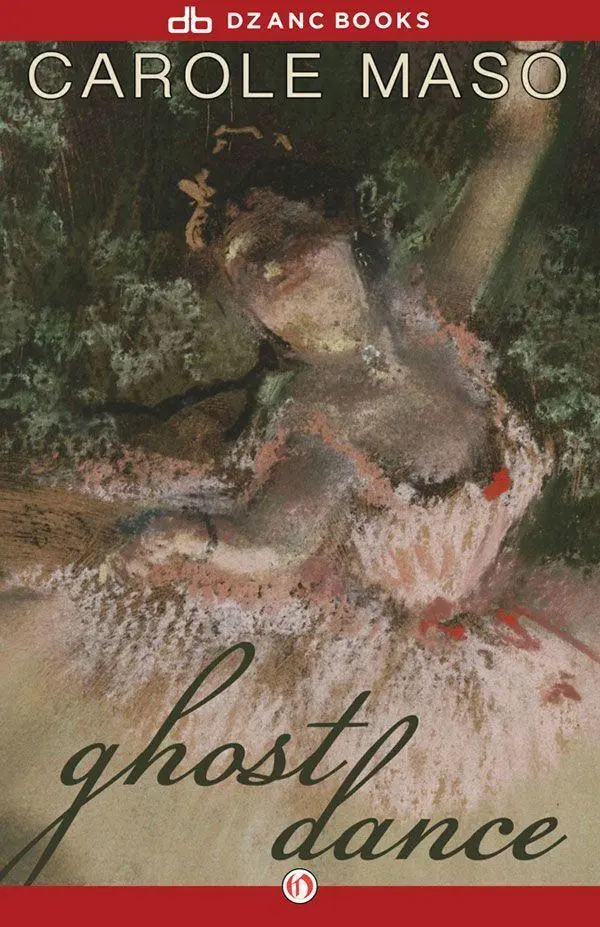
- Название:Ghost Dance
- Автор:
- Издательство:Dzanc Books
- Жанр:
- Год:2013
- ISBN:9781480441897
- Рейтинг книги:5 / 5. Голосов: 1
-
Избранное:Добавить в избранное
- Отзывы:
-
Ваша оценка:
Ghost Dance: краткое содержание, описание и аннотация
Предлагаем к чтению аннотацию, описание, краткое содержание или предисловие (зависит от того, что написал сам автор книги «Ghost Dance»). Если вы не нашли необходимую информацию о книге — напишите в комментариях, мы постараемся отыскать её.
has to offer. Like her artist-protagonists, Maso's subject as well as medium is language, and she is brave and dangerous in her command of it. She abandons traditional narrative forms in favor of a shaped communication resembling Beckett and rivalling his evocative skill. Immersed in dilated and intense prose, the readers view is a privilege one, riding the crest of clear expression as it navigates the tangled terrain of loss and desperate sorrow.
Ghost Dance — читать онлайн бесплатно полную книгу (весь текст) целиком
Ниже представлен текст книги, разбитый по страницам. Система сохранения места последней прочитанной страницы, позволяет с удобством читать онлайн бесплатно книгу «Ghost Dance», без необходимости каждый раз заново искать на чём Вы остановились. Поставьте закладку, и сможете в любой момент перейти на страницу, на которой закончили чтение.
Интервал:
Закладка:
Plants pushed through the cracked earth. Fish twirled in the air, their scales reflected light in every direction. Thousands of ants moved together like black shadows across the yard.
But none of this seemed to bother her. “Dinner,” she’d call from the kitchen window. “Dinner,” she’d say, ringing a large bell, wiping her hands on her apron. I loved you best in spring, Grandma, if I ever loved you.
In the dreams of my grandmother the barn looks enormous — a red cutout against the stark sky. The sky itself is almost white but not quite; there’s a hint of gray, a touch of blue there. Somewhere in the cloudless, birdless sky, my grandfather lies — somewhere I can’t see, he’s lost in gray-blue.
“How much longer?” I ask the sky. I feel myself to be an ancient instrument upon which someone’s fingers play slow, sad music, hesitantly, careful not to touch the wrong note. It’s something eerie and difficult, something I’ve never heard before, and yet I feel a part of it. The music continues as I look out the back window and see the hay he stacked in huge piles before he died, still there, about to ignite. There’s a message among those brittle bales. I study them from every angle. The notes fade. Or perhaps he forgot to leave one as he moved closer and closer to the place where messages no longer count. Does a twelve-year-old girl make any difference at all to him now? Maybe in the overall pattern there’s a larger truth, a design I can’t yet see. He tells me something — the best way to reach him or how to live a better life. Some days I think I hear his voice coming from the center of the stacks, the voice I’ve kept vivid and perfect in my mind. It’s softer than in life, muffled, but distinctly his. “Why do you make your grandmother walk so far?” it asks.
“Why don’t we just sit for a minute, Grandma? Why don’t we just rest?” I place my hands on the tops of her shoulders, wanting to push her down. Already I am as tall as she. She sits for a minute to tie her shoe. Her bones are brittle. She could break so easily under my hands.
“I can’t, Vanessa. My feet won’t do it.” She rises. Quickly, I lift my hands up.
“Thank God I’m able,” she says, as we begin the walk to the cemetery on the other side of town. I suppose she believed that soon enough her shoes would fill with dirt for billions and billions of years, too heavy to lift.
Grandma would have buried him on the farm. Wheat would have sprung between his bones. The lacy leaves of tomatoes would have formed a crown for his head. Fruit would have grown in his mouth. His fingers would have fed the flowers.
It was my father who objected when my grandmother suggested a plot of land left of the silo in the north pasture behind the barn.
“I will not,” his pale hands looked like two smooth fish, “I will not eat my own father’s flesh.” He stared at his mother, the stare of the orphan, the stare of the terrified child left totally alone in the world — the stare that much later would become the permanent face of my father. But now the look changed: the grown man came back; his eyes grew darker; his pupils opened; his mouth seemed to curl in sarcasm or anger. Did he think then, looking at my grandmother in her yellow apron, why was it she — pacing in the kitchen, now lighting the oven and complaining about the price of oil — who continued while his gentle father in the next room could not even get up? As he sat there at the table, his eyes bloodshot and wide, did he wish to trade their deaths? Her hair that had not yet completely grayed seemed an insult, her feet that would not drag. I thought of my own tenuous position in my father’s heart. He looked to me. I thought he wanted to touch me; it seemed his body moved slightly forward in my direction but then pulled back. I think he wanted to be forgiven, for he was sorry he would never be a father like his father, and he didn’t know how to make it up to us. He stood up. His face went blank.
“I will not eat my own father’s flesh.” He turned toward the window. The wheat quivered in the wind. “Bury him somewhere else. The dead grow enormous without our help — so huge you cannot swallow them, you cannot choke them down.”
Already when my father looked out onto the land that his father loved so much he could see him there, his hands folded across his chest in the slopes of the hills. When he walked on the land he thought he heard my grandfather sigh. In the cow’s brown eyes he thought my grandfather watched him. In the wind my grandfather whispered requests my father could not keep.
I remember wandering into the barn one night very late and seeing him, lit by the moon, kneeling in the hay. Was I just sleepwalking? Was I only dreaming? I still do not know for sure. His arms were bent to his chest, and he held something gently, carefully, close to his heart. At first I could not see. And then he laid them down in the hay. They were two white eggs. Anyone might have thought my father crazy then. But I understood. He thought they were his own father’s fragile testicles.
My grandmother shook her head the way horses do, trying to cast something off, and peered at my father as if he indeed were some stranger, not her child at all, some madman, some insult.
Although my father could never stand the slaughter of hogs, now he cried. He thought he heard his father wailing in their throats.
“I don’t know where we went wrong with him,” my grandmother sighed one day as we weeded the peas. “I’m afraid there’s not much sense to your father.”
He had perplexed her from the very beginning. She remembered the nine months he lay inside her. “In all that time,” she said, “he never moved, never gave one kick, never turned. Not even I knew whether he would be born dead or alive.” And then there had been, after the final contraction, that awful silence. So it was over, she thought, before it had ever really begun. My father had taken one look at the world through his mother’s blood and decided he did not care to live here. Given one moment, he knew he did not want to take air into his lungs and breathe. But the young doctor, bent on preserving life no matter how reluctant his subject, saw this right away and spanked my father repeatedly until finally he gave a small yelp, then a cry of protest, and then a long full-bodied scream.
After his tentative start my father was a quiet, brainy child. He could spend day after day working on a single problem of mathematics or lose himself in a dream of fission. He could entertain himself for weeks with the details of the big bang theory or the concept of black holes. By age ten he had mastered geometry; by twelve, algebra; by fourteen, advanced calculus. He grew bored with it after that, though, and did no more — no algorithms, no studies of number theories. Mostly, he listened to music alone in his room in the farmhouse attic: Poulenc, Mahler, Rachmaninoff, Stravinsky. “Music saved my life,” he confessed to me on one of the rare occasions he allowed himself to reminisce.
“He could have been a pioneer in genetics,” my grandmother said.
“No, Grandma,” I said, giggling at the thought of my father in pioneer clothes, sporting a rifle or a bear trap.
“He could have worked in aerospace. He could have found the cure for something.”
The dream of my father’s greatness was the only dream my pragmatic grandmother had ever cared to keep. After all these years, it still shone in her eyes like a light, but it served no purpose except to make the reality of my father’s life almost unbearable to her. She had wanted to be intimately related to greatness and not just a mother-in-law to it.
“He could have been a chemical engineer,” my grandmother whispered, “had she not been so beautiful.”
“I don’t think so, Grandma.”
Читать дальшеИнтервал:
Закладка:
Похожие книги на «Ghost Dance»
Представляем Вашему вниманию похожие книги на «Ghost Dance» списком для выбора. Мы отобрали схожую по названию и смыслу литературу в надежде предоставить читателям больше вариантов отыскать новые, интересные, ещё непрочитанные произведения.





Обсуждение, отзывы о книге «Ghost Dance» и просто собственные мнения читателей. Оставьте ваши комментарии, напишите, что Вы думаете о произведении, его смысле или главных героях. Укажите что конкретно понравилось, а что нет, и почему Вы так считаете.