Howard Jacobson - Kalooki Nights
Здесь есть возможность читать онлайн «Howard Jacobson - Kalooki Nights» весь текст электронной книги совершенно бесплатно (целиком полную версию без сокращений). В некоторых случаях можно слушать аудио, скачать через торрент в формате fb2 и присутствует краткое содержание. Год выпуска: 2007, Издательство: Simon & Schuster, Жанр: Современная проза, на английском языке. Описание произведения, (предисловие) а так же отзывы посетителей доступны на портале библиотеки ЛибКат.
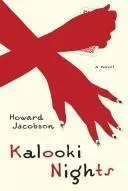
- Название:Kalooki Nights
- Автор:
- Издательство:Simon & Schuster
- Жанр:
- Год:2007
- ISBN:нет данных
- Рейтинг книги:5 / 5. Голосов: 1
-
Избранное:Добавить в избранное
- Отзывы:
-
Ваша оценка:
Kalooki Nights: краткое содержание, описание и аннотация
Предлагаем к чтению аннотацию, описание, краткое содержание или предисловие (зависит от того, что написал сам автор книги «Kalooki Nights»). Если вы не нашли необходимую информацию о книге — напишите в комментариях, мы постараемся отыскать её.
Spanning the decades between World War II and the present day, acclaimed author Howard Jacobson seamlessly weaves together a breath-takingly complex narrative of love, tragedy, redemption, and above all, remarkable humor. Deeply empathetic and audaciously funny, "Kalooki Nights" is a luminous story torn violently between the hope of restoring and rebuilding Jewish life, and the painful burden of memory and loss.
Kalooki Nights — читать онлайн бесплатно полную книгу (весь текст) целиком
Ниже представлен текст книги, разбитый по страницам. Система сохранения места последней прочитанной страницы, позволяет с удобством читать онлайн бесплатно книгу «Kalooki Nights», без необходимости каждый раз заново искать на чём Вы остановились. Поставьте закладку, и сможете в любой момент перейти на страницу, на которой закончили чтение.
Интервал:
Закладка:
‘Mr Nasser Azam,’ he said, ‘my friend M-max.’
Mr Azam rose to shake my hand, inclining his head slightly. I did the same. He would have introduced his children, but Manny got in first. ‘This is Tamoor — am I pronouncing it right? — and this is Zahra. Tamoor and Zahra Azam. This is my friend Max.’
Great names, I wanted to remark. Tamoor and Zahra, great names for a comic-book hero and heroine from another galaxy. The other thing I wanted to remark was how beautiful they were, eyes like the fishpools in Heshbon, their heads like Carmel and the hair on their heads like purple, and indeed how exquisitely they smelled — frankincense, myrrh, calamus and cinnamon, like the gardens of Lebanon — but one ethnic minority cannot marvel over the exoticism of another without offence.
‘We have been comparing notes,’ Mr Azam told me. He too was succulently beautiful, his hands — always the first thing I look at — a lustrous, ochreous brown, the fingers extraordinary in that they appeared to be flat-sided, faceted even, the crescents of his nails as thrilling in their perfected nakedness as Ilse Cohen’s used to be.
‘Notes? On the museum?’ I feigned alarm. ‘Has Manny told you that he and I have been disagreeing about the gods of ancient Egypt?’
He shook his head, laughing. ‘Well, we,’ he said, ‘have been comparing our views of Abraham.’
‘Amicably, I hope.’ Which was an asinine thing to say, but then I wasn’t versed in the etiquette of Abrahamic discussion Jew to Muslim in plein-air Bloomsbury.
He bowed. Of course amicably.
‘Presumably Zahra,’ I said, ‘is a variation of Sarah, Abraham’s wife.’
Again he inclined his head to me. If I were wrong, if Sarah and Zahra were polar opposites, he certainly wasn’t going to tell me.
My head was spinning. Where had Manny found the savoir faire to strike up conversation with the Azams? I had only been away ten minutes. How come he had hit it off so well with them, utter strangers, in that time? And how come he had dared venture, so soon, into the minefield of Torah and Koran? Was it chutzpah, or stupidity? Had all those years of being locked away dulled him to the sensitivities of Jews and Muslims in the matter of one another’s mutually confuting faiths?
I was also strangely touched that he had introduced me as his friend. ‘Friend’ had not been in the air between us much. It was on the basis of our friendship that we were doing whatever it was we were doing — making notes towards a film of Manny’s ruined life, were we really embarked on that? — but the word itself had not previously been used, at least not by him, and it made a difference. I was no less touched by Manny’s engrossment in the children. As I stood there, not quite knowing what to say to their father, Manny examined Tamoor’s and Zahra’s toys, laughed at a snowstorm on the pyramids, helped them with a metal puzzle which had baffled the holy priests of Mesopotamia. They were huddled about him, attentive, like acolytes around a senior boffin, apparently oblivious to his oddities. It seemed to me, too, from the way he bent over them — though this was only a surmise, a cartoonist’s reading of the body’s longings — that he wanted to touch them, that he would have liked to gather them to him so he could breathe in the incense of their hair, but knew he couldn’t.
They gave him their email addresses when we parted. God knows what he intended to do with those. He watched them go, dark into the great white city, waving longer than I thought was necessary.
Over a minestrone and bruschetta lunch, his eyes suddenly filled with tears. He wiped them with his serviette, but there was no staunching the flow. I grew embarrassed. There were people at adjoining tables watching, wondering what I’d done to him.
At last he said, ‘They didn’t remind you of anybody?’
‘Tamoor and Zahra?’ I thought about it. And then I realised that yes, yes they did.
Asher.
4
Sometime in my first or second term at art school I received an invitation to dinner on Oriana notepaper, disappointingly postmarked Manchester, not Surabaya or Trincomalee. Chloë, whom I’d just met — though I couldn’t be certain she’d met me — would have warmed to a candlelit spread in Surabaya. ‘I like exceptional men,’ I had heard her telling a group of her friends in the refectory, and what could have been more exceptional in 1963 than a man who took his girlfriend to dinner in the South China Sea. The sender of the invitation was Shani’s Mick — Mick Kalooki, as we’d taken to calling him after Shani’s joke — and the venue to which he was inviting me was any restaurant of my choice, with a good bottle of wine thrown in. A PS requested that I make no mention of the invitation to Shani.
I wasn’t sure how I felt about this. After mulling it over for a few hours I decided that the invitation couldn’t possibly bode ill to Shani, not given its bon vivant spirit (by 1963 standards), and not unless the man was a bounder, which he wasn’t. More likely it presaged a desire to get to know the family better, either with a view to making Shani an offer she couldn’t refuse, or as a preliminary to moving in with us — or with them rather, as I had already moved out — so that he could be at the kalooki table before anybody else. Fine by me so long as it was fine by Shani and my mother. Mick was a nearly permanent fixture already. He had left his seafaring the year before, folded away his purser’s uniform to the disappointment of every woman over fifty in Crumpsall Park, and opened up a barber’s shop right next to Radiven’s, the delicatessen he rated above all others in the world, and he was a man who could be said to know the world. Whether he could be said to know barbering was another matter, but he had barbered a bit at sea before becoming a purser, and though seamen were less fussy about their hair than dry-land Jews, barbering was, by his own admission, the nearest thing he had to a civilian profession. Eventually this would cause friction with Errol Tobias’s mother who did a little moonlighting with men’s hair when women’s business in her salon was slow, but in the beginning Mick’s transition from sailor to hairdresser, as from bird of passage to fixed star in Shani’s affections, was smooth. He snuggled up a bit close for my taste — he could make you feel there was more of him inside your skin than there was of you — but I liked him well enough at a distance of two hundred miles. My fear, on getting the invitation, was that he meant to snuggle up even closer. But for what reason, since he was already a combination of brother, son, husband and lapdog to all of us except Tsedraiter Ike, who had detested him at first sight and never wavered, I couldn’t imagine.
We met in a Jewish restaurant in Whitechapel, ate saveloys with boiled potatoes and drank a wine of no known varietal type. The restaurant wasn’t my choice. I’d suggested a nice little Italian I knew in Soho, next door to a strip joint on one side and a clip joint on the other — now I come to think of it, probably an earlier incarnation of the very place where Francine Bryson-Smith would lunch me into Jewing up the tragedy of Manny Stroganoff — but Mick didn’t think Soho was suitable given that he was my sister’s boyfriend. And besides, he wanted to eat kosher.
I quickly discovered he wanted to talk kosher too.
‘So what’s a nish?’ he asked me.
‘A nish? I don’t know of any nish.’
He pointed to the word in the menu.
‘Oh, k’nish! The k isn’t silent. In fact it’s noisy. You rock on it — k’nish.’
‘K’nish.’ He practised it, pushing his face forward. ‘K’nish. K’nish.’
‘That’s good,’ I said. ‘And it means dumpling.’ I didn’t tell him, for the same reason that he didn’t want to meet me in Soho, that a k’nish was also a vagina.
Читать дальшеИнтервал:
Закладка:
Похожие книги на «Kalooki Nights»
Представляем Вашему вниманию похожие книги на «Kalooki Nights» списком для выбора. Мы отобрали схожую по названию и смыслу литературу в надежде предоставить читателям больше вариантов отыскать новые, интересные, ещё непрочитанные произведения.







Обсуждение, отзывы о книге «Kalooki Nights» и просто собственные мнения читателей. Оставьте ваши комментарии, напишите, что Вы думаете о произведении, его смысле или главных героях. Укажите что конкретно понравилось, а что нет, и почему Вы так считаете.