Nasser Amjad - Land of No Rain
Здесь есть возможность читать онлайн «Nasser Amjad - Land of No Rain» весь текст электронной книги совершенно бесплатно (целиком полную версию без сокращений). В некоторых случаях можно слушать аудио, скачать через торрент в формате fb2 и присутствует краткое содержание. Год выпуска: 2014, Издательство: Bloomsbury Qatar Foundation Publishing, Жанр: Современная проза, на английском языке. Описание произведения, (предисловие) а так же отзывы посетителей доступны на портале библиотеки ЛибКат.
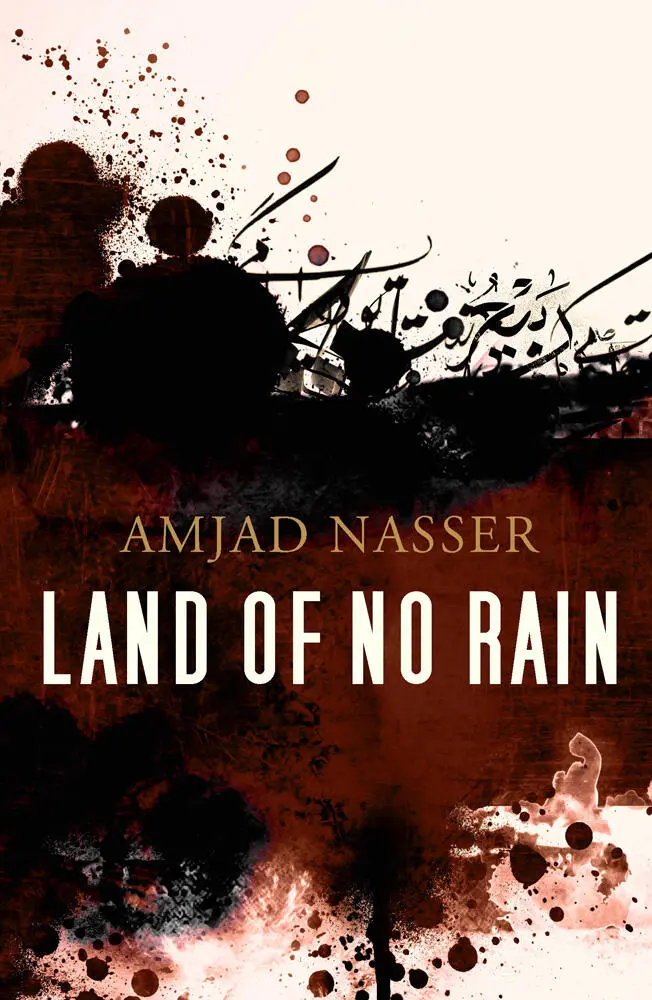
- Название:Land of No Rain
- Автор:
- Издательство:Bloomsbury Qatar Foundation Publishing
- Жанр:
- Год:2014
- ISBN:нет данных
- Рейтинг книги:4 / 5. Голосов: 1
-
Избранное:Добавить в избранное
- Отзывы:
-
Ваша оценка:
Land of No Rain: краткое содержание, описание и аннотация
Предлагаем к чтению аннотацию, описание, краткое содержание или предисловие (зависит от того, что написал сам автор книги «Land of No Rain»). Если вы не нашли необходимую информацию о книге — напишите в комментариях, мы постараемся отыскать её.
Land of No Rain — читать онлайн бесплатно полную книгу (весь текст) целиком
Ниже представлен текст книги, разбитый по страницам. Система сохранения места последней прочитанной страницы, позволяет с удобством читать онлайн бесплатно книгу «Land of No Rain», без необходимости каждый раз заново искать на чём Вы остановились. Поставьте закладку, и сможете в любой момент перейти на страницу, на которой закончили чтение.
Интервал:
Закладка:
‘That doesn’t prove you’re Younis al-Khattat,’ he said. ‘There’s a writer called Ayham Jaber, or Adham Jaber, who claimed in an article in a local newspaper that he was the one who did that. The newspapers aren’t very careful these days about verifying what they publish, not since they laid off the censors who used to check articles and news reports for accuracy before publication. So that’s no proof either, because the story was published, in a distorted form, and lots of people read it.’
‘What about the watch?’
‘Which watch?’
‘The watch you had to wind up.’
You lifted your left arm and showed him the watch, which was ticking with the regular beat of a young heart. He looked at you for a while, then said, ‘It’s true I gave my watch to Younis al-Khattat, and the man called Ayham, or Adham, wrote a story about it in the same paper. But then in the old days all the watches were manual.’
‘If the fact that I knew your name, and the fact that I knew about the exam papers incident and about the watch, don’t amount to conclusive proof of my identity, then let me remind you of something else. You remember that Younis al-Khattat was severely punished when the Hamiya secret police found him in possession of a book called The State and Revolution , and he was branded with an iron cross on his stomach. That was out of respect for his father because, as you know, the custom was to brand people who committed such acts on the back of their right hand, so that everyone would know what kind of thing they had done.’
With an obstinacy that almost exhausted your patience, he said, ‘But the man called Ayham, or Adham, published that in the same newspaper.’
Without further ado, you found yourself lifting up your sweaty linen shirt and showing him the scar of the cross branded on your rounded belly. Small, sparse hairs, some of them greying, had sprouted around it.
‘Impossible,’ he said.
‘Sometimes reality is like that,’ you said.
Khalaf’s hair was greyer than you expected and his back, after forty years, was stooped more than usual for someone from Hamiya, where people often remain upright well into their sixties. The man now faced two possibilities: either he was dreaming in broad daylight in the heat of summer, or he had to concede that Younis al-Khattat, whom he had not seen much in recent years, was indeed this strange person who did somewhat resemble his old friend.
‘How could you be Younis al-Khattat?’ he said in confusion. ‘You have balding grey hair and a thin moustache. You’re frail, older and more careworn, judging by your face, while Younis al-Khattat, after that incident with the branding and after reading too many poisonous books, contracted a mysterious disease that froze his appearance as he was when he was twenty, with the same interests and powerful emotions. The doctors diagnosed it as a rare ailment they’d never seen before among the inhabitants of Hamiya. Medical delegations visited him to investigate the nature of this disease, which preserved his slender figure, his droopy moustache and his thick black hair.’
‘I’m also called Adham,’ you told your old friend, who used to ignore the books he found in your possession as you went into Hamiya, in spite of the gravity of the offence.
Khalaf no longer understood exactly what was happening. He waved you aside and said, ‘Go away, brother, I don’t have time to waste with you. I want to go back to my nap, which I hold sacred, and I’ll miss it if you carry on with your riddles.’
But you didn’t leave. You coughed more than once. You wiped your lips with the pocket handkerchief you were carrying in your hand and then hid it. Then you tried to explain to him, using all the memories you had to hand and all the evidence you could muster from your memory, that Younis and Adham were two names for the same person, or two names for two people who were once the same person but who then split in two after the book incident and other more serious incidents, because Younis stayed here while Adham went to the city overlooking a tame sea, from where his fates led him to countries overlooking wilder seas. You also told him that the person who used to write modern metrical poetry had lately became a writer of articles and biographies and had had books published in cities Younis never reached. You didn’t expect Khalaf to know Adham, the writer of articles and biographies, except perhaps through extracts of his writings published in a local newspaper — writings he called allegations or fabrications about Hamiya and its characters. As for books, you knew his attitude towards them and you didn’t expect him to have read any of them.
Khalaf began to reel from the existential shock.
He told you he was longer a guard working for the Hamiya government, that the Grandson had died and there was a new commander from the Grandson’s family; not a direct descendant because, although the Grandson had been briefly married to a relative of his, under pressure from his father, they didn’t have any children. (Of course you knew that and more. You knew the rumours about the real purpose of his annual tours of inspection in the countryside and to the troops on the front, which lasted the whole of the spring, and of course you had also heard of the resentment the Commander the father felt in his latter years because of his son’s divorce and failure to produce an heir to preserve the chain of succession in his immediate family.) He said that one of the Grandson’s relatives had been brought back from a military academy abroad before he had finished his studies, to take the Grandson’s place; that the Hamiya he had known no longer existed, or, to be more precise, the contract for a project to develop it had been awarded to a large company that had started the transformation; that he was now an employee on a short-term contract with a new company that was going to lay him off after rebuilding and renovating Hamiya’s infrastructure; that the company was planning to set up modern facilities and malls stocked with all kinds of goods, and was working on turning the houses of the officers, soldiers and civilian employees who had been living in Hamiya for successive generations into contemporary-looking flats; and so on and so on. .
More distraught than he had appeared earlier, Khalaf told you that the authorities no longer banned the books that had given the families sleepless nights and that had led to the development of very thorough monitoring mechanisms in the departments responsible for national security and traditional values; and that those in charge now had a list of banned items that included books and other publications that dealt with such apparently contradictory topics as weaponry and computer programs. Now civil servants fluent in several languages kept themselves busy registering the titles and classifying them into categories, the most dangerous of which were the booklets on thick belts that explode automatically as soon as the temperature of the bodies they pass matches the setting in the electronic chip connected to the explosive charge in the lining of the belt. Now that he was reluctantly convinced that two people with different names and in separate places might be, for some reason that escaped him, the one person Younis al-Khattat, you told Khalaf that books lose their magic when faith in them wanes. They become just pale ink on paper. A book can be poison, or a flower, or a heart that throbs when it stumbles upon someone who believes in it. You also told him he had done well not to fall under the spell of words, which boast, sometimes deceptively, that they are the epitome of life or even life itself, while life, according to a writer who does not care to have his name mentioned, is somewhere else.
After listening at first in confusion and anxiety, Khalaf gradually began to take a genuine interest in what you were saying, reminding you of the days when you used to tell him stories or the plot of a novel that had captivated you. There probably isn’t anyone who isn’t fascinated by stories. They may not read books that tell stories, but for sure no one objects to listening to a story, especially if it comes to them when they’re lonely or bored. So Khalaf thought it well worth listening to the story of the man who, to his misfortune, turned into two people, who were however reunited in flesh and in spirit when they dreamed or when they met face to face on the balcony of their family home.
Читать дальшеИнтервал:
Закладка:
Похожие книги на «Land of No Rain»
Представляем Вашему вниманию похожие книги на «Land of No Rain» списком для выбора. Мы отобрали схожую по названию и смыслу литературу в надежде предоставить читателям больше вариантов отыскать новые, интересные, ещё непрочитанные произведения.




Обсуждение, отзывы о книге «Land of No Rain» и просто собственные мнения читателей. Оставьте ваши комментарии, напишите, что Вы думаете о произведении, его смысле или главных героях. Укажите что конкретно понравилось, а что нет, и почему Вы так считаете.