Nasser Amjad - Land of No Rain
Здесь есть возможность читать онлайн «Nasser Amjad - Land of No Rain» весь текст электронной книги совершенно бесплатно (целиком полную версию без сокращений). В некоторых случаях можно слушать аудио, скачать через торрент в формате fb2 и присутствует краткое содержание. Год выпуска: 2014, Издательство: Bloomsbury Qatar Foundation Publishing, Жанр: Современная проза, на английском языке. Описание произведения, (предисловие) а так же отзывы посетителей доступны на портале библиотеки ЛибКат.
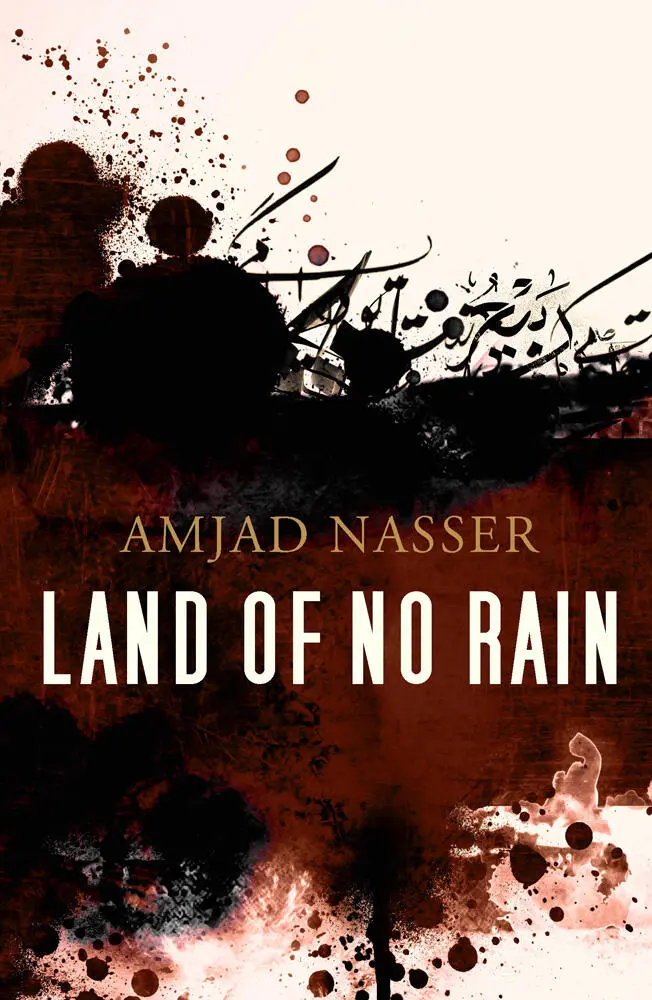
- Название:Land of No Rain
- Автор:
- Издательство:Bloomsbury Qatar Foundation Publishing
- Жанр:
- Год:2014
- ISBN:нет данных
- Рейтинг книги:4 / 5. Голосов: 1
-
Избранное:Добавить в избранное
- Отзывы:
-
Ваша оценка:
Land of No Rain: краткое содержание, описание и аннотация
Предлагаем к чтению аннотацию, описание, краткое содержание или предисловие (зависит от того, что написал сам автор книги «Land of No Rain»). Если вы не нашли необходимую информацию о книге — напишите в комментариях, мы постараемся отыскать её.
Land of No Rain — читать онлайн бесплатно полную книгу (весь текст) целиком
Ниже представлен текст книги, разбитый по страницам. Система сохранения места последней прочитанной страницы, позволяет с удобством читать онлайн бесплатно книгу «Land of No Rain», без необходимости каждый раз заново искать на чём Вы остановились. Поставьте закладку, и сможете в любой момент перейти на страницу, на которой закончили чтение.
Интервал:
Закладка:
Khalaf no longer spent much time checking the identity papers of those going into Hamiya or searching the bags of those coming out. He and his hut were just props from the past, because those tasks were now performed by modern electronic devices that saw through things, operated by unseen specialists. You saw people passing who didn’t even greet Khalaf, people wearing uniforms and with plastic laminated name tags hanging from their necks. They definitely weren’t Hamiya people or their offspring. You heard some of them speaking several languages, some of which you knew from living in numerous countries. Trucks and large bulldozers passed under the vast triumphal arch that could be seen from tens of kilometres away, inscribed with an incomplete line of verse. Khalaf was smoking a cigarette made in some foreign country. He offered you one and you said, ‘I’ve given up smoking.’ He was surprised. ‘Younis al-Khattat is a voracious smoker!’ he said. You smiled at the expression, which he had picked up from you, or from Younis al-Khattat, in the days of enthusiasm and promises. You remembered that he used to smoke local cigarettes that came in a square packet in the three colours of the national flag. You asked him why he had stopped smoking them and he told you they were no longer to be found. Khalaf sounded impatient that the story about the person who became two people was being interrupted, and wanted to hear it all, without any side talk or digressions. ‘That was a long time ago,’ you said. ‘As you can see, I have all the time in the world,’ he said. ‘I’ve just arrived,’ you said, ‘and perhaps there’ll be a chance later to tell you the story of what happened, and anyway, my story is like all stories, which tell of some things and are silent on other matters.’
‘Here we are, breathing some new life into our old friendship, so if you don’t want to tell your story, at least tell me who you are now. I mean, are you Younis or Adham?’ asked Khalaf.
You told him, ‘I’m both of them. My greying hair and my posture, which is no longer as upright as a strict upbringing in Hamiya requires, are Adham, whereas the stubborn ticker (you smiled as you uttered the phrase) between my ribs may still be Younis. In fact it’s hard to tell them apart. I know Younis stayed behind and, as you said, he hasn’t changed much. But my new name and my new life apparently haven’t turned me into a completely different person, and the proof is that I want you to come with me to where I buried Roula’s letters and the perfumed locks of her hair, under the cinchona tree in front of our house before I escaped.’
Khalaf laughed. He still had his bushy moustache and there was a gap where two of his upper teeth had fallen out. The rest of his teeth were stained yellow by tobacco. Because of the two, or maybe three, missing teeth, he looked older than you, and you felt a deep sense of empathy with him.
‘Why do you laugh?’ you said, without disapproval. His bushy moustache, streaked with grey, cast a dark shadow on his lips. ‘Don’t you know?’ he asked.
‘Know what?’
‘What happened to Roula.’
‘Not much.’
‘But Younis knows!’ he said.
Then he looked at you with a trace of pity, or maybe of caution. You thought he was going to say you were like the bankrupt who goes through his old ledgers looking for debts he’s owed, but he didn’t. If he had, he could have wounded your pride, which was already wounded. You were going to say that you might be bankrupt but it was beneath you to leaf through old ledgers, because what was past was past and one shouldn’t cry over spilt milk. You didn’t say that, though he looked into the very depths of you, to the fragility that lurked there. You told him you were writing a history of Hamiya and that your sentimental youth was a core part of the book.
With that mix of pity and caution, he said, ‘You’d better not do that.’
‘Why not?’
‘Take my advice,’ he said.
‘But I have nothing to lose,’ you said, without thinking what the words meant.
At that very moment you had a coughing fit that you tried to smother with the pocket handkerchief you carry around. ‘You look tired,’ Khalaf said. ‘Would you like to sit down a while?’
‘OK, let’s go,’ you said.
Khalaf shut the door of his ramshackle wooden hut and went off with you.
* * *
From the outside, because of the remains of the wall, the tall trees, the massive gun emplacements, the rusty glare reflectors and the dust blockers, the old installations looked the same as when you left. Of course you had expected them to look a little old and dilapidated, but you hadn’t expected the public library with its dome, the vaulted barracks, the polo ground or the central market to be gone. Nor did you expect that the company assigned to renovate Hamiya would have started demolishing most of what was left with bulldozers and dynamite, or that it would all look completely different. Near the polo field you were surprised to note the disappearance of the iron fence around the headquarters of the General Command, where the Grandson had been based. The guards had been withdrawn; it had lost its aura of mystery and dread and been turned into a company headquarters. You saw young men and women going in and out of the building, carrying maps and long rulers, with mobile phones that never stopped ringing. You were surprised to find the Commander’s new palace nestling, remote and stately, on top of the only hill overlooking Hamiya, surrounded by missile batteries and artillery pieces. You remembered that the hill had once provided the local people with a place to breathe fresh air when the heat was stifling, and had served as an arena for the carefree nocturnal frolics of young lovers, but in their conflict with the Grandson the jihadists had used the hill to bombard his office several times. You and Khalaf passed close by the Upright Generation Secondary School where you had studied. It was still there but was being used as a depot for the dynamite the company was using to blow up the deep concrete foundations of the stone structures. The name was still there, inscribed in a familiar ruqaa script on a stone plaque at the entrance, but underneath it the company had attached a metal sign with lettering written mechanically. ‘Dynamite Depot. Keep Away’, it said. As for the girls’ school nearby, it had been wiped off the face of the earth, and it seemed impossible to make out the cobbled pathway that led to the park where young men used to date their girlfriends, under the pine and queen-of-the-night trees. Nonetheless you imagined a school uniform with purple stripes, a head of wavy chestnut hair and big dark eyes looking bashfully at a dark, thin young man with the sparkle and the mysteries of the desert in his eyes. You took the girl in the purple striped uniform by the hand. Your hand started to sweat and your heart raced.
Sustain me with cakes of raisins,
Refresh me with apples,
For I am lovesick.
You heard Khalaf say, ‘This is where the Mothers grocery store stood, where you would trick the owner and steal the cigarettes she sold in ones.’ You remembered the square packets of local cigarettes she used to sell. Khalaf carried on naming the buildings and districts that for a long time defined the real or imagined image of Hamiya, both for those who lived there and for those passing through. You could hear his voice as he spoke the names with a whistling sound caused by the gap left by the missing two or three upper teeth, but your hand was still sweating and your heart pounding. That hand, with its five dainty fingers, was still in your hand and the wavy chestnut hair sometimes brushed your face, and you could smell a mixture of jasmine and faint girlish sweat. In the meantime you thought about Khalaf laughing when you mentioned Roula and her letters buried under the tree with the perfumed locks of her hair, and you wondered what he meant when he said, ‘Younis knows!’ When you reached the site of your old house, its stones heaped up like a pagan grave, and you saw the enormous trunk of the cinchona torn out of the ground, you realised what his laugh meant. You didn’t notice that your tour of the ruins of the old buildings with Khalaf had made you more like Younis than Adham, until you reached the site of your demolished house, where the teeth of a bulldozer blade had ploughed up the ground. You stood in front of the trunk of the cinchona tree, which you could once embrace with your two arms but which even four arms could not possibly encircle now. Four or five big slow scenes crossed your mind: Roula at your last meeting, telling you that you were still a child and would never grow up; Khalaf himself, avoiding looking you in the eye whenever you met; the Grandson, shot in the shoulder, and the master of ceremonies shot dead; the poultry farm where you and several of your comrades hid, waiting for the smugglers who took you across the border one dark night.
Читать дальшеИнтервал:
Закладка:
Похожие книги на «Land of No Rain»
Представляем Вашему вниманию похожие книги на «Land of No Rain» списком для выбора. Мы отобрали схожую по названию и смыслу литературу в надежде предоставить читателям больше вариантов отыскать новые, интересные, ещё непрочитанные произведения.





Обсуждение, отзывы о книге «Land of No Rain» и просто собственные мнения читателей. Оставьте ваши комментарии, напишите, что Вы думаете о произведении, его смысле или главных героях. Укажите что конкретно понравилось, а что нет, и почему Вы так считаете.