Nasser Amjad - Land of No Rain
Здесь есть возможность читать онлайн «Nasser Amjad - Land of No Rain» весь текст электронной книги совершенно бесплатно (целиком полную версию без сокращений). В некоторых случаях можно слушать аудио, скачать через торрент в формате fb2 и присутствует краткое содержание. Год выпуска: 2014, Издательство: Bloomsbury Qatar Foundation Publishing, Жанр: Современная проза, на английском языке. Описание произведения, (предисловие) а так же отзывы посетителей доступны на портале библиотеки ЛибКат.
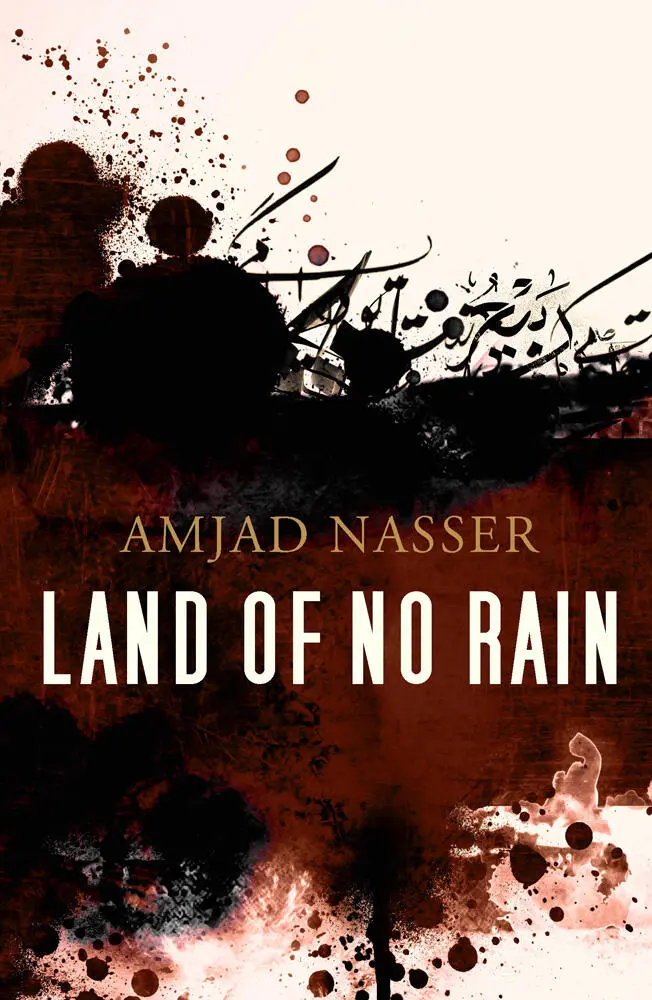
- Название:Land of No Rain
- Автор:
- Издательство:Bloomsbury Qatar Foundation Publishing
- Жанр:
- Год:2014
- ISBN:нет данных
- Рейтинг книги:4 / 5. Голосов: 1
-
Избранное:Добавить в избранное
- Отзывы:
-
Ваша оценка:
Land of No Rain: краткое содержание, описание и аннотация
Предлагаем к чтению аннотацию, описание, краткое содержание или предисловие (зависит от того, что написал сам автор книги «Land of No Rain»). Если вы не нашли необходимую информацию о книге — напишите в комментариях, мы постараемся отыскать её.
Land of No Rain — читать онлайн бесплатно полную книгу (весь текст) целиком
Ниже представлен текст книги, разбитый по страницам. Система сохранения места последней прочитанной страницы, позволяет с удобством читать онлайн бесплатно книгу «Land of No Rain», без необходимости каждый раз заново искать на чём Вы остановились. Поставьте закладку, и сможете в любой момент перейти на страницу, на которой закончили чтение.
Интервал:
Закладка:
Alongside the walls were massive cannons with long barrels and wide mouths, brought back by the ginger general from bloody wars overseas and painted a black colour that shimmered in the sunlight. The sight of them, next to the adjustable glare reflectors, struck fear into the hearts of the last remnants of tribesmen, whose only weapons had been short swords and single-shot rifles. In a way that left no room for doubt, the textbooks assigned to schoolchildren such as you asserted that the ginger general came from ancient martial stock, but this did not prevent a minority of troublemakers from casting doubt on aspects of the ruler’s family tree, which was dominated by people with military decorations. Whatever the truth about his origins, the ginger-haired general, who was known among the people of Hamiya as ‘the Commander’, behaved like a father to all — a tradition continued by his son and grandson, the subsequent commanders.
In more recent times, when the cypress, poplar and cinchona trees had grown tall in the streets, in the military camps and housing districts, which were divided into square blocks, those who knew Hamiya attributed the decrease in raids and the disappearance of armed tribesmen to the awesome establishment that had begun life as a vague glint in the eyes of the ginger general. Others said the reason was the influx of traders, labourers and artisans, and the lighting of the streets, while others trace the decline and eventual disappearance of the tribesmen’s attacks to the tribesmen’s progeny, who were no longer as fierce as their fathers and did not have the same hunger in their bellies.
Anyway, Hamiya gradually subjugated the tribal raiders, with their swords and rifles, and took control of the surrounding area.
The population around Hamiya increased as people came in search of the work and security that Hamiya provided to the surrounding area. They moved into shanty towns that did not have the planning accorded to the square blocks, equal but different, of Hamiya’s residential districts and barracks. The population increase on the outskirts began during the reign of the commander known as the Grandfather. It started to accelerate in the reign of his son and became a troubling phenomenon in the early years of the Grandson. These areas had no formal name but with time they came to be known as ‘the town’. The districts that proliferated had no central authority. They were just communities governed by elders and strong men competing for dominance. Then, in the reign of the Grandson, they submitted to Hamiya’s authority and together the two formed a combined political entity. But the name Hamiya still prevailed in common usage, while the official name was confined to government transactions. There must have been numerous debates in Hamiya about extending its sovereignty over these scattered communities. This is clear from the fact that there are contradictory versions of the relationship between Hamiya and ‘the town’. Some people say it was the elders of these communities who asked to come under Hamiya’s authority after a struggle between them came to a head and no one of them could resolve the conflict in his favour. Others say it was objective necessity that intertwined the needs of Hamiya and of ‘the town’ so closely that it was difficult to keep them apart, while others say that ‘the adviser’ suggested the idea to the Grandson, who — as a man descended from warrior stock — was not enthusiastic about it at first. The military life enthralled him. Discipline was his creed. According to this version, he seems to have feared that chaos, instability and the disruptive ideas characteristic of civilian life would seep into the heart of Hamiya. The Grandson knew it was his duty to safeguard Hamiya’s supreme interests, whatever the circumstances. This was the family legacy, which would be in danger of extinction if he let down his guard and slept too soundly. Unlike his father and grandfather, he did not have friendly relations with civilians. He did not feel comfortable in their presence. There were civilians in Hamiya, running the municipality and the public services, but they were subject to military discipline. They even wore military-style uniforms, each according to his profession. Those who favour this version of events say ‘the adviser’ gave the Grandson sleepless nights with his warnings of the consequences that could arise if a powerful elder or an adventurous thug managed to unite the communities scattered around Hamiya into a single entity. The adviser’s background in the social sciences, anthropology and astrology, before he started working for the Grandson, enabled him to detect social movements and rebellions, and to foresee the outcome, from his observation of the conduct of a single individual. No one knows for sure which is the correct version, because the minutes of the meetings of Hamiya’s Supreme Council occupy a special corner in the Commander’s archives, marked Top Secret. Anyway, the relationship between Hamiya and ‘the town’ probably began at the start of the Grandson’s reign, and produced a single political entity. The Grandson was at the head, followed from the protocol perspective by the prime minister, who was traditionally from the elite of ‘the town’. He was largely nominal and everyone knew that the Grandson was the de facto prime minister. But neither the Grandson nor his prime minister had as much influence over people’s daily lives as the National Security Agency. Although it was certainly the head of state who initially gave the agency its authority it later became hard to tell who had the upper hand. No other institution penetrated every aspect of life as much as the National Security Agency, including the Grandson’s office itself. This, at least, was the consensus among the opposition forces, both the armed and the unarmed, and it was almost the only point of agreement between them.
In your youth you had a chance to see the precisely geometric layout of Hamiya’s extensive core, which you had not previously grasped. Only a minority of people, as far as you know, were aware of all Hamiya’s facilities, because there were restricted areas, above and below ground. Once, and only once, you were one of the top students at the Upright Generation Secondary School. The Grandson, in line with the practice of his father and grandfather, was in the habit of receiving outstanding students in his office to honour their scholastic performance, or perhaps to prove that he really existed and was after all a person of flesh and blood. There you saw a large photograph of Hamiya’s heartland, taken from the air and filling a whole wall of his office. You were so amazed at how regular, how extensive and elaborate it was that you thought the photograph was a fabrication or a photograph of somewhere other than Hamiya, which you thought you knew like the back of your hand. The settlements that surrounded Hamiya and that had started to expand even further had left the eastern side untouched. They lay to the west, the north and the south, whereas the eastern side was open to the desert, to the howling wind, and to the remaining wolves and hyenas that roamed at night across an ancestral home haunted by beasts like them, and tribesmen on the alert for anything that moves. This dreadful void was no accident, and some people thought it was deliberate. A kind of strategy. The purpose was not to let Hamiya be surrounded, to leave one side open as an eerie space that would strike fear of the unknown into the hearts of all.
You are your parents’ second child. Your brother Sanad is older than you. You were born at the height of the time of the big shiny black cannons. In the days of your childhood a space charged with fear and dread lay between ‘the town’ and Hamiya. You remember your childhood outside the walls. Your family lived in a poor neighbourhood at the end of the downtown area. Your father had an office there until he moved to work officially in the centre of Hamiya and took you there with him. Only the children of those who lived behind the wall enjoyed the distinction of crossing that protected space, and not the other way round. You remember your bloody battles with the other children. Your attempts to approach the wall, which were rapidly repelled by the guards. The furthest you could reach was the carpentry shop owned by the hunchback. Right next to that ran the covered watercourse that separated Hamiya from everything else. But this almost total separation gradually began to change when the economic elite and the political forces intensified their demands for more openness and for equal representation in the new political union. Despite the new relationship between Hamiya and the surrounding communities, the Grandson constantly refused to remove the wall of volcanic rock that separated Hamiya from its environs or to open up the gates where guards barred the way to any casual intruders. Only in his latter years, under duress, did he agree to relax the restrictions.
Читать дальшеИнтервал:
Закладка:
Похожие книги на «Land of No Rain»
Представляем Вашему вниманию похожие книги на «Land of No Rain» списком для выбора. Мы отобрали схожую по названию и смыслу литературу в надежде предоставить читателям больше вариантов отыскать новые, интересные, ещё непрочитанные произведения.






Обсуждение, отзывы о книге «Land of No Rain» и просто собственные мнения читателей. Оставьте ваши комментарии, напишите, что Вы думаете о произведении, его смысле или главных героях. Укажите что конкретно понравилось, а что нет, и почему Вы так считаете.