Nasser Amjad - Land of No Rain
Здесь есть возможность читать онлайн «Nasser Amjad - Land of No Rain» весь текст электронной книги совершенно бесплатно (целиком полную версию без сокращений). В некоторых случаях можно слушать аудио, скачать через торрент в формате fb2 и присутствует краткое содержание. Год выпуска: 2014, Издательство: Bloomsbury Qatar Foundation Publishing, Жанр: Современная проза, на английском языке. Описание произведения, (предисловие) а так же отзывы посетителей доступны на портале библиотеки ЛибКат.
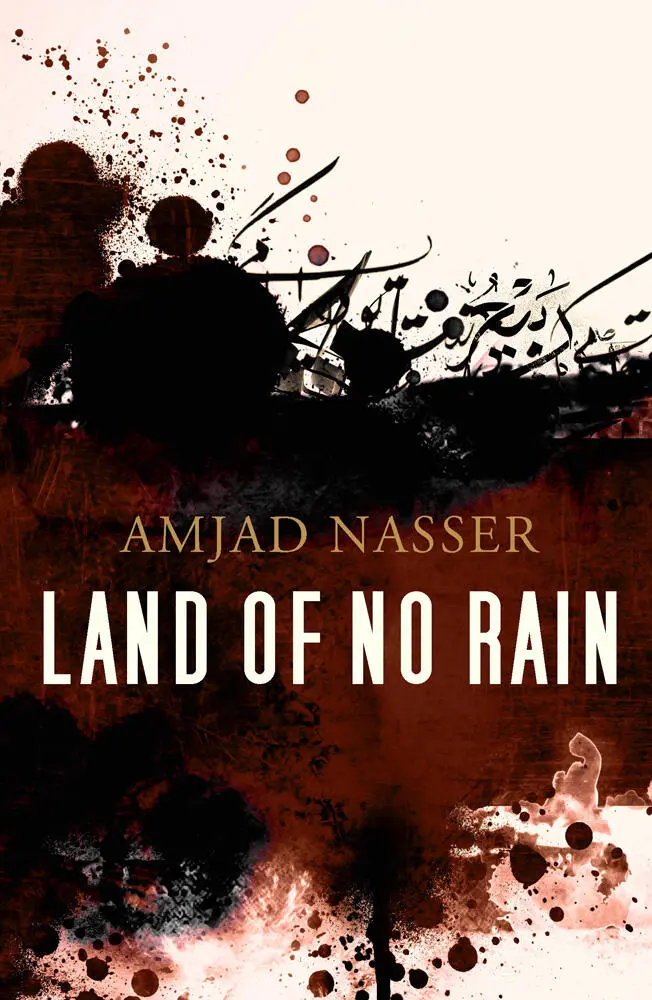
- Название:Land of No Rain
- Автор:
- Издательство:Bloomsbury Qatar Foundation Publishing
- Жанр:
- Год:2014
- ISBN:нет данных
- Рейтинг книги:4 / 5. Голосов: 1
-
Избранное:Добавить в избранное
- Отзывы:
-
Ваша оценка:
Land of No Rain: краткое содержание, описание и аннотация
Предлагаем к чтению аннотацию, описание, краткое содержание или предисловие (зависит от того, что написал сам автор книги «Land of No Rain»). Если вы не нашли необходимую информацию о книге — напишите в комментариях, мы постараемся отыскать её.
Land of No Rain — читать онлайн бесплатно полную книгу (весь текст) целиком
Ниже представлен текст книги, разбитый по страницам. Система сохранения места последней прочитанной страницы, позволяет с удобством читать онлайн бесплатно книгу «Land of No Rain», без необходимости каждый раз заново искать на чём Вы остановились. Поставьте закладку, и сможете в любой момент перейти на страницу, на которой закончили чтение.
Интервал:
Закладка:
In fact you’re not sure whether the story your old comrade told you about the Grandson is true. It may be true, it may not. But that’s not the whole story. And it’s not a matter of people but rather, probably, of a corrupt elite. There are two sides, maybe more, to every story. It would be difficult to dispute the fact that your old comrade, by holding the highest media position in Hamiya, reflected only one side of the story.
Mahmoud’s enthusiasm hadn’t changed, and his inner energy hadn’t diminished. Only the orientation had changed. Your old comrade, whom you had nominated to join the Organisation and for whom you then became responsible, had a unique distinction that rapidly caught the attention of the leadership: his capacity to speak fluently and coherently and his almost instinctive ability to persuade. What he said was not just talk. It came from deep inside, as with a character actor. You thought Mahmoud, driven by an extraordinary sense of competition, tried to follow your example in everything, to get involved in politics like you, to fall in love like you, to write like you. He wrote poetry but you made fun of it and he gave up. He tried short stories. He wasn’t a great success at that. Finally he became an incendiary newspaper columnist. In this he succeeded. Perhaps it was precisely that, you reckon, that brought him to his current position in Hamiya. He knew how to aim his blows. He would vent his wrath against successive governments, the bureaucrats, the Grandson’s aides, but not against the Grandson himself. You’re now trying to recall a single strongly worded article attacking the Grandson, but you can’t. Neither can you recall any article he wrote about the dreaded National Security Agency. And here he is, trying to win you over to his choice, to triumph over you, for once to gain the upper hand over you. Look out.
You have to admit he’s clever and knows how to get what he wants. In fact you’ve long considered him clever and perceptive, with qualities you don’t have. You might be a more talented writer, but you don’t have his ability to persuade, nor his flexibility, let alone his patience and persistence. But you should remember the following: the difference between you may not lie in these traits, but perhaps in your objectives. What he wants is not exactly what you want.
From what your old comrade said you understood that the new officials in your country no longer considered your organisation, or other leftist organisations, as hostile to them. Their enemy was now the religious forces that were infiltrating society, that almost controlled the street and that called almost everyone infidel. You also understood from him that, unlike in the past, the new officials were encouraging ideas. They wanted liberal, enlightened ideas, open to the modern age. The very same ideas they used to describe as imported. The funniest thing he told you in this respect was that the head of the National Security Agency had called together the leaders of all the secular and leftist parties, people he used to chase from one hiding place to another, and told them off for being lazy, and failing to be active among the masses!
We kept striving for the freedom we held dear, even though we knew we might have to sacrifice our lives for its sake.
In the City of Siege and War people repeated those words enthusiastically. You laughed. But your old comrade didn’t notice you laughing, fortunately. You drank three or four cups of coffee brought with increasing surprise by a blonde waitress. Mahmoud Abu Tawila couldn’t keep his hand off her shoulder and complimented her in a manner unknown, if not downright offensive, in the City of Red and Grey. You don’t recall how the conversation ended between you and Mahmoud but you do remember how he used his hands, his eyes and facial features in his usual manner as he talked, so much so that he drew the attention of the other customers to the strange language he was speaking and to the rhythmic, undulating tone of his voice. Because you were distracted or completely detached from the scene, perhaps you felt you were watching a play or having a dream that had gone on longer than it should.
V
Hamiya is a real place, to the extent that places are real in the lives and imaginations of those who live in them. It was given the name because originally it really was a ‘hamiya’, a military garrison, a small fort made of black rock, with weapons and lean horses, set up on the caravan route that crossed this forlorn tract in the age of the far-flung empire. The area was rife with bandits and tribes that lived off raiding, and Hamiya deterred their deadly attacks for some time. Hamiya did not change, either in appearance, size, function or demographics, until the time of the ginger-haired general, but even then its name did not change. It survived in the same role until the empire declined and disintegrated. Hamiya’s system of government is hereditary, or so it became. The constitution doesn’t specify that the reins of power should pass down through a particular family. People hear about the constitution, the elite talk about it at length and the newspapers refer to it and even quote it, but it has no real substance. They say it was printed once, in complicated legal language that ordinary people couldn’t fathom. But this probably falls into the category of things said about Hamiya that seem so exaggerated that they make its very existence subject to doubt. It was your father who told you, when you started to take an interest in public affairs, that the system of government in your country was not in fact hereditary, but more consultative, and when you asked him why power was confined to the family of the ginger-haired general, he told you they were the founders and guardians of present-day Hamiya and that their role as heads of state was in effect a tradition that no one contested. But those who reject this interpretation say the source of their power is the armed forces and the National Security Agency. That’s how they have remained in power and monopolised it for so long. These divergent views on whether the system is constitutional or not do not appear to concern ordinary people, who have never seen a ruler other than a member of the ruling family, and do not expect to see one in the future. That’s what they are familiar with and what is customary.
Only our ancestors remember how the ginger-haired general came to this area. Although they are long gone, they passed on their memories to those who came after them. The general chose the dilapidated fort of black rock as his base after scanning the surrounding expanse. After that, with help from the commanders of his small army, he set about drawing up an ambitious design, starting with about two thousand acres of land and ending up at about twenty thousand acres, or some say two hundred thousand acres. It was in the nature of Hamiya that it could expand beyond its core, or contract according to need or in response to the challenges it faced. The ginger general was a former officer in the imperial army and what he did was not unusual in those days. Similar things happened in other parts of the empire as it collapsed. They used to say that Hamiya’s borders did not extend to the sea until a later stage, but this is not certain. A military man such as the ginger general could not have been unaware of the importance of having an outlet to the world. That’s hard to imagine, especially as the old trade route originally led to the sea and this route was still used, intermittently, at the time Hamiya was founded.
When you escaped, Hamiya’s physical appearance had already been stable for many years: there was the wall of volcanic rock, the lookout towers, the encampments of the various branches of the armed forces, the shooting ranges, the vaulted barrack blocks, the housing estates for each service, the large public park, the tall trees that lined the streets, the central market built in the traditional style, the public library with its dome, the sports halls, the polo field, the military airport, the large dam, the power plants, the model farms with their vegetables and livestock, the schools, the star-shaped headquarters of the National Security Agency, the devices that blocked the dust, the glare reflectors that tracked the sun as it crossed the sky, and so on.
Читать дальшеИнтервал:
Закладка:
Похожие книги на «Land of No Rain»
Представляем Вашему вниманию похожие книги на «Land of No Rain» списком для выбора. Мы отобрали схожую по названию и смыслу литературу в надежде предоставить читателям больше вариантов отыскать новые, интересные, ещё непрочитанные произведения.








Обсуждение, отзывы о книге «Land of No Rain» и просто собственные мнения читателей. Оставьте ваши комментарии, напишите, что Вы думаете о произведении, его смысле или главных героях. Укажите что конкретно понравилось, а что нет, и почему Вы так считаете.