Nasser Amjad - Land of No Rain
Здесь есть возможность читать онлайн «Nasser Amjad - Land of No Rain» весь текст электронной книги совершенно бесплатно (целиком полную версию без сокращений). В некоторых случаях можно слушать аудио, скачать через торрент в формате fb2 и присутствует краткое содержание. Год выпуска: 2014, Издательство: Bloomsbury Qatar Foundation Publishing, Жанр: Современная проза, на английском языке. Описание произведения, (предисловие) а так же отзывы посетителей доступны на портале библиотеки ЛибКат.
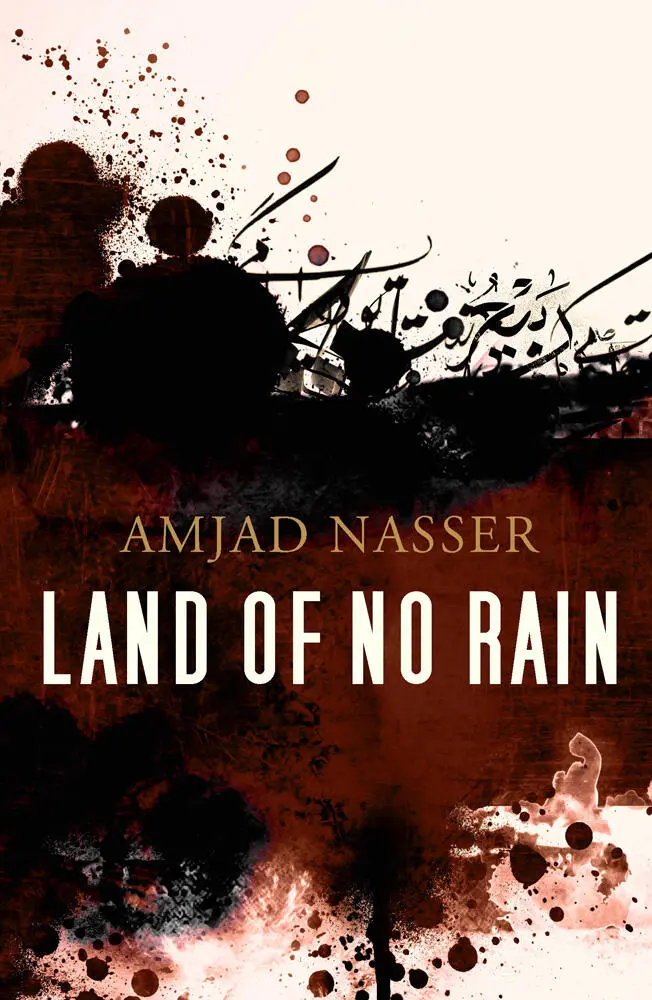
- Название:Land of No Rain
- Автор:
- Издательство:Bloomsbury Qatar Foundation Publishing
- Жанр:
- Год:2014
- ISBN:нет данных
- Рейтинг книги:4 / 5. Голосов: 1
-
Избранное:Добавить в избранное
- Отзывы:
-
Ваша оценка:
Land of No Rain: краткое содержание, описание и аннотация
Предлагаем к чтению аннотацию, описание, краткое содержание или предисловие (зависит от того, что написал сам автор книги «Land of No Rain»). Если вы не нашли необходимую информацию о книге — напишите в комментариях, мы постараемся отыскать её.
Land of No Rain — читать онлайн бесплатно полную книгу (весь текст) целиком
Ниже представлен текст книги, разбитый по страницам. Система сохранения места последней прочитанной страницы, позволяет с удобством читать онлайн бесплатно книгу «Land of No Rain», без необходимости каждый раз заново искать на чём Вы остановились. Поставьте закладку, и сможете в любой момент перейти на страницу, на которой закончили чтение.
Интервал:
Закладка:
The timing was appropriate: the celebration of the silver jubilee of the Grandson’s accession.
* * *
This house has an arched stone gateway with an inscription in Persian script that irritated you for years. The house, to which you are returning after twenty years, was the family’s summer house. It lies in an area allocated to the families of Hamiya’s junior and non-commissioned officers and civilian staff such as your father. You lived there during the long summer holidays and your memories of it are partly good, partly bad. It hasn’t changed much. The strange inscription on the gateway is still holding out against the ravages of dust. A new floor was added after your brothers and sisters had lots of children and finally moved in when your father was laid off. The venerable olive tree has grown and its trunk and branches have thickened. Now it reaches your bedroom window on the second floor, from which you used to see children playing football in the street, girls filling the afternoons with the scent of lavender, soldiers going to the front, and bedouin still attached to their scrawny camels. In front of it there now stands a supermarket with a foreign brand name, a hairdresser’s for both men and women, and an Internet café frequented by adolescents whose long hair glistens with gel. But Antar, the dog that became devoted to you after you found him as a puppy yelping in the street and brought him up, has died. He no longer keeps vigil under your window or wags his tail when he sees you. Shortly before you came back, he stopped eating or drinking or wagging his tail. Your grandfather and grandmother, your father and mother, have passed away one after another. Your favourite brother Sanad, to whom you entrusted your boyhood secrets, lives in the Land of Palm Trees and Oil. Your younger brother, Shihab, the air force pilot, was given early retirement because they suspected his relationship with you might be more than merely fraternal. Salem, with whom you smoked, chased girls and daydreamed, and who became a National Security officer after you left, had a stroke and lost half his memory. Tom Thumb, who was your bitter rival in the gang warfare in the narrow lanes and who later became the leader of a feared smuggling gang, comes out of jail only to go back in again. Comrade Hanan has died. Salman, who first taught you poetry, has become an itinerant preacher. Your friend Hasib, who wrote detective stories, has disappeared from sight and is said to have died in a traffic accident while crossing the street drunk, or to have entered a monastery and become an ascetic. What next? It’s hard to list them and count.
Nevertheless, in your room, which has become a guest room, you found books that had taken you away from your family, scraps of paper, official documents and sentimental letters promising eternal love. Among the books, which remained almost exactly as they were when you left, you reached out for a small book. Dormant memories of a distant age flooded back.
You opened the book and a multitude of sounds, images and smells swirled in your head. It was an inspirational book for you, and from the moment you opened it you were never the same person again. The moment you discovered it marks the unexpected dividing line between your old self and the new.
It was a magical book, but not magical in the sense of secret talismans, mysterious triangles or squares. It didn’t have any of that. Its magic lay only in the fact that the words and images in it, its esoteric whisper, coincided with a willingness deep inside you to come under its spell. A susceptibility of this kind seems to have persisted in you for some time, but your receptivity to enthralment diminished the longer the road turned out to be and the less clear the landmarks became along the way.
As with any such book, you didn’t have full control over yourself as the text led you from one discovery to another. Before you ventured into the expanses of that book you were yourself, but gradually you began to change as the book’s subtle vibrations seeped into you. The first thing you lost was your sense of your own weight, then your old memory. The words in the book began to wipe out most of the words that were there before them. That’s what you felt when you read it for the first time, or rather that’s how you were predisposed to react, because you were fertile ground at the time. Seed sown in fresh furrows soon sprouts.
The book, which you thought you had lost in your apartment in the downtown area, took you back twenty years. You felt lighter, thinner, nimbler. You imagined your hair had grown longer, that you had a droopy moustache, feet that hardly touched the ground and eyes that reflected tall trees, blue beaches and girls from whose shoulders little panthers leapt. You recognised this feeling of being so light you were about to take off. You had experienced it before when you opened the very same book, brought to you by a young man named Hannawi, who was tall and thin with dishevelled hair and a slight limp in one foot.
Hannawi had come from abroad, and after you met by chance in the Black Iris café he became your best friend for some time. He was entranced by the book and for you the effect was contagious. The book was passed around among others, but its magic did not work for them. The book held its secret gifts within a cover that did not reflect the contents. You and Hannawi shared those secret gifts. Both of you changed after that. You changed for several reasons, some connected with the book, others connected with the workings of fate or chance, and maybe of volition. After you escaped you lost touch with your friend. You looked for the book in the City Overlooking the Sea but couldn’t find it. You discovered you didn’t need it anyway because the words now ran in your blood.
It was a poetry book. It had nothing in common with The State and Revolution , the book that had left you with a scar in the shape of a cross above your navel. You thought you were the only person alive in the world created by the subdued language of the book, its limpid images, its muted rhythms, the evanescent quotidian worlds it evoked. But you discovered that the book had changed others too. There were other people the book had transformed. There weren’t many of them but they were slowly growing in number with the passage of time. They never became many. The title of the book was A Prophet Who Shares My Apartment With Me . It’s a rather strange title. The strangeness lies in the juxtaposition of the words ‘prophet’ and ‘apartment’. Prophets are usually associated with the wilderness and antiquity, apartments with cities and the present. So he was a modern prophet. Without a message. Without commandments that make people tremble. His revelations might be ordinary, commonplace, superfluous. The title of the book was in fact like its contents, and the author was a poet from the city of Sindbad who had lived through the noisy last century and survived into this even noisier century with the same vigour, the same scepticism and the same preference for seclusion.
Before escaping abroad you lived with your friend Hannawi in an unusually elongated apartment in the downtown area. You first encountered the book when he pulled a cheap modest paperback edition of it from his bag, which didn’t hold much, and read you some lines of poetry in free verse with a muted rhythm that was cunningly insidious. As he read, your friend’s voice was moving. He was like someone reading to himself. He didn’t know that the words were sinking into you and coming to rest somewhere deep inside that had been waiting since you don’t know when. As he concentrated on the book, in his eyes you saw water rippling, arches swaying and skies rising, with sad palm or cypress trees. Your friend Hannawi was like the man who lived with the narrator of the poem in the book, also in an elongated apartment. You thought it was just a coincidence. But nonetheless you did feel that, several years earlier, someone far away had looked down upon your future life and written it up. Here was someone who had said things that you wanted to say but still didn’t know how. When Hannawi had finished reading the poem, you said, ‘Give me that book.’ You went to the Black Iris café that you frequented in the downtown area, sometimes with Khalaf, telling him stories, and sometimes with Hannawi, reading what the two of you had written or talking about books that might have changed other people but not you two, which in fact might have bored you. In the café you saw Hamed Alwan the poet sitting in his usual place in the middle. Your relationship with him was a mixture of love and hate. You liked the direct way he spoke, his daring approach to criticism, his surprising ideas, but you hated his biting sarcasm about your younger generation’s taste for what he called the gimmicks of modernity. He believed in direct poetry. Poetry that would move the masses and provide them with a weapon against injustice and tyranny. He was famous. He had a following that memorised many of his protest poems. Maybe that was another reason why you hated him; or, more precisely, it made your relationship with him more ambiguous. As soon as you came in he invited you to a cup of coffee. At the time you only wanted to be alone with the book. Nothing else. But you would have been embarrassed to turn down his invitation. He saw the book in your hand. He took it without asking. He read the title aloud: A Prophet Who Shares My Apartment With Me . He laughed his famous laugh. His raucous laugh. He examined it quickly and handed it back to you. Strangely, he said, ‘An excellent book. I’ve read it. But his voice is more muted than it should be. I met the author at a poetry festival in the city of Sindbad. An admirable man but not impressive.’ His opinion surprised you. You had thought he would heap scorn on him without mercy. Hamed Alwan laughed aloud again and, speaking in his irritating rustic manner, said, ‘You look spooked.’ You didn’t know what he meant but you laughed along with him. You didn’t want to have a long conversation. Fortunately Alwan left the café for a prior engagement, or so he said, and you remained alone with the book.
Читать дальшеИнтервал:
Закладка:
Похожие книги на «Land of No Rain»
Представляем Вашему вниманию похожие книги на «Land of No Rain» списком для выбора. Мы отобрали схожую по названию и смыслу литературу в надежде предоставить читателям больше вариантов отыскать новые, интересные, ещё непрочитанные произведения.





Обсуждение, отзывы о книге «Land of No Rain» и просто собственные мнения читателей. Оставьте ваши комментарии, напишите, что Вы думаете о произведении, его смысле или главных героях. Укажите что конкретно понравилось, а что нет, и почему Вы так считаете.