Nasser Amjad - Land of No Rain
Здесь есть возможность читать онлайн «Nasser Amjad - Land of No Rain» весь текст электронной книги совершенно бесплатно (целиком полную версию без сокращений). В некоторых случаях можно слушать аудио, скачать через торрент в формате fb2 и присутствует краткое содержание. Год выпуска: 2014, Издательство: Bloomsbury Qatar Foundation Publishing, Жанр: Современная проза, на английском языке. Описание произведения, (предисловие) а так же отзывы посетителей доступны на портале библиотеки ЛибКат.
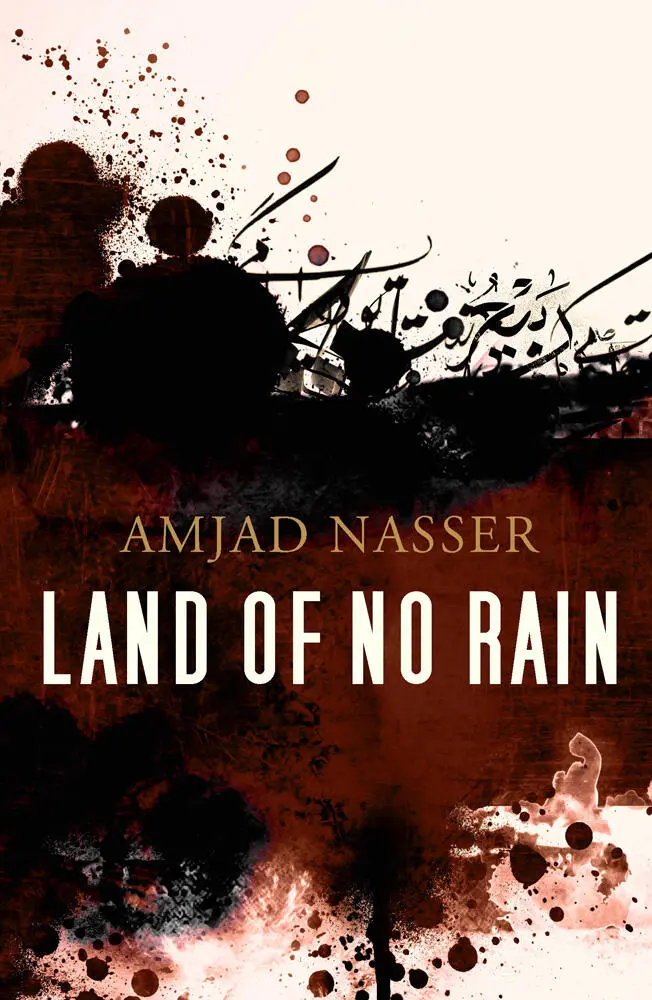
- Название:Land of No Rain
- Автор:
- Издательство:Bloomsbury Qatar Foundation Publishing
- Жанр:
- Год:2014
- ISBN:нет данных
- Рейтинг книги:4 / 5. Голосов: 1
-
Избранное:Добавить в избранное
- Отзывы:
-
Ваша оценка:
Land of No Rain: краткое содержание, описание и аннотация
Предлагаем к чтению аннотацию, описание, краткое содержание или предисловие (зависит от того, что написал сам автор книги «Land of No Rain»). Если вы не нашли необходимую информацию о книге — напишите в комментариях, мы постараемся отыскать её.
Land of No Rain — читать онлайн бесплатно полную книгу (весь текст) целиком
Ниже представлен текст книги, разбитый по страницам. Система сохранения места последней прочитанной страницы, позволяет с удобством читать онлайн бесплатно книгу «Land of No Rain», без необходимости каждый раз заново искать на чём Вы остановились. Поставьте закладку, и сможете в любой момент перейти на страницу, на которой закончили чтение.
Интервал:
Закладка:
VI
When you told Khalaf, ‘I don’t have a story worth telling,’ you were lying. If it was up to Khalaf, he would have said graciously, ‘Let’s go and sit on a wooden bench in Hamiya Park and I’ll tell you what happened today.’ You could have done that twenty years ago too. In fact, that’s what you used to do. It used to be other people’s stories, not your own. You didn’t have a story at that time, and anyway telling other people’s stories is easier and living them is more fun. Lying to Khalaf was not pure lying. You didn’t lie to him because you wanted to lie, but perhaps because you weren’t confident of your story. It wasn’t like those stories you used to tell him, sometimes on a wooden bench in Hamiya Park, sometimes on a chair in a café in the downtown area, or like the secret information Khalaf used to tell you about people arrested trying to smuggle banned books into Hamiya.
* * *
That’s because Khalaf was in fact dead.
Khalaf had been killed before you came home, in a confrontation with jihadists who had adopted the shanty towns as the base for their activities. These people became active after you left and they came close to establishing a monopoly on the streets. They broke their long truce with the Grandson, or rather their undeclared alliance with him from the days when the National Security Agency was hunting you down like rats in holes. A group of them tried to infiltrate Hamiya while Khalaf was on duty at the pedestrian gateway, and he resisted and was killed. Khalaf was dead. You read the news, which was published in the local press, and you saw a picture of Roula, whom you hadn’t seen since you escaped abroad, receiving the Medal of Duty, Hamiya’s highest decoration, from the Grandson. She looked different from how you remembered her. Her hair was tightly gathered at the back, her face was severe, her mouth pursed and her dimples less pronounced, but nonetheless she had preserved some of her magic, which was hard to define.
You weren’t alone when you escaped from Hamiya. You were a group. Most of those who planned the conspiracy to assassinate the Grandson and took part in carrying it out tried to escape abroad. Some were arrested before they could get away. Those who had played the least important roles were imprisoned. The fugitives were sentenced in absentia. The chief conspirator, the local leader of your organisation, was executed, and his relatives had to bury him in an unmarked grave. There were branches of your organisation in the City Overlooking the Sea. They were from an older generation than you. A generation whose ties to Hamiya had in effect long been severed. You felt there was a gap between you and those who hadn’t set foot in your country for thirty years. They had the leadership positions. You noticed that relations between them and the people of the City Overlooking the Sea were not as they should have been. In fact that’s how relations were between the other foreign groups and the people of the city, which had in theory embraced the cause of revolution and change. Those of you who had recently arrived from Hamiya and had just read the theoretical texts diagnosed the relationship as elitist. You wanted a relationship with the common people, not with the political elite and prominent people. The common people, or the masses, to use the phrase common in your political literature, were the rock on which your struggle must be founded. They were the armour that would protect your presence among them on their soil. But for numerous reasons this did not happen. What your group had done together had created a strong bond between you. You were scarcely ever apart and you thought that what you had done had won you worldwide renown. A short time after taking refuge in the city, you were surprised to discover that few people knew where Hamiya was, although your country was not far away. As time passed and you moved around, the bonds within your group weakened. The warning signs of fragmentation began to appear at closed meetings and in cafés. Before the thousand-day siege of the City Overlooking the Sea, you began to argue among yourselves — over who was responsible for what had happened, who had informed on whom, who had lost interest and had turned to chasing the local women or was mixed up in business or smuggling, who still kept the flame burning for the cause — and this began to loosen a bond that had seemed eternal. After the siege, which drove you either to the sea or to the wilderness, some of you tried to slip back but you were deported. For years you haven’t had any official connection with the Organisation, and after you left the Island of the Sun you all dispersed to various countries. Your relationship with the Organisation became largely nominal. It was the leaders (in fact you had become one of them) who maintained a loose and vague relationship with you. They accepted your criticism. Your aloofness. Your moods, which have become more and more changeable. But they still see you as their protégé, perhaps because of your modest fame, perhaps out of loyalty to an old dream. You meet whoever’s left of your old comrades by chance. At a conference here. A seminar there. You no longer hear much of their news, except that some of them have gone home and taken important positions in government. Obviously you weren’t among them. After several failed attempts to go home, you convinced yourself that matters had become settled and that nothing could change the direction of winds that blew from just one quarter. But you did go home, in the end. You didn’t find much of what you remembered. Change had not only swept you along; it had touched everything. Those who have been living abroad for years want everything at home to remain as it was when they left. This is impossible. You know that and do not often complain.
You braced yourself to accept the cold, and the dark sky,
The passage of time, the uncertainties of life, and the treachery of friends.
But sometimes you cry. Some powerful force convulses you and you cry. Alone, beside a river with dark waters, you cry. Under a disused railway bridge, you cry. In front of the spectre who turns up at the worst of times, his arms folded across his chest, scrutinising you like an obstinate examiner, you cry. They do not last long, these convulsive moments, which might be inspired by an image that crosses your mind or a smell that reminds you of another smell, and you soon recover your composure and control of your emotions. This is a price you know must be paid, although no one seems to check the accounts any longer.
With all your self-confidence, your wounded intellectual pride, your deep sense of disappointment, your exhausted and sickly body, could you have said all that to Khalaf, if he were still alive? Probably not, although you’re confident he wouldn’t have gloated at your misfortune. He wouldn’t have said, ‘Didn’t I tell you to stay away from those ideas, which only lead to ruin?’ He’s not malicious like that. You didn’t tell him you belonged to the Organisation, because that’s a secret you wouldn’t have divulged to anyone, especially if you were arrested. You had received strict training on how to keep secrets and not to divulge anything important under interrogation. Khalaf knew deep down that you were no longer the person who used to tell him stories, who used to share secrets with him, including about your relationship with Roula, his friend who wrote love letters for the other adolescents in your gang. But how could you have told him you’d been chosen to check out the location where they planned to assassinate the Grandson, and to make sure the assassins could enter and leave Hamiya safely?
In the eyes of the Organisation you were very much the right person to perform this task, because you were the youngest member and the son of ‘the calligrapher’, whom everyone assumed to be above suspicion, and most importantly, because you knew how to get in and out of Hamiya without going through the checkpoints. You met all the criteria for someone who would not be suspected and from whom no danger was to be expected. You might add to that the recklessness that hovered over your head like an unholy halo. So the leaders of the Organisation decided to carry out an act that others had attempted before and failed. They set the date and zero hour for the operation.
Читать дальшеИнтервал:
Закладка:
Похожие книги на «Land of No Rain»
Представляем Вашему вниманию похожие книги на «Land of No Rain» списком для выбора. Мы отобрали схожую по названию и смыслу литературу в надежде предоставить читателям больше вариантов отыскать новые, интересные, ещё непрочитанные произведения.





Обсуждение, отзывы о книге «Land of No Rain» и просто собственные мнения читателей. Оставьте ваши комментарии, напишите, что Вы думаете о произведении, его смысле или главных героях. Укажите что конкретно понравилось, а что нет, и почему Вы так считаете.