J. Ledgard - Submergence
Здесь есть возможность читать онлайн «J. Ledgard - Submergence» весь текст электронной книги совершенно бесплатно (целиком полную версию без сокращений). В некоторых случаях можно слушать аудио, скачать через торрент в формате fb2 и присутствует краткое содержание. Год выпуска: 2011, ISBN: 2011, Издательство: Random House UK, Жанр: Современная проза, на английском языке. Описание произведения, (предисловие) а так же отзывы посетителей доступны на портале библиотеки ЛибКат.
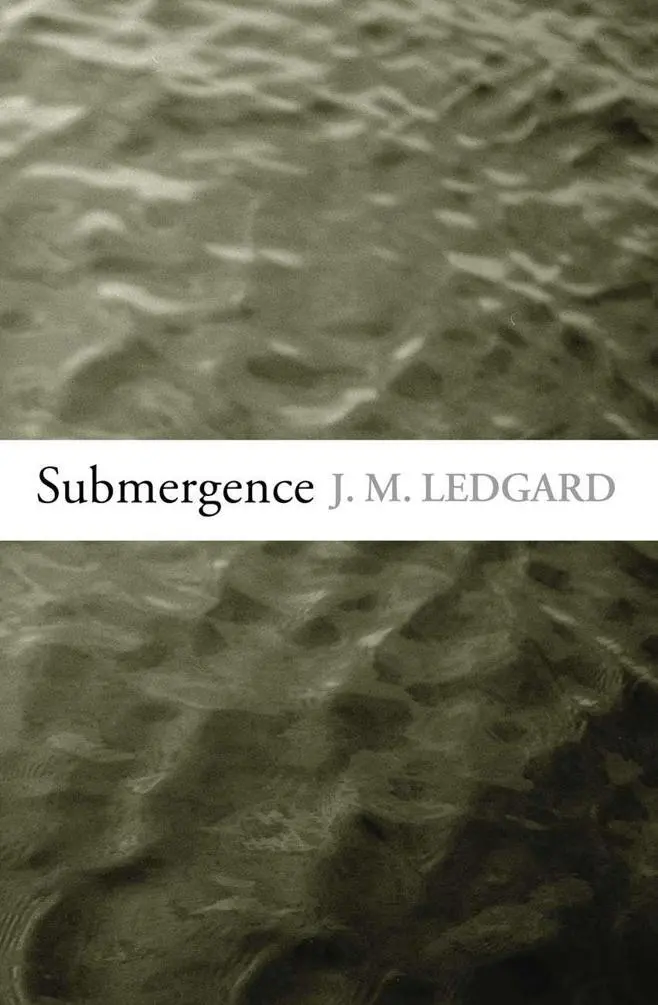
- Название:Submergence
- Автор:
- Издательство:Random House UK
- Жанр:
- Год:2011
- ISBN:9781446496831
- Рейтинг книги:5 / 5. Голосов: 1
-
Избранное:Добавить в избранное
- Отзывы:
-
Ваша оценка:
Submergence: краткое содержание, описание и аннотация
Предлагаем к чтению аннотацию, описание, краткое содержание или предисловие (зависит от того, что написал сам автор книги «Submergence»). Если вы не нашли необходимую информацию о книге — напишите в комментариях, мы постараемся отыскать её.
Both are drawn back to the previous Christmas, and to a French hotel on the Atlantic coast, where a chance encounter on the beach led to an intense and enduring romance. For James, his mind escapes to utopias both imagined and remembered. Danny is drawn back to beginnings: to mythical and scientific origins, and to her own. It is to each other and to the ocean that they most frequently return: magnetic and otherworldly, a comfort and a threat.
Submergence — читать онлайн бесплатно полную книгу (весь текст) целиком
Ниже представлен текст книги, разбитый по страницам. Система сохранения места последней прочитанной страницы, позволяет с удобством читать онлайн бесплатно книгу «Submergence», без необходимости каждый раз заново искать на чём Вы остановились. Поставьте закладку, и сможете в любой момент перейти на страницу, на которой закончили чтение.
Интервал:
Закладка:
They put him on a cement floor in a smoke-blackened room at the back of the mosque. He was nauseous. There was ringing in his ears. A pile of mobile phones on a carpet vibrated, stirring motes of fecal dust and frankincense in light that slanted down from windows which were barred but held no glass. His vision blurred. When he came to a lantern cast the same room more richly, so at first sight the faces of the commander and the fighters were like those in a Netherlandish painting.
The commander was sitting cross-legged on the carpet. He recognised him as Yusuf Mohamud al-Afghani, a forward commander of al-Qaeda in Somalia: thickset for a Somali, but with the usual Somali vanity, the hair crimped and made to shine like a songbird, like a jazz singer, the beard short and smoothed with ointments and dyed with henna, so that its underside was ginger.
Hair was the quality of the Pakistanis sat on either side of Yusuf: it curled and spilled astrakhan-like from their faces and shoulders and down their forearms and wrists and knuckles and piled in a greasy sheen under their headscarves.
He counted a dozen others in the room, most were Somali boys with very white teeth. Kalashnikovs and grenade launchers were stacked against one wall, sacks of frankincense piled high against another. Some of the men sat on crates of ammunition. A cheap Chinese clock with a picture of the Grand Mosque in Mecca on its dial hung over the door.
On the wall behind Yusuf was a framed page of the Koran, a newspaper cutting of Osama bin Laden before his submergence, and a poster of the French footballer Thierry Henry playing for Arsenal. There were rat droppings. There was litter. A teakettle simmered on a low paraffin flame in the centre. Beside it were bowls, a pot of steaming rice, sacks of chickpeas, sweets, and sultanas brought by boat from Karachi. It was a badger sett: close, mephitic and possessing the threat of danger, Netherlandish brushstrokes painting the faces with depths and shadows.
The ardent young Saudi who had stood over him on the beach and fired his gun into the air and covered him in his headscarf breathed in close and fed him sultanas one at a time: Saif was there. Saif the gap-toothed, who was also known as Haidar, the lion, because he was a suicide bomber who had done all that was asked of him: whose vest had not exploded, and so was between the living and the dead, invincible, a martyr who went among them still.
Saif’s smile was misleading; he was calibrated, in this other respect a detonation waiting to happen, prone to violent mood swings and other reversals. He had memorised scenes from Pink Panther films, poured sweet tea for the poor, slit the throat of a student in Jeddah, and without regret threw a grenade into a video shack in Mogadishu, killing those inside for the crime of watching a Bollywood film.
Yusuf picked up mobiles at random and texted orders to the battle lines. When he finished he scooped rice into his mouth with his fingers and sipped tea. He ate in silence. He stood up and stepped over the legs of his men with care and courtesy. He paused over James, read aloud the words on the Englishman’s T-shirt, and continued out into the starry night.
A wind blew in off the sea. The courtyard of the mosque was sifted with sand. Yusuf washed his hands and feet and entered the mosque. He carried a lamp into the dark and knelt behind a pillar in the back and prayed. The jihad had been hard. His men had fought Ethiopian soldiers, African Union peacekeepers from Uganda and Burundi, and the Somali Transitional Government troops and its allied militias. At one time in Mogadishu the Ethiopians fired in phosphorous shells with a petroleum-jelly-like napalm which ignited and burned through shacks and stuck to the flesh of his men and smouldered through them. There was another offensive where they had to scrape together the pieces of the boys who had been directly hit by mortars and gather them for a funeral. He had resorted to the methods of Iraq, hiding among the poor, using them as decoys, placing improvised explosives in the marketplaces, and training suicide brigades for attacks on Crusader targets.

On the day they made love for the first time, she spoke to him about her work. They were sitting by the table in her room. Her papers and photocopies were stacked at one end. The filing cards were loosely arranged at the other. In the centre of the table was a glass ashtray. She pulled from among her papers an aerial photograph of a ship. It was her way of easing into the subject.
‘The research vessel Knorr . Home port: Woods Hole, Massachusetts. It carries all of the instruments that are meant to assist oceanographers. On longer expeditions there is often a submersible on board.’
It was summertime on the Arctic Ocean. There were fragments of ice. The decks were arranged in rectangles. There was a hangar at the back of the vessel. It struck him as industrial compared to the whaling ships in the paintings hung in his family home, which were curved, studded with whale teeth along the rails. Then again, what he did know? He was a paratrooper who had become a spy.
‘I have a French view of science,’ she said. ‘Very romantic. Don’t get me wrong. I am sensible. It’s just I have to stop myself from falling for comments like “exploration is a hunt whose prey is discovery”.’ She lit another cigarette. ‘Anyway, I’ve never worked in France. When I began my doctorate I divided my time between Zurich and a town called La Spezia in Italy. Do you know it?’
‘No.’
‘The locals call it Spesa. It was convenient; not so far along the coast from my parents’ place. It’s the Italian naval base for the Ligurian Sea. There’s a lovely mural by the Futurist Prampolini in the town post office. There’s also a submerged statue of Christ in the harbour, a few metres down. You can’t see it, but I always felt it under me when we headed out, the hands stretched up’ — she held her two hands over her head — ‘blessing all the boats passing above.
‘The Ligurian Sea is one of the deepest parts of the Mediterranean. It looks like this’ — she doodled with a pencil a gash on a line she indicated to be the sea floor — ‘it goes down to 2850 metres. An underworld within touching distance of the Riviera. Amazing.
‘I’d gone to Spesa to work on a NATO project to protect the Cuvier’s beaked whales in the Ligurian Sea. They needed a mathematician to understand how noise reverberated in the undersea canyons. The hope was to track the diving range of the Cuvier’s and see if the navy sonar was damaging them. There were dolphins in the Tigulian Gulf and fin whales, pilot whales and very occasionally sperm whales further out. In my work I only had eyes for the Cuvier’s. They’re rough-toothed whales.’ She sketched one. She was a teacher. ‘Seven metres long from short beak down its sloping head to its tail fin, here. They’re shy and difficult to spot. They live to eighty.’
Her drawing made them look like dolphins.
‘Are they playful?’
She thought about it. ‘No, I wouldn’t say so. They’re hard to place. At first I felt they hadn’t grown up, that they were childlike, but the more we studied them, the graver their lives seemed to be. What is really interesting about them is how deep they go. They are the deepest diving creatures in the world. They stay underwater for an hour, to a depth of 2000 metres, using sonar to hunt for squid there.’
‘Drink?’
‘Not for me.’
He poured himself a whisky.
‘I appreciated the way they looked, they were pretty things, chalked up under the jawbone, with heavily lidded eyes. The work wasn’t challenging, I grew tired of it, by the end the whales did not interest me any more than a partridge, or one of those funny three-legged dogs you sometimes see in the parks in London. The Cuvier’s are K-selected under the constant conditions of the ocean: slow maturation without predators; large brains, long gestation and low birth rate. If I had been an engineer like you I suppose I might have been interested in how they were at one time rendered for watch oil, causing the seconds to tick on Swiss watches.’ She tapped her dial. ‘If I was a biologist I would definitely have been interested in how they can’t swim into the rivers that flow into the Ligurian Sea because their kidneys can’t clean out the bacteria that’s in freshwater. I probably should have marvelled at their intelligence. Instead there I was on the boat, and the boat was tipping, the boat is always tipping, listening for them, first at this many fathoms, then deeper, and … do you know what a whale sounds like underwater?’
Читать дальшеИнтервал:
Закладка:
Похожие книги на «Submergence»
Представляем Вашему вниманию похожие книги на «Submergence» списком для выбора. Мы отобрали схожую по названию и смыслу литературу в надежде предоставить читателям больше вариантов отыскать новые, интересные, ещё непрочитанные произведения.


Обсуждение, отзывы о книге «Submergence» и просто собственные мнения читателей. Оставьте ваши комментарии, напишите, что Вы думаете о произведении, его смысле или главных героях. Укажите что конкретно понравилось, а что нет, и почему Вы так считаете.