J. Ledgard - Submergence
Здесь есть возможность читать онлайн «J. Ledgard - Submergence» весь текст электронной книги совершенно бесплатно (целиком полную версию без сокращений). В некоторых случаях можно слушать аудио, скачать через торрент в формате fb2 и присутствует краткое содержание. Год выпуска: 2011, ISBN: 2011, Издательство: Random House UK, Жанр: Современная проза, на английском языке. Описание произведения, (предисловие) а так же отзывы посетителей доступны на портале библиотеки ЛибКат.
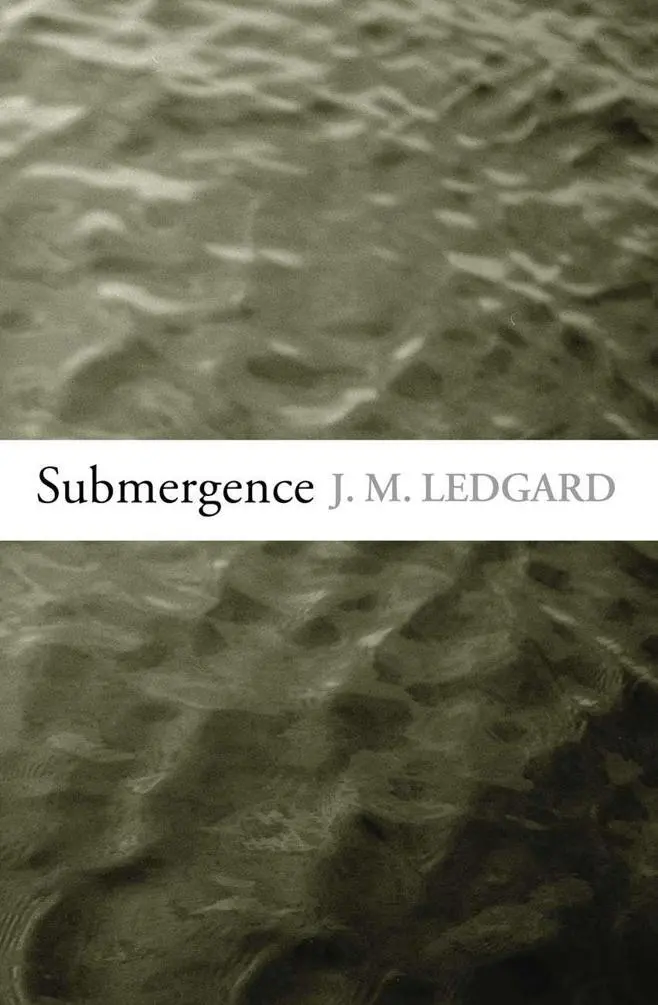
- Название:Submergence
- Автор:
- Издательство:Random House UK
- Жанр:
- Год:2011
- ISBN:9781446496831
- Рейтинг книги:5 / 5. Голосов: 1
-
Избранное:Добавить в избранное
- Отзывы:
-
Ваша оценка:
Submergence: краткое содержание, описание и аннотация
Предлагаем к чтению аннотацию, описание, краткое содержание или предисловие (зависит от того, что написал сам автор книги «Submergence»). Если вы не нашли необходимую информацию о книге — напишите в комментариях, мы постараемся отыскать её.
Both are drawn back to the previous Christmas, and to a French hotel on the Atlantic coast, where a chance encounter on the beach led to an intense and enduring romance. For James, his mind escapes to utopias both imagined and remembered. Danny is drawn back to beginnings: to mythical and scientific origins, and to her own. It is to each other and to the ocean that they most frequently return: magnetic and otherworldly, a comfort and a threat.
Submergence — читать онлайн бесплатно полную книгу (весь текст) целиком
Ниже представлен текст книги, разбитый по страницам. Система сохранения места последней прочитанной страницы, позволяет с удобством читать онлайн бесплатно книгу «Submergence», без необходимости каждый раз заново искать на чём Вы остановились. Поставьте закладку, и сможете в любой момент перейти на страницу, на которой закончили чтение.
Интервал:
Закладка:
‘The Cuvier’s,’ she continued, ‘have learned to dive deeper over a million-year evolution. They edged further in from one mutation to the next. Thinking about the way a beaked whale dives is a good way to think about the dimensionality of the ocean.’ She selected a softer lead pencil and drew in thick lines on the paper she used for her calculations: a cross section of the planet from its stratosphere to its molten core.
‘The oceans cover 70 per cent of the planet surface. You know that. It has five layers. The first is epipelagic. OK. That’s wristwatch depth. It contains all the plant life and coral reefs and all the shipwrecks that can be dived with aqualungs; all of Jacques Cousteau. Whatever memory we have of baptism or any other form of submersion is here in blue water.
‘The next layer is the mesopelagic. This is the twilight zone, into which blue and all the other colours and light vanish.’ She drew more lines. ‘Everything under the mesopelagic is night. First the bathypelagic zone, then the abyssopelagic, finally the hadopelagic.’
She looked up. They both did.
‘The hadopelagic is what interests me. Hadal from the Greek hades , meaning unseen. This,’ she said, shading it in, ‘is the other world in our world. The only light is the bioluminescence of fish who move under the weight of a thousand atmospheres.’
She drew circles representing the inner parts of the planet.
‘There are 3481 kilometres of molten rock and 2690 kilometres of mantle. No one knows much about the mantle. It has no life and therefore no possibility of reanimation and so is without scientific interest. I disagree. I’m studying what I think is the living bit of the mantle, the first few kilometres underlying the Hadal deep. I believe the fissures on the sea floor into the mantle are filled with microbial life.’
Her pencil lingered on the core and mantle.
‘The biosphere is the dermis. All life and regeneration in our world belongs to it. Thick as it seems to us, with our histories of evolution and extinction, exploration and colonisation, the abiotic mantle is several hundred times thicker.’ She drew another scale showing how nearly all the biosphere was in the ocean.
‘We exist only as a film on the water,’ she said. ‘Of course, this goes against the religion of the Garden of Eden and the canon of political documents ending with the international law of the sea which promote the primacy of man on the planet. Just take a look at it,’ she said, running the pencil again over the lines and curves. ‘We’re nature’s brief experiment with self-awareness. Any study of the ocean and what lies beneath it should serve notice of how easily the planet might shrug us off.’
‘Wow,’ he said.
‘We use the words “sea” and “ocean” interchangeably in English, and that’s fine, I do it myself, “sea” is a powerful word. A yacht belongs to the sea, it’s aimed always to the next port of call. Surfers likewise belong to the sea, not the ocean. You saw how tiny they were on the waves today. How they’re spun around like in a washing machine when they fall off their boards. Sometimes they’re ground into the bottom. When they ride out a wave, it carries them home, to land. The sea has its transformative power, its own history. I told you my mother is from Martinique. For Martiniquans the history of the sea is slavery. The sea goes across, that’s the point. The sea is a pause between one land-bound adventure and another. It joins lands. The ocean goes down and joins worlds.’
She had not even begun with chemosynthetic life and the rest — the refractory molecules of anoxgenic photoheterophotic bacteria — but she could not recall having spoken so acutely with a lover. Perhaps it was because they were so close to the Atlantic, or that he lived in Africa and she would not see him again, or perhaps it was the opposite, that she would see him all the time.
They talked into the night and were awake to each other. The uprightness of the chairs worked against intimacy. There had already been a consummation and their courtship was subsequent; in talk, not in the silence of touching.
He felt a brittleness inside him. He was not able to share his career with her, and it was the imbalance in their conversation that perhaps made him speak about the Midgard serpent, which lived so enormously in the ocean the Norsemen believed it encircled the world.
‘Do you know the story?’
‘Vaguely,’ she said, ‘hardly.’
‘The bond which held the Midgard serpent in was the weight of the sea itself, which was too heavy to push away. The serpent had a sister and a brother. The sister, Hel, became Death. She was given power by Thor to send the dead into nine separate worlds. Her table was made of hunger, the walls of her house were built with agony, and the mortar was horror. The serpent’s brother was the wolf Fenrir. He was bound by chains made of the opening and clamping of fish gills, the footfall of a lynx, the roots of stones under a glacier, the moods of bears and the droplets on the talons of an eagle dropping down on a lamb.
‘Of these three siblings it was the Midgard serpent who remained alive in longest in the sea.’ He smiled. ‘I mean the ocean.’
‘Who was the father?’ she asked.
‘Loki, the god of mischief. Of course, he ended up badly too. Odin had him chained to a rock and venom spat into his face.
‘His writhing caused earthquakes underwater.’
She got up and stretched herself.
‘The Greeks,’ she said, touching her toes, ‘believed in Okeanos, the ocean about the equator shown on the shield of Achilles which kept the known world afloat.’
She told him this and they spoke about Atlantis. She said nothing of Sumer and Enki; Abzu was as private to her as numbers were.
She instead spiralled down the axis of time in the ocean. She held up for him the example of the orange roughy.
‘It is a fish that takes forty years to reach maturity and lives to one hundred years on the seamounts, but it has been fished nearly to extinction in a generation.
‘Let’s say the Atlantic is 160 million years old,’ she continued. ‘It might be older. We appeared less than one million years ago. We walked in yesterday. It’s not much of a claim. Yet somewhere in the Atlantic right now and in the other oceans, some man, I’m sorry, it’s always a man isn’t it, some man is smashing up a seamount more ancient than any greenwood on land, which he can’t see and refuses to value.’
She was taken aback at her own vehemence. She stopped, then began again. ‘Tens of thousands of seamounts have been destroyed in our lifetime. Any seamount is sure to be demolished the moment it is located. The chains of those bottom trawlers will break into powder the cold-water corals and sponges which were there before there was an English language and which contain in them the most powerful antibiotics and chemicals which might be used for cancer treatment. If this was happening in a science-fiction world we would see it clearly for what it is, but we don’t because it’s happening here and now. It’s obscured by the money someone is making off it. Scientists are partly to blame. We’re always raising our hands after the destruction has taken place. There are scientists who become industrial collaborators, bringing out tailored research for one company or another. I’m lucky to be working at a depth beyond the reach of industry. They want the manganese nodules, gold and fuels that are in the deep, but they’re too expensive to get at now. There’s still some undisturbed time,’ and as she said this she was thinking very precisely of the abyss, its compass, duration, its secrets: of species of hagfish older than the Atlantic, who lived on those sunk from above and tied themselves in knots so as to give their jaws purchase on the rotting and blanched forms of the dead.
Читать дальшеИнтервал:
Закладка:
Похожие книги на «Submergence»
Представляем Вашему вниманию похожие книги на «Submergence» списком для выбора. Мы отобрали схожую по названию и смыслу литературу в надежде предоставить читателям больше вариантов отыскать новые, интересные, ещё непрочитанные произведения.



Обсуждение, отзывы о книге «Submergence» и просто собственные мнения читателей. Оставьте ваши комментарии, напишите, что Вы думаете о произведении, его смысле или главных героях. Укажите что конкретно понравилось, а что нет, и почему Вы так считаете.