J. Ledgard - Submergence
Здесь есть возможность читать онлайн «J. Ledgard - Submergence» весь текст электронной книги совершенно бесплатно (целиком полную версию без сокращений). В некоторых случаях можно слушать аудио, скачать через торрент в формате fb2 и присутствует краткое содержание. Год выпуска: 2011, ISBN: 2011, Издательство: Random House UK, Жанр: Современная проза, на английском языке. Описание произведения, (предисловие) а так же отзывы посетителей доступны на портале библиотеки ЛибКат.
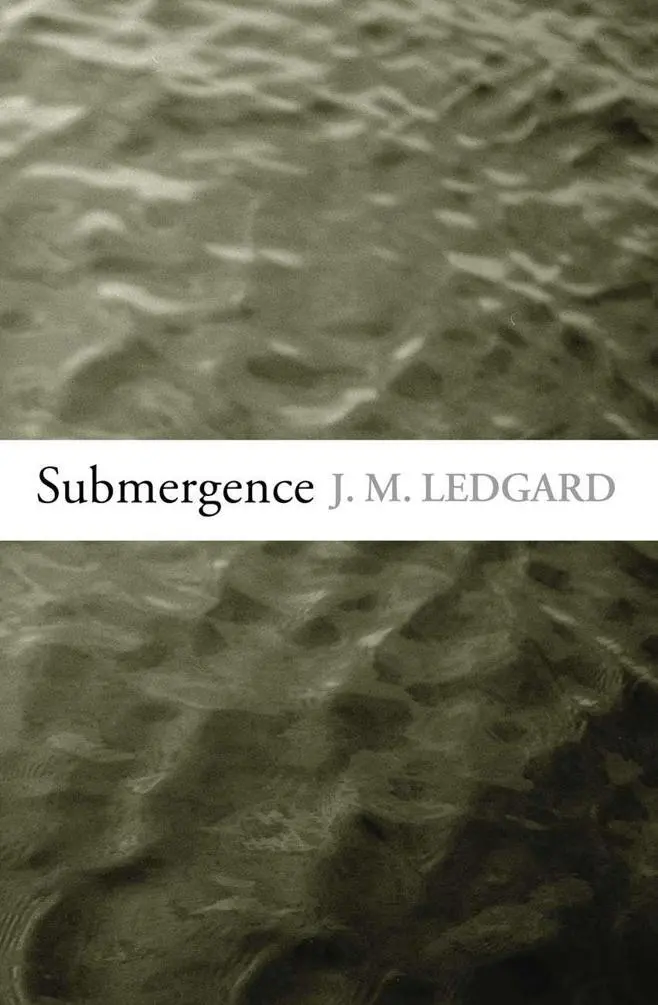
- Название:Submergence
- Автор:
- Издательство:Random House UK
- Жанр:
- Год:2011
- ISBN:9781446496831
- Рейтинг книги:5 / 5. Голосов: 1
-
Избранное:Добавить в избранное
- Отзывы:
-
Ваша оценка:
Submergence: краткое содержание, описание и аннотация
Предлагаем к чтению аннотацию, описание, краткое содержание или предисловие (зависит от того, что написал сам автор книги «Submergence»). Если вы не нашли необходимую информацию о книге — напишите в комментариях, мы постараемся отыскать её.
Both are drawn back to the previous Christmas, and to a French hotel on the Atlantic coast, where a chance encounter on the beach led to an intense and enduring romance. For James, his mind escapes to utopias both imagined and remembered. Danny is drawn back to beginnings: to mythical and scientific origins, and to her own. It is to each other and to the ocean that they most frequently return: magnetic and otherworldly, a comfort and a threat.
Submergence — читать онлайн бесплатно полную книгу (весь текст) целиком
Ниже представлен текст книги, разбитый по страницам. Система сохранения места последней прочитанной страницы, позволяет с удобством читать онлайн бесплатно книгу «Submergence», без необходимости каждый раз заново искать на чём Вы остановились. Поставьте закладку, и сможете в любой момент перейти на страницу, на которой закончили чтение.
Интервал:
Закладка:
‘Like I say, Mrs Memory.’
She laughed gaily. ‘What about you? What do you do?’
He answered in an instant. He did not want her to guess. ‘I consult on water projects in Africa.’
‘A charitable man.’
‘For the British government,’ he added.
‘So you live in Africa?’
‘In Nairobi.’
‘Do you like it?’
One of the first things he had been taught in the intelligence service was how to push conversation away from the realities of the job. He did not speak to her in detail about his cover as a water consultant, only of his genuine impressions of Africa. He described to her his garden in Muthaiga — the hanging flowers, the pool, the way the tree trunks turned vermilion with ants after rain, his housekeeper, his cook, and elderly gardener. He made it clear he lived alone. Then, matching the polarity of the day, he told her a story of how he had ridden a polo pony into Nairobi’s Ngong forest in the half-light and had seen a stolen car engine hoisted high in the tree, a monkey sitting on it, the ropes creaking, the metal like a nest, and he explained to her the reason there were so many hyenas in the forest.
‘The poorest people in the Kibera slum can’t afford a coffin, so they carry their dead into the forest at night and bury them with a short ceremony under the stump of a mugoma tree. Unthinkingly, they feed the hyenas.’
He went on to explain, as best he could, that although those doing the burying were Luos, originally from Lake Victoria, the rough treatment given to the pauper corpses by the hyenas was similar to a death rite of the Kikuyu, last recorded in 1970, in which a dying man or woman was pushed into a grass hut the size of a hutch, with an opening at either side, one for pushing the nearly dead relative in, the other for the hyena to drag the fresh body out.
‘Time is compressed there,’ he said. ‘Kenya has gone in a couple of centuries from some ancient and unwritten place to a hinterland for Arab traders and slavers, to a blank on a map which the white hunters explored, then, hey ho, a colony. Now it’s the Republic of Kenya, a country which doubles its population every generation.’
She appeared to be fascinated. ‘There must be people alive who remember the hyena death rites,’ she said.
‘My cook’s grandmother was eaten by hyenas.’
‘No!’
Emboldened, he went on to tell her it was only a generation since the death of the Danish writer Countess Blixen — Karen Blixen — in her seaside manor on the Zealand coast north of Copenhagen. She who had grandly considered her coffee estate at the edge of Nairobi as an eighteenth-century English landscape, in which there was an abundance of horses, dogs, servants — and lions — but never any money.
‘The night in Nairobi is like a river,’ he said.
‘What do you mean?’
‘It’s deep and treacherous in the way of African rivers, you can’t see into it, you have no idea where the crocodiles are, or where the rapids run. It has its own lustre.’
She gave nothing back to his stories. Perhaps she was just guarded. She knew nothing of development work or consultancies. It was said she was worldly. Well, she was worldly in wealth, and had been worldly enough in the toilet stalls of nightclubs, but she was not properly worldly. She had not come into contact with the poor. She was spoilt, like her mother. Her instinct was for refinement — of literature, fashion, cuisine — refinement of everything really, and what could not be refined was not worth having. Could poverty be refined? She did not think so. On her visits to Australia she headed to the galleries in Sydney. These days, Manly was seamy enough for her. She had been taken to Flinders Island, which had been named for her paternal forebear. Despite her father’s insistence, she had never visited an Aboriginal community in Australia or shown any interest in indiginous culture, except in so far as to use its images and textiles to garland her life. She was a woman with slave ancestry, yet she was prejudiced against Africa as a continent without research universities. Aside from a trip to Cape Town she had only been to Africa once, on an oceanographic research vessel that had anchored off the coast of Senegal. They had motored ashore in great excitement, but the village they arrived at had left her embarrassed. The village women gathered around her and asked her to speak on their behalf. They recognised her. She felt found out. It was not about skin colour; that was of no importance. It was a sudden sense of community, a rusticity which complicated her metropolitan identity.
That is not to say she was porcellaneous. She was rather the opposite: physically and emotionally hard to break; generous, weighted, in no way translucent. She preferred to be defined as a scientist. She felt she had contained within her an understanding of a greater polarity than that which James described between the rich and poor in Nairobi, and still larger than the contrast which existed that winter afternoon between the candlelit mirrored room in the hotel and the snows outside. What was it? It was the division between life on the surface of the world and the life she studied in the Hadal deep; light and dark, air and water, the breathing and the drowned. She almost wanted to say it was the division between the saved and the damned, but, no, that was not right.
When he coaxed her, she spoke quietly about the Hotel Atlantic. She said she had been coming to the hotel for several years.
‘I even know why Asturian stew is on the menu.’
‘What is it?’
‘A peasant dish made of pork shoulder, sausage and beans.’ She related the story the hotel manager had told her: ‘A Spanish nobleman in the court of Alfonso XIII staying here before the First World War challenged a Russian to a game of chess using life-sized pieces. These two men stood on separate balconies overlooking the lawn and commanded the chess pieces, which were made up of serving girls, farm labourers, and children from the village on the other side of the wood — all dressed in costume and standing for hours on their required squares. It was in autumn. Cold. The Spaniard played white and the Russian black. They wagered large bets on the outcome and on the taking of certain pieces with certain other pieces: a knight taking a rook was worth a motor car, for example. Cider was served to the pieces. Naturally, as the afternoon wore on, a fight broke out between opposing rooks, the one running after the other, scattering the pawns, and a bishop had to intervene. The game went on late into the evening. When the pieces were taken, they were given a few francs for their trouble and a bowl of Asturian stew on the Spaniard’s account to warm up.’
He had pheasant, she sole. They kept looking at each other, leaning, peering. The wind subsided and the snow fell thickly through the fog, as though it were falling underwater. The sheep moved out there in the whiteness, behind the railings. It was a winter afternoon of the old world, old Europe, weightless for Danny and James. The split logs burned on the fire with the bark on them, the resin sputtered; they imagined wolves in the wood, the paths to the outlying village and church tangled. Every breath they took drew them closer to the nativity which repeated: the Annunciation to the shepherds, the straw arranged in the manger, the smell of animals, the bleating, the star shining bright.
More wine was poured for them into crystal glasses. The tables were square and set at an angle. From the chandelier, they looked like dice. The dishes were dots denoting numbers. The guests at the other tables had their own stories, occasionally they flashed a piece of cutlery, but they were in the background; her eyes ran across them as across hypertext.
She saw him presently. She was seduced, although there was something that was not true. The man sitting across from her, so boyishly tucking into his dessert, was concealing another history. She did not know what, she had no reference, only that the bones in his soft hands were broken, and he was scarred about the nose and the ear. There was some shutting down in him. His eyes showed it. He had been abraded by the world.
Читать дальшеИнтервал:
Закладка:
Похожие книги на «Submergence»
Представляем Вашему вниманию похожие книги на «Submergence» списком для выбора. Мы отобрали схожую по названию и смыслу литературу в надежде предоставить читателям больше вариантов отыскать новые, интересные, ещё непрочитанные произведения.


Обсуждение, отзывы о книге «Submergence» и просто собственные мнения читателей. Оставьте ваши комментарии, напишите, что Вы думаете о произведении, его смысле или главных героях. Укажите что конкретно понравилось, а что нет, и почему Вы так считаете.