Boualem Sansal - Harraga
Здесь есть возможность читать онлайн «Boualem Sansal - Harraga» весь текст электронной книги совершенно бесплатно (целиком полную версию без сокращений). В некоторых случаях можно слушать аудио, скачать через торрент в формате fb2 и присутствует краткое содержание. Год выпуска: 2014, Издательство: Bloomsbury Publishing, Жанр: Современная проза, на английском языке. Описание произведения, (предисловие) а так же отзывы посетителей доступны на портале библиотеки ЛибКат.
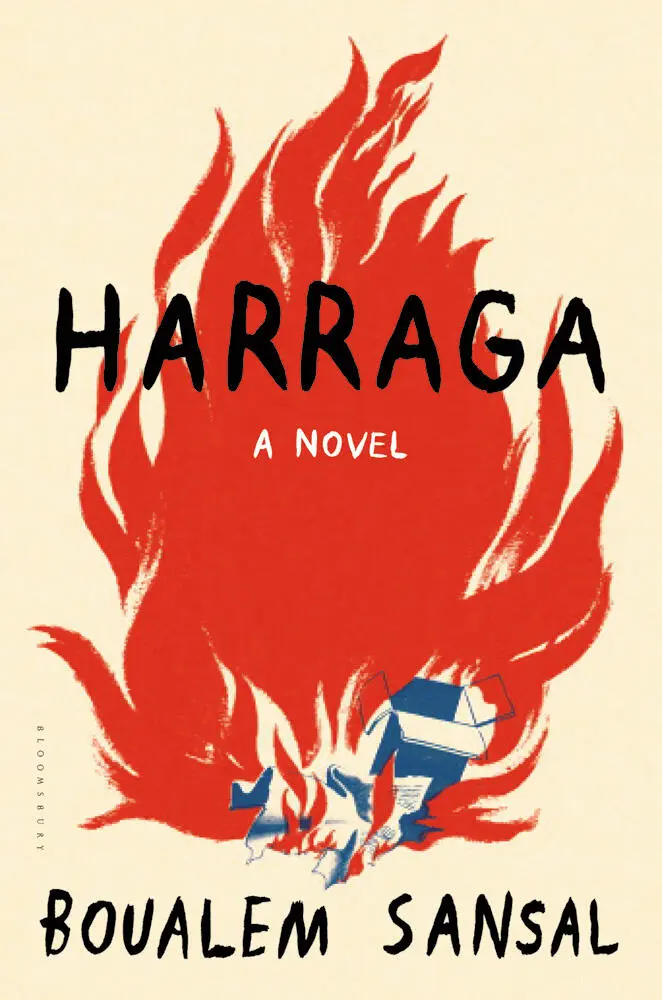
- Название:Harraga
- Автор:
- Издательство:Bloomsbury Publishing
- Жанр:
- Год:2014
- ISBN:нет данных
- Рейтинг книги:3 / 5. Голосов: 1
-
Избранное:Добавить в избранное
- Отзывы:
-
Ваша оценка:
Harraga: краткое содержание, описание и аннотация
Предлагаем к чтению аннотацию, описание, краткое содержание или предисловие (зависит от того, что написал сам автор книги «Harraga»). Если вы не нашли необходимую информацию о книге — напишите в комментариях, мы постараемся отыскать её.
Boualem Sansal creates, in Lamia, an incredible narrator: cultured, caustic, and compassionate, with an ironic contempt for the government, she is utterly convincing. With his deceptively simple story, Sansal delivers a brave indictment of fundamentalism that is also warm and wonderfully humane.
Harraga — читать онлайн бесплатно полную книгу (весь текст) целиком
Ниже представлен текст книги, разбитый по страницам. Система сохранения места последней прочитанной страницы, позволяет с удобством читать онлайн бесплатно книгу «Harraga», без необходимости каждый раз заново искать на чём Вы остановились. Поставьте закладку, и сможете в любой момент перейти на страницу, на которой закончили чтение.
Интервал:
Закладка:
And yet, for the longest time I found it impossibly romantic to be living here in Rampe Valée, this tangled world where mystery and misery battled it out in a hell of noise and dust and mud. It was a particular phase in my life when I subscribed to a certain idea of utopia, I was discovering Gandhi and Mother Teresa, Rimbaud and his cohorts, I felt a kinship with Calcutta, with Mogadishu, with the ghettos of Pretoria and the favelas of Bahia. I was electrified by tragedies in far-flung places. These days I’ve had enough, now I dream only of palaces, of carriages, of high society, of passionate fleeting affairs.
Opposite our lavish mansion was a drab little house, a sandcastle crowned with a peaked cap built by a man about whom we never really knew anything. Some said he worked on the streetcars, others that he worked for the National Tobacco and Safety Match Corporation, that he was a fitter for the gas company, a sales rep for Orangina, a tax inspector, a cement packer with Lafarge, a teacher of some unknown subject, and various other things. Too much information is no information. In short, everyone had their own view of him. During the war he was rarely spotted. After Independence, he disappeared or at least he kept a low profile. Some insisted that he was a traitor who had secretly supported French rule as an active member of the OAS and that sinister meetings had taken place within these walls, while others maintained it had been used as a safe house by one of the leaders of the FLN during the Battle of Algiers. Gradually, people began to forget, they left behind those stories of good guys and bad guys. Life after Independence was no bed of roses, the good ship Algeria was being skippered by incompetents and crooks, everyone aboard was panicking. With time memories fade, but they emerge again and so the thread of history remains unbroken. We told each other strange stories, about how our enigmatic neighbour had abandoned the house across the road because it was hunted — I mean haunted . It was a sorry sight, shrouded in cobwebs, creepers and weeds and encased like an ancient mummy in desiccated bird droppings. Only a single pair of shuttered windows is still visible; the windows that face my house. A ghost was the only logical explanation for such a baleful building and so that was what we decided, and ever afterwards we called it the ghost’s house . This is the ghost I now call Bluebeard. The neighbours give him other names, each related to their deepest fears: Bouloulou, Barbapoux, Azrael, Frankenstein, Dracula, Fantômas.
Only the old-timers still remember the period the good Doctor Montaldo spent living here. They refer to it as the poor man’s house , as though God himself had sojourned here and they resent me for not carrying on the tradition. I pull a few strings for them at the hospital when I have a chance, it’s my way of applying a little arnica to their memory, of earning their respect. The good doctor spent too much of his time tending to the poor and needy, he gave little thought to repairs, to comfort, to cosiness. His legacy includes a basin and a tap in the room he once used as his surgery, a collection of surgical instruments and medical books — which proved very useful to me in my studies. It’s astonishing how, in the past half a century, medical knowledge has changed without really changing. There is some indefinable difference between the textbooks of then and now, but I’m too dim to spot it. I would say it was context, but where does that get us? Mourad talks about governance, in fact it’s all he talks about, but I don’t know what the word means. I’m not ashamed to admit that medicine is just a job to me, there is nothing profound or poetic about it. How the hell can anyone practise genuine, sincere, caring, holistic medicine when everything — people, ethics, cities, hospitals — is going to hell in a handcart? If proof were needed, the good doctor died penniless and exhausted while many of his patients ended up rich and powerful. Many went on to rule us with an iron hand and their successors — military and religious — still do so today.
The memory of Doctor Montaldo brings a human face to my relationship with time even though I disapprove of treating villains as effectively as honest folk. In choosing paediatrics, I opted for the innocent; with children there can be no qualms of conscience, nice or not you treat them just the same and — hup! — off to bed.
Finally my family arrived here on a September day in the year of our Lord 1962. It was a Sunday, the sun was at its height, we stepped into the house as into a temple, heads bowed, awe-stricken. At least that’s how I imagine the scene, since I came into the world somewhat later. We had come from Kabylia — from the mountains, the poverty, the cold — and we were little more than troglodytes, stubborn to the marrow and in permanent revolt against the Caïd and the capital. Now we found ourselves perched high above the capital, living in this magnificent mansion — vast, labyrinthine, mysterious, Olympian. And antiquated, with deep wrinkles and a look about it as though it had forgotten how to weather time. How Papa came to own this house I have no idea; he had his secrets and he took them to his grave. I was born ten years after my older brother Yacine on an October day in 1966. For seven long years, war had kept my parents apart, and it took them three more years to learn to rekindle the passion of lovebirds. Papa needed to forget the harsh realities of the maquis while Maman needed to remember what, over time, she had forgotten. We were the first native-born Algerians to own this extraordinary house. We felt as though, since the dawn of time, it had been waiting for us to arrive when in fact we hadn’t had the first idea where we were going. Uprooted from our mountain lair, we looked out at the sky as though it were boundless. The house had known so many people, had travelled far and wide. It taught us much about ourselves and about its former occupants. Scarcely credible stories of lives as hazy as mirages, true tales filled with spice and suspense. The lightest ones always float to the surface, but vast, unfathomed depths lie beneath, throbbing like a pulsar. How would we ever have known of the existence of vampires if the mysterious Carpatus had stayed in his native Transylvania? The djinns that populated our oldest memories suddenly seemed less powerful, but they were more sympathetic since they fed, not on hot blood sucked from the carotid artery of another human being, but upon the same misery we did. Would I have chosen to study medicine had I not stumbled upon Doctor Montaldo’s textbooks as a girl? Where else would we have come upon the stories, the sayings, the jokes from distant lands that enlivened our evenings? Not to mention the humdrum things we gradually discovered about life, the world, the customs and habits of different peoples, the way their stories intertwined with ours, and the interminable questions that clutter the mind from dawn till dusk — the why of one thing, the how of another — and all that this entails, the obsessive fears, the wounded silences, the constant migraines. An ancient house is a succession of stories laid down in strata, thick or thin, with evil sprites flitting along seams and veins. And this is how we experienced it — in exaltation, striving and doubt.
Everything about this place speaks of ancient mysteries.
This house, my house, has also taught me sorrow, fear and loneliness.
That is the story of my family. The house is the centre, time is Ariadne’s thread which must be uncoiled without being broken. I am the last to live here. When I am gone, it will crumble and the story will be over.
While brooding about all this and cursing Sofiane’s recklessness, I had a sort of epiphany: yesterday, today and doubtless tomorrow and on until the end of time, more people have fled this country than have arrived. There is no logic to it, it is not in the nature of the earth to bring forth a vacuum, no mother dreams of driving her children away and no man has the right to uproot another from his birthplace. It is a curse that has survived from century to century from Roman times when we were wild-eyed Circumcellions razing farms all the way to the present day when, since we cannot all burn our bridges and flee, we live with our bags permanently packed. This is a huge country, vast enough to accommodate whole peoples; if necessary we could have taken more from our neighbours who don’t need so much space, but no, at some point or other the curse returns and the vacuum brutally swells. Since the beginning of time we have always been harragas , those who burn a path, such is the course of our history.
Читать дальшеИнтервал:
Закладка:
Похожие книги на «Harraga»
Представляем Вашему вниманию похожие книги на «Harraga» списком для выбора. Мы отобрали схожую по названию и смыслу литературу в надежде предоставить читателям больше вариантов отыскать новые, интересные, ещё непрочитанные произведения.






Обсуждение, отзывы о книге «Harraga» и просто собственные мнения читателей. Оставьте ваши комментарии, напишите, что Вы думаете о произведении, его смысле или главных героях. Укажите что конкретно понравилось, а что нет, и почему Вы так считаете.