Boualem Sansal - Harraga
Здесь есть возможность читать онлайн «Boualem Sansal - Harraga» весь текст электронной книги совершенно бесплатно (целиком полную версию без сокращений). В некоторых случаях можно слушать аудио, скачать через торрент в формате fb2 и присутствует краткое содержание. Год выпуска: 2014, Издательство: Bloomsbury Publishing, Жанр: Современная проза, на английском языке. Описание произведения, (предисловие) а так же отзывы посетителей доступны на портале библиотеки ЛибКат.
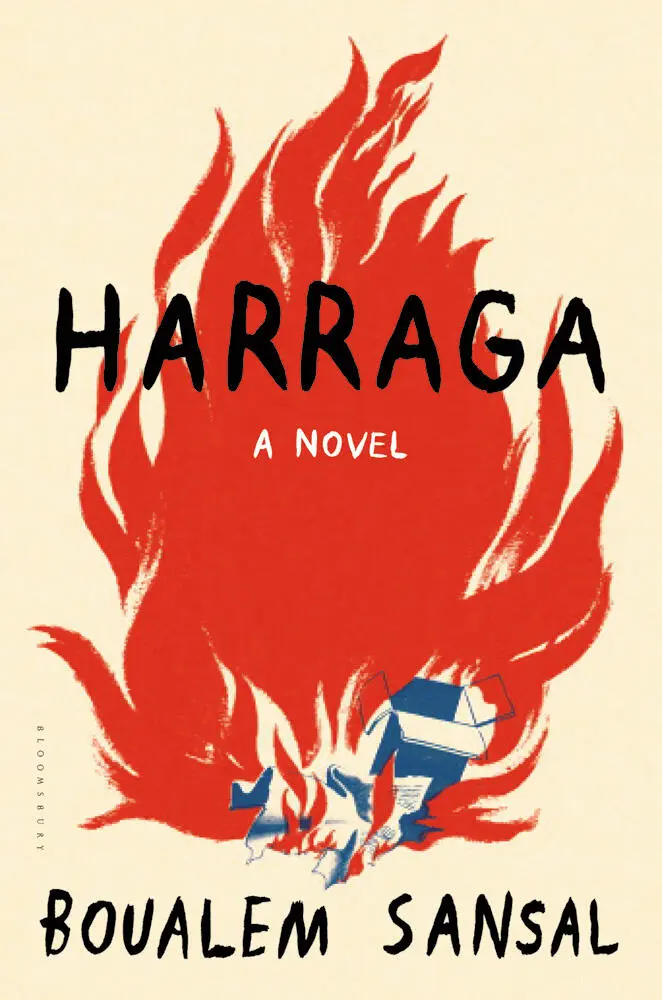
- Название:Harraga
- Автор:
- Издательство:Bloomsbury Publishing
- Жанр:
- Год:2014
- ISBN:нет данных
- Рейтинг книги:3 / 5. Голосов: 1
-
Избранное:Добавить в избранное
- Отзывы:
-
Ваша оценка:
Harraga: краткое содержание, описание и аннотация
Предлагаем к чтению аннотацию, описание, краткое содержание или предисловие (зависит от того, что написал сам автор книги «Harraga»). Если вы не нашли необходимую информацию о книге — напишите в комментариях, мы постараемся отыскать её.
Boualem Sansal creates, in Lamia, an incredible narrator: cultured, caustic, and compassionate, with an ironic contempt for the government, she is utterly convincing. With his deceptively simple story, Sansal delivers a brave indictment of fundamentalism that is also warm and wonderfully humane.
Harraga — читать онлайн бесплатно полную книгу (весь текст) целиком
Ниже представлен текст книги, разбитый по страницам. Система сохранения места последней прочитанной страницы, позволяет с удобством читать онлайн бесплатно книгу «Harraga», без необходимости каждый раз заново искать на чём Вы остановились. Поставьте закладку, и сможете в любой момент перейти на страницу, на которой закончили чтение.
Интервал:
Закладка:
After Ben Chekroun had finished his labours, the house fell into the hands of an immigrant newly arrived from far-off Transylvania. We never quite knew what that meant, but we suspected that he was Romanian by day, Hungarian by night and a ferryman in times of trouble. It was as he took his last step down the steamship’s gangplank that the rogue and the stranger met by sheer chance. It is possible that, as has been attested, the deal was struck quickly and quietly in the best interests of all concerned. But that is simply legalistic jargon, a magical incantation; I am more inclined to believe that two deaf-mutes could not have made more noise in trying to make themselves heard. Ben Chekroun was, after all, a man of some importance and the newcomer was not just anyone. He is remembered as a character who might have stepped straight out of the silver screen. Perhaps it is possible to be born in the Carpathians and retain one’s humanity, but our character believed only in the supernatural. Vampires were his friends, he spoke of them as of some eternal truth. When he arrived, he bore the unpronounceable name Tartem-something-or-other; his first name, a real tongue-twister, was Crzhyk-I-forget-what. A simple greeting was a real mouthful. Back in the snow-capped mountains of Transylvania, he had served a Voivode — a warlord — descended from the race of Phanariotes about whom the literature of the region has nothing good to say. In short, he had learned from a master the gentle art of treachery. I suspect the negotiations were dramatic and long-drawn-out and attracted a vast crowd. A quick trip to the town hall and suddenly our friend Tartem-thingumabob declares himself ready to die for the country of Rousseau. Immediately, the insults hurled at him by first-generation immigrants ceased. Overnight, he became just another pied noir like everyone else. Back then, integration simply meant shucking your shoes and donning a beret. Once you’d done that, you could run around proclaiming that you had truly arrived. ‘ Ze suis frantuzeasca?! ’ he roared, as the Negroes on the docks waiting for corvettes might have yelled ‘ Bwana, bwana! ’ I assume people said such things, it was in the spirit of the times, part of the local colour of the period, like gas streetlamps. From that day forth, he styled himself François Carpatus. He cannily established a reputation as an excellent repairman, which brought customers to his ironmongery-cum-seed-merchants-cum-grocery-cum-haberdashery-cum-gunsmiths-cum-perfumery, a chaotic Aladdin’s cave of the kind that existed long ago. A terror of vampires, hitherto unknown in our part of the world, mysteriously spread through the medina and with it the remedies to be rid of it, from garlic braids to consecrated wooden stakes. It was François Carpatus who converted our barn into a shop, something that proved extremely profitable for those who came after him — all except for Doctor Montaldo, the last occupant of the house before we arrived. Nor was it particularly profitable for us, since by then the Algerian government had decided to adopt the Soviet model of feeding a starving populace, and we were not granted a licence to run a shop (Papa dreamed of owning a delicatessen stocked with everything that anyone could want).
Towards the end of his life, at the turn of the twentieth century, M. Carpatus suffered a mysterious ailment, a sort of delirium tremens brought on by an overdose of garlic. After a number of fruitless treatments, he emigrated to the United States and was never heard of again. American vampires clearly did not recognise him as one of their own.
It’s difficult to know exactly what happened next, the machinations and the manoeuvres, the whole business was shrouded in secrecy, but the house was bought by… a certain Daoud Ben Chekroun! By this time, Carpatus was no longer in his right mind and may rashly have sold his assets at a knock-down price; then again, pretending to be mad can be a great advantage in negotiations.
All sorts of ridiculous rumours have been circulated by wagging tongues about the aforementioned Mustafa, Louis-Joseph-Youssef, Ben Chekroun, Carpatus. A crooked Turk, a Frenchman who stumbled into the melting pot of Islam, a wandering Jew, an abominable snowman from the Carpathians, a Doctor Schweitzer who died on the job. What better tales to inspire a wandering storyteller? As children we lapped it up, we delighted in these far-fetched stories which also enhanced the prestige of our house. Genies, vampires, hidden treasures, apparitions by prophets, paranormal phenomena, Jewish fables, we had stories enough to while away many a pleasant evening. Other people might have envied us.
These tales still run through my head, they fuse, they feed on one another, speaking in their different tongues, garbed in their different costumes. I shift from one century to another, one foot here and my head on some distant continent. This explains why I seem to be from everywhere and nowhere, a stranger in this country and yet firmly entrenched within these walls. Nothing is more relative than the origin of things.
Fantasies have always been the means of killing time in Rampe Valée. People who live by old stories do not notice the passing of time, if I can put it like that.
Throughout the first half of the twentieth century — a dismal period — the house was occupied by various nonentities, pen-pushers, newcomers, large families. They all knew Daoud Ben Chekroun through his kids, Jacob, Zadok, Elijah and his great-nephews Ephraim and Mordecai (though they knew them by their Muslim names). Sceptics might suspect some posthumous ploy on the part of the old curmudgeon, but in fact the subterfuge was dictated by events. The turbulent period was marked by successive waves of Jewish immigrants to Algeria which, with a contemptuous click of their tongue, people back then brazenly referred to as the Yid Invasions. Such prejudices were fuelled by the Socialist anti-Jewish leagues, the Crémieux Decree, the Dreyfus Affair and Musette’s tales of the vagabond Cagayous. This is history, it is convoluted and calamitous. The newcomers, as I said, stayed just long enough to put together a case file and lodge it with the town hall. Meanwhile, an ideal habitat for the Town Mouse had just been devised: the tower block. As wealth trickled down to the colonies, tower blocks sprang up in Algiers and its suburbs. A vast procession of people cheerfully rushed to live there, transporting their belongings in vans, in handcarts, on pack mules, in convoys led by children singing at the tops of their voices as little old ladies trailed behind devoutly muttering suras . No sooner had they climbed the stairs and set up camp than pennants — and laundry — were hoisted on the balconies. The war between neighbours could now begin. As I set down the story of my misfortunes, that war is beginning to seem like a massacre, one covertly fuelled by those who work as government officials by day and estate agents by night. At the foot of the stairwells, the children finish off the wounded and race to see the imam for their reward. All these fleeting comings and goings did much damage to the house. The series of ‘renovations’ proved in time to be mutilations: veneer, formica, linoleum and leatherette gradually invaded the venerable old house driving out the terracotta floor-tiles, the stucco, the mosaics and the coppers, even the lingering smell of old leather. It was a terrible shame.
The neighbourhood changed radically. It became a warren. Buildings sprang up here and there, this way and that, aslant and askew, seedy hovels and lavish residences, a maze of narrow streets and blind alleys appeared out of nowhere and with them crooked flights of steps, rubbish tips, open sewers, filthy gutters, cowsheds, cheap restaurants, a synagogue, seven mosques, some sort of temple that vanished into the crowd, three cemeteries, cramped shops, brothels, overflow pipes, smithies and, later, two or three schools built of corrugated iron on the children’s playgrounds and a complaints office that was burned to the ground on the precise day and time it was inaugurated by the mayor and his entourage of estate agents. Out of the misery of the mid-twentieth century, a favela was born, one that may endure for centuries.
Читать дальшеИнтервал:
Закладка:
Похожие книги на «Harraga»
Представляем Вашему вниманию похожие книги на «Harraga» списком для выбора. Мы отобрали схожую по названию и смыслу литературу в надежде предоставить читателям больше вариантов отыскать новые, интересные, ещё непрочитанные произведения.






Обсуждение, отзывы о книге «Harraga» и просто собственные мнения читателей. Оставьте ваши комментарии, напишите, что Вы думаете о произведении, его смысле или главных героях. Укажите что конкретно понравилось, а что нет, и почему Вы так считаете.