Reif Larsen - I Am Radar
Здесь есть возможность читать онлайн «Reif Larsen - I Am Radar» весь текст электронной книги совершенно бесплатно (целиком полную версию без сокращений). В некоторых случаях можно слушать аудио, скачать через торрент в формате fb2 и присутствует краткое содержание. Год выпуска: 2015, Издательство: Penguin Press, Жанр: Современная проза, на английском языке. Описание произведения, (предисловие) а так же отзывы посетителей доступны на портале библиотеки ЛибКат.
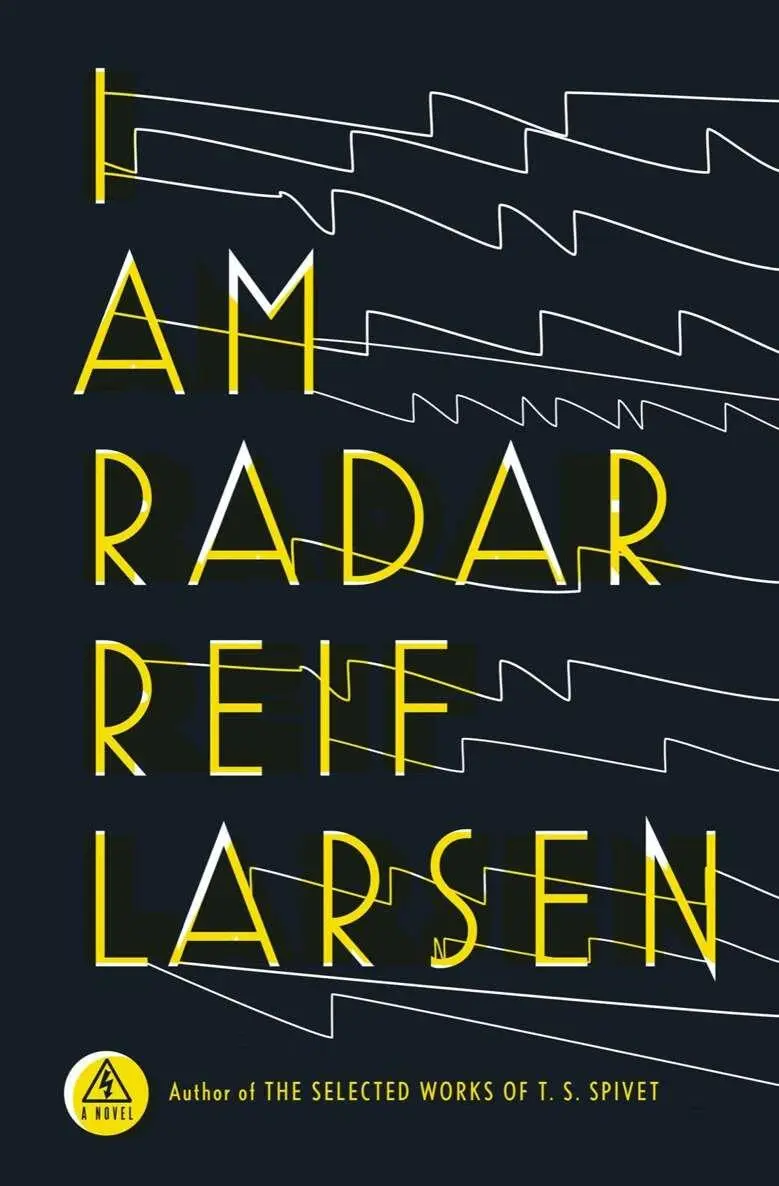
- Название:I Am Radar
- Автор:
- Издательство:Penguin Press
- Жанр:
- Год:2015
- ISBN:нет данных
- Рейтинг книги:3 / 5. Голосов: 1
-
Избранное:Добавить в избранное
- Отзывы:
-
Ваша оценка:
I Am Radar: краткое содержание, описание и аннотация
Предлагаем к чтению аннотацию, описание, краткое содержание или предисловие (зависит от того, что написал сам автор книги «I Am Radar»). Если вы не нашли необходимую информацию о книге — напишите в комментариях, мы постараемся отыскать её.
I Am Radar Deep in arctic Norway, a cadre of Norwegian schoolteachers is imprisoned during the Second World War. Founding a radical secret society that will hover on the margins of recorded history for decades to come, these schoolteachers steal radioactive material from a hidden Nazi nuclear reactor and use it to stage a surreal art performance on a frozen coastline. This strange society appears again in the aftermath of Cambodia’s murderous Khmer Rouge regime, when another secret performance takes place but goes horrifically wrong. Echoes of this disaster can be heard during the Yugoslavian wars, when an avant-garde puppeteer finds himself trapped inside Belgrade while his brother serves in the genocidal militia that attacks Srebrenica. Decades later, in the war-torn Congo, a disfigured literature professor assembles the largest library in the world even as the country around him collapses. All of these stories are linked by Radar — now a gifted radio operator living in the New Jersey Meadowlands — who struggles with love, a set of hapless parents,and a terrible medical affliction that he has only just begun to comprehend.
I Am Radar — читать онлайн бесплатно полную книгу (весь текст) целиком
Ниже представлен текст книги, разбитый по страницам. Система сохранения места последней прочитанной страницы, позволяет с удобством читать онлайн бесплатно книгу «I Am Radar», без необходимости каждый раз заново искать на чём Вы остановились. Поставьте закладку, и сможете в любой момент перейти на страницу, на которой закончили чтение.
Интервал:
Закладка:
Xanadu, Xanadu . . What was Xanadu?
He had heard this name before. In a movie? Or was it a book? He cursed his ignorance of pop culture. His time was ticking away. He looked at his watch. It was 8:23 P.M. He estimated he was already down to forty-five minutes.
The house was dark. He lit another candle and headed upstairs.
“Mom?” he called.
She was lying on her bed, listening to a hand-cranked record player crackling away on the floor. The windows were wide open. There was a collection of uncapped sniffing bottles on the bedside table.
“He still isn’t back?” she said.
“No,” he said.
“I wonder where he’s gone off to?” she said. “Obviously he feels no obligation to protect his own family.”
“I’m sure he has good reason.”
She shifted on the bed. “This is his favorite piece,” she said.
“What is?”
“Caruso singing ‘Una furtiva lagrima.’ We used to take this out and listen together after you had gone to sleep. We would hold hands. Can you believe it? Holding hands, ” she said. “I pulled out the record player and thought that if I played it, I might lure him back.”
So they both had their homing beacons: his was liquor; hers was music.
They were quiet, listening to the aria. Caruso sustained, inspected, and released a high note out through the windows and into the ether.
“Where could he be?” she said. “I don’t have a good feeling about this.”
“It’s going to be okay,” he said. “You’ll see. There’ll be some explanation and we’ll all laugh about this later.”
Charlene reached over and sniffed one of the bottles on her bedside table.
“I still can’t smell a thing,” she said.
“I’m sure it’ll come back.” He went over and sat on the bed. “You did really good today, Mom. You helped a lot of people. Tata would be proud.”
“Are you sure he’s not in his shack?”
“I—” He again thought about telling her all. “No. I checked.”
He lay down beside her. His parents’ room had morphed and changed colors and layout over the years, but lying on his back now, he was able to recall all of those nights when he would burrow down between his parents after having a nightmare, Kermin sideways and snoring, Charlene rubbing his back and humming a little lullaby. In his memory, this room was a place no nightmares could penetrate.
After a final exhortation from Caruso, the aria clicked to an end. The needle shifted into an endless groove, spinning around and around. Radar got up, cranked the box several times, and then flipped the record to the other side.
“It’s amazing the things that still work now,” he said. “Maybe we’ll become a mechanical society. Everything will be hand-cranked.”
“Do you think we’ll ever get the electricity back?” she asked.
“I think so,” he said. “The city already got its power back. But then, I don’t think the city got hit like we did.”
“Ha! Of course. The city will always have its power.”
“Mom,” said Radar, “what’s Xanadu?”
“Xanadu?” she said. “You mean the poem?”
“The poem?”
She began to orate in a faux British accent:
In Xanadu did Kubla Khan
A stately pleasure-dome decree:
Where Alph, the sacred river, ran
through caverns measureless to man
Down to a sunless sea.
“What is that?” he said.
“Coleridge,” she said. “I wasted my time in college writing a useless thesis about Coleridge and narrative fragmentation.”
“It doesn’t sound so useless.”
“Oh, it was. I think the title was ‘Completion as a Function of Interruption’ or some nonsense like that.”
“But is Xanadu an actual place?”
“I think it did exist in China once upon a time.”
“But I mean, we couldn’t actually go to Xanadu now, right?”
“No, but then, that’s the whole point. It’s something not real. . The poem was famous in part because it was incomplete.”
“How do you mean?”
“Coleridge claimed he had been reading this book about Kublai Khan right before he smoked some opium and then he fell asleep. And while he was sleeping, he had this very vivid dream about a poem. . a complete poem, in five parts. . something like three hundred lines long. And so he wakes up and begins writing it all down. But then the doorbell rings and a visitor from Porlock interrupts him. The visitor stays for about an hour or so, and when Coleridge finally gets back to writing the poem, he’s forgotten the rest.”
“So what did he do?”
“He left it as it was. At least that’s what he claimed. A lot of people think he made the whole story up, but I guess I just loved the idea of this mysterious visitor from Porlock coming in and interrupting genius at work. It’s the idea that if only we hadn’t been interrupted, then we could’ve accomplished our magnum opus. . but in the end, we come to realize that the interruption is the work itself.” She paused, opening and closing her hand like a jellyfish. “Did you know that in Lolita, Quilty checks into the hotel as ‘A. Person, Porlock, England’?”
Radar was suddenly struck by the depth of his mother’s knowledge. He realized he had never once asked her about her college thesis. He had always dismissed her as his slightly less hapless parent, when in fact, here she was, a walking literary encyclopedia, a font of information, untapped for all these years. How had he never quite understood this? Perhaps because proximity — contrary to popular belief — did not breed clarity. Her habits were not habits, but merely the backdrop for his own upbringing, quite literally: for as long as he could remember, sheets had obscured all of the bookshelves in the house. He had grown up thinking of books as something dirty, to be kept but never shown, which might explain why as a teenager he would regularly develop random erections in the school library. But these books, her books, hidden as they were, had all been considered, read, placed in an order dictated by a mind at work. For the first time, he saw her as a fully functioning being, someone other than just his mother.
“A. Person, Porlock, England,” he repeated.
“When I first read that, I almost died. It was like Nabokov and I were living in the same world. We were not so different, he and I. We both had our Porlocks.”
“Someone said they would meet me at Xanadu.” He reached into his fanny pack and took out the scrap of paper. “Xanadu P4 D26.”
“Sounds very Dadaistic.”
“I think it’s some sort of code.”
“You mean like spies ?” she said.
“Some kind of transposition cipher or something.”
“Or maybe they were talking about Xanadu.”
“What do you mean?”
“You know, Xanadu —that monstrosity by the football stadium.”
“What monstrosity by the football stadium?” Radar said. A dim light flickered in his head.
“You know, the mall. Xanadu. The building with the awful stripes?”
The awful stripes. Yes . Why hadn’t he thought of it before? Xanadu . The answer had been staring him in the face the entire time. Of course.
“It’s the mall!” he whispered.
“It’s an abomination,” she said. “Have you seen that thing?”
She was right. It was an abomination. Billed as “the largest mall in the world,” the hideously gargantuan pajama-striped mega shopping complex sat at the confluence of the New Jersey Turnpike and Route 3, just across from the newly constructed Meadowlands Stadium, a stone’s throw from the Hackensack River. One day soon, Xanadu promised to offer six million square feet of glory for the entire family, including an indoor ski slope, a skydiving tunnel, a skating rink, a water park, and a three-hundred-foot Ferris wheel that orbited a giant Pepsi symbol visible for twenty-five miles on a clear day. The only problem was that it looked like a day care turned terrorist detention center and had been languishing, empty, for years now — ever since its primary backers, Lehman Brothers and the Mills Corporation, had both gone belly up. Xanadu had been renamed Xanadu Meadowlands Mall, which was then shortened to Meadowlands Mall, which had recently been rechristened again as the American Dream Meadowlands Mall. But Xanadu would always be Xanadu.
Читать дальшеИнтервал:
Закладка:
Похожие книги на «I Am Radar»
Представляем Вашему вниманию похожие книги на «I Am Radar» списком для выбора. Мы отобрали схожую по названию и смыслу литературу в надежде предоставить читателям больше вариантов отыскать новые, интересные, ещё непрочитанные произведения.









Обсуждение, отзывы о книге «I Am Radar» и просто собственные мнения читателей. Оставьте ваши комментарии, напишите, что Вы думаете о произведении, его смысле или главных героях. Укажите что конкретно понравилось, а что нет, и почему Вы так считаете.