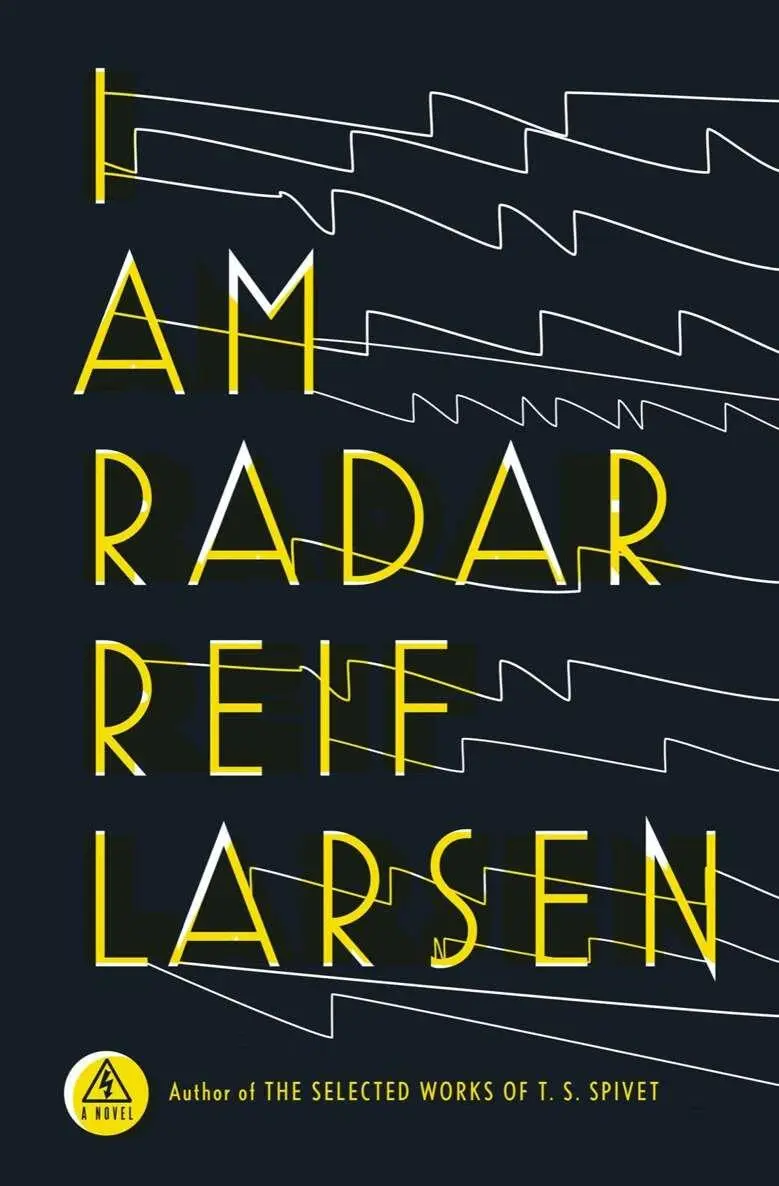
Reif Larsen - I Am Radar
Здесь есть возможность читать онлайн «Reif Larsen - I Am Radar» весь текст электронной книги совершенно бесплатно (целиком полную версию без сокращений). В некоторых случаях можно слушать аудио, скачать через торрент в формате fb2 и присутствует краткое содержание. Год выпуска: 2015, Издательство: Penguin Press, Жанр: Современная проза, на английском языке. Описание произведения, (предисловие) а так же отзывы посетителей доступны на портале библиотеки ЛибКат.
- Название:I Am Radar
- Автор:
- Издательство:Penguin Press
- Жанр:
- Год:2015
- ISBN:нет данных
- Рейтинг книги:3 / 5. Голосов: 1
-
Избранное:Добавить в избранное
- Отзывы:
-
Ваша оценка:
I Am Radar: краткое содержание, описание и аннотация
Предлагаем к чтению аннотацию, описание, краткое содержание или предисловие (зависит от того, что написал сам автор книги «I Am Radar»). Если вы не нашли необходимую информацию о книге — напишите в комментариях, мы постараемся отыскать её.
I Am Radar Deep in arctic Norway, a cadre of Norwegian schoolteachers is imprisoned during the Second World War. Founding a radical secret society that will hover on the margins of recorded history for decades to come, these schoolteachers steal radioactive material from a hidden Nazi nuclear reactor and use it to stage a surreal art performance on a frozen coastline. This strange society appears again in the aftermath of Cambodia’s murderous Khmer Rouge regime, when another secret performance takes place but goes horrifically wrong. Echoes of this disaster can be heard during the Yugoslavian wars, when an avant-garde puppeteer finds himself trapped inside Belgrade while his brother serves in the genocidal militia that attacks Srebrenica. Decades later, in the war-torn Congo, a disfigured literature professor assembles the largest library in the world even as the country around him collapses. All of these stories are linked by Radar — now a gifted radio operator living in the New Jersey Meadowlands — who struggles with love, a set of hapless parents,and a terrible medical affliction that he has only just begun to comprehend.
I Am Radar — читать онлайн бесплатно полную книгу (весь текст) целиком
Ниже представлен текст книги, разбитый по страницам. Система сохранения места последней прочитанной страницы, позволяет с удобством читать онлайн бесплатно книгу «I Am Radar», без необходимости каждый раз заново искать на чём Вы остановились. Поставьте закладку, и сможете в любой момент перейти на страницу, на которой закончили чтение.
Интервал:
Закладка:
In their own backyard, there was a path — carefully lit at all hours by theatrical clamshell lights — that led to the “playpen,” as Charlene called it, the radio shack into which Kermin had retreated, full stop. The shack itself was not very remarkable except for its outsize appendage: a giant 119-foot antenna tower with multiple dipoles and rotatable reflectors mounted up and down its trunk. Even Radar, supposed champion of wave propagation and far-flung DXing, would have been the first to tell you that the tower was obscene and unnecessary, its soaring reticulation shivering upward like the twisted hand of a dying corpse. Here, writ large, was the conundrum of the amateur radioman’s antenna: there were always more signals to catch, always that obscure 5.910-MHz radio wave from Papua New Guinea that could be corralled with just the right forty-five-foot parallel yagi. And so the antenna would grow, collecting its metallic progeny, until it threatened to collapse under its own excess. When he had installed it ten years earlier, the neighbors all served complaints and held town meetings and tried to sue Kermin, but he had done his homework: as long as the tower was under 120 feet and posed no immediate health risk, it was perfectly legal. God bless America.
On the day it was finally complete, when the cranes had left and the very last dump truck had hauled away its load, Kermin, bleeding freely from the forehead after being stabbed by some errant antenna spoke, came into the living room and announced: “We are now part of the world.”
The opposite was true. One year later, he finally shuttered his shop, a business that had been failing steadily since its opening. It could now be freely said out in the open: the Sony Watchman™ had been a flop. Kermin, long blind to the writing on the wall, had been slow to adapt to new, successful technologies. For years, Ravna Gora Communications had languished as one of those sad, musty repair stores with no one coming or going save its hunchbacked owner, haunting his collection of junk like a ghost of spare parts past. After the shop’s closure, with no real reason to leave the house, Kermin had hunkered down in his shack at the base of that monstrosity. He now left their property only to fetch an obscure part at J & A Specialties Electronics or to walk the banks of the Passaic River when a technical problem was particularly vexing.
The strange thing was that for all of their supposed overlap in interest and expertise, Kermin would never talk with Radar about his work in the shack. Radar had learned long ago to stop asking. He had also accepted that no matter his own qualifications, he would never gain entrance into that sacred ground. Such a prohibition might’ve seemed gratuitous once upon a time, but now it was just another fact of life. The closest he had come was several lingering peeks when the door was momentarily left ajar, before Kermin noticed the trespass and snapped the door shut like a lizard’s mouth.
“This world is so big,” he once said. “I just want one space that is only mine.”
After the tower went up, Radar had asked if he could tap the mighty antenna to service his own modest ham station in his bedroom. Kermin had refused. Late one night, Radar tried to run a discreet coaxial line into the tower’s box, but Kermin found it on his inspection rounds the next day and ripped up the cable.
“We must not let others do work we should be doing,” Kermin said, dangling the offensive wire like a demised serpent.
“But I’m your son,” said Radar.
“This is the lesson: find your own frequency,” said Kermin. “If you want tower, buy tower, and place tower next to mine. But please don’t cast signal shadow. And you might want to make less than ten meters high so the neighbor won’t get feisty again.”
Radar never did end up building his own tower.
• • •
ON THE DOOR TO the shack, his father had hung the alphanumerics of his call sign, K2W9, carefully burned into a board of stained maple alongside a framed picture of a cartoon radio tower expelling boisterous, parenthetical signals. Radar rapped out a K, dah-dit-dah ——, on the door. In the past, confronting the shack had always been a reminder of the balance of power in this world, for it was still a forbidden place, a monument to his father’s tenuous generational hold on the reins of authority. But now that the current was gone, the shack suddenly seemed sad and useless, its antenna a ridiculous hubristic appendage. What would he find inside? His father weeping amid a sea of dead receivers?
Radar knocked again. Dah-dit-dah —— . Dah-dit-dah —•—.
No answer. All was quiet.
He tried the door, assuming it would be double-bolted, but found, to his surprise, that it was unlocked. He tentatively pushed it open. His internal motor hiccuped, upshifted, spinning its gears at this rare chance to glimpse the shack’s coveted interior.
“Hello? Tata? You in there? There’s been a. .”
An intense wave of burnt metal wafted out from the gloom. He coughed, reeling backwards. The smell made him shudder and gag at the same time.
“ Tata? Are you okay?” he called into the gloom, knowing even as he said it that if anyone was inside there, it was highly unlikely they would be okay. He lifted the collar of his shirt above his nose and ventured forth.
“Tata!” he yelled.
The open door let some light into the hut’s darkened interior. The place looked like a disaster zone. Several large shelves had collapsed, spilling heaps of equipment onto the floor. Nearly every surface was covered with electrical components — buckets of antennae, spare parts, wires dangling from the ceiling, all manner of radios in various states of decay. Radar peered into the darkness. Nothing appeared to be on fire, but the smell of cordite was incredibly strong. One wall was completely black and scorched.
In the middle of the room, Radar spotted a giant machine. A long series of interlocking metal cylinders ending in a large cone. It looked like a futuristic ray gun. Radar took a step forward. What the hell was this thing? He noticed that the end opposite the cone appeared heavily damaged. The metal was twisted and gnarled. This must have been what he smelled. It looked as if there had been some kind of explosion.
Radar carefully approached, fearful of another blast. He put a hand on the smooth barrel of the machine. There were three main parts to it: the end that had burst open, the middle series of cylinders, which were covered in a sea of wires, and then the cone, which was made of a very fine mesh.
Could it be? Radar closed his eyes. Counted to three. Opened them again. The machine was still there.
All at once, he realized he had seen this machine before. It was in a science magazine that had been floating around their house for years.
But no. It was preposterous. He could not believe it. This was from a science fiction movie. It couldn’t be real.

Fig. 3.7. Explosively Pumped Flux Compression Oscillating Cathode Electromagnetic Pulse Generator
From Radasky, W. (2005), “Non-Nuclear Electromagnetic Pulse Generators,” Journal of Electrical Engineering 27: 24–31
And yet all the proof was here: the exploded flux compression generator that would precipitate the massive blast of electrons, the barrel-like vircator to shape this blast into a brief, powerful pulse of microwave energy, and the conical antenna to diffuse and direct the pulse. He would never have thought it was possible to build a machine like this without massive governmental support, yet here it was. Not only had his father built it ( Where had he gotten the parts? ), but it had actually worked . The pulse must have been magnified by the giant 119-foot antenna above the shack and been broadcast across a huge area.
Читать дальшеИнтервал:
Закладка:
Похожие книги на «I Am Radar»
Представляем Вашему вниманию похожие книги на «I Am Radar» списком для выбора. Мы отобрали схожую по названию и смыслу литературу в надежде предоставить читателям больше вариантов отыскать новые, интересные, ещё непрочитанные произведения.












Обсуждение, отзывы о книге «I Am Radar» и просто собственные мнения читателей. Оставьте ваши комментарии, напишите, что Вы думаете о произведении, его смысле или главных героях. Укажите что конкретно понравилось, а что нет, и почему Вы так считаете.