Reif Larsen - I Am Radar
Здесь есть возможность читать онлайн «Reif Larsen - I Am Radar» весь текст электронной книги совершенно бесплатно (целиком полную версию без сокращений). В некоторых случаях можно слушать аудио, скачать через торрент в формате fb2 и присутствует краткое содержание. Год выпуска: 2015, Издательство: Penguin Press, Жанр: Современная проза, на английском языке. Описание произведения, (предисловие) а так же отзывы посетителей доступны на портале библиотеки ЛибКат.
- Название:I Am Radar
- Автор:
- Издательство:Penguin Press
- Жанр:
- Год:2015
- ISBN:нет данных
- Рейтинг книги:3 / 5. Голосов: 1
-
Избранное:Добавить в избранное
- Отзывы:
-
Ваша оценка:
I Am Radar: краткое содержание, описание и аннотация
Предлагаем к чтению аннотацию, описание, краткое содержание или предисловие (зависит от того, что написал сам автор книги «I Am Radar»). Если вы не нашли необходимую информацию о книге — напишите в комментариях, мы постараемся отыскать её.
I Am Radar Deep in arctic Norway, a cadre of Norwegian schoolteachers is imprisoned during the Second World War. Founding a radical secret society that will hover on the margins of recorded history for decades to come, these schoolteachers steal radioactive material from a hidden Nazi nuclear reactor and use it to stage a surreal art performance on a frozen coastline. This strange society appears again in the aftermath of Cambodia’s murderous Khmer Rouge regime, when another secret performance takes place but goes horrifically wrong. Echoes of this disaster can be heard during the Yugoslavian wars, when an avant-garde puppeteer finds himself trapped inside Belgrade while his brother serves in the genocidal militia that attacks Srebrenica. Decades later, in the war-torn Congo, a disfigured literature professor assembles the largest library in the world even as the country around him collapses. All of these stories are linked by Radar — now a gifted radio operator living in the New Jersey Meadowlands — who struggles with love, a set of hapless parents,and a terrible medical affliction that he has only just begun to comprehend.
I Am Radar — читать онлайн бесплатно полную книгу (весь текст) целиком
Ниже представлен текст книги, разбитый по страницам. Система сохранения места последней прочитанной страницы, позволяет с удобством читать онлайн бесплатно книгу «I Am Radar», без необходимости каждый раз заново искать на чём Вы остановились. Поставьте закладку, и сможете в любой момент перейти на страницу, на которой закончили чтение.
Интервал:
Закладка:
The employee-of-the-month awards were not undeserved. In truth, he probably should have won the accolade every month, but then, this would not have been good for company morale. Radar was that good. A bona fide professional. No — what was the step above bona fide professional? A natural. A motherfucking sorcerer . He would glide his hands across the stacks of panels, checking the levels, whispering a knob here or there, often with eyes closed, adjusting the modulators and repeaters and phase monitors as if he were playing a perfectly sculpted contrapuntal fugue. In that precise moment of propagation and frequency, amplitude and scissor-slip wattage, he was the Buddha himself sitting beneath the electrical bodhi tree.
Radar’s unique spiritual connection to the machines also made it difficult to find another human who enjoyed working with him in that swampland radio outpost. He had gone through no fewer than twenty-one partners in his thirteen years, from poor old Ernie Bailey to his current co-workers, Gary “Knock Yourself Out” Balkin and Moses “Mo’ Money” Rodriguez. The managers seemed willing to accept this revolving door of placeholders in order to keep around an employee who looked mostly humanoid but functioned more like an extension of their radio transmission system. On his watch, they had never lost signal. Not once. How this was possible, the station execs in Manhattan could not say. Every station lost signal — it was the way of the world, of the incoherent spectrum, of the random grumblings of electrons, but Radar was always able to anticipate these electromagnetic hiccups and swivel the backup systems accordingly. It was as if he could look down the barrel of time and see into the future. Even his seizures at the workplace, of which there had been several, had never disrupted his craftsmanship. He would wake up on the floor of the transmission site, sweating and sore, and the fearful machines would be calling to him, wondering how he was doing. They had looked after themselves while he had shifted into another plane. They had felt his contractions, felt the throbbing agony of his synapses, but they had not faltered in his absence. They had his back. They would always have his back.
• • •
PEDALING BACK to the transmission site after his near miracle encounter at the A&P Express, Radar was initially ecstatic over Ana Cristina’s invitation, but as the sulfuric breeze from the swamps blew against his face, a little sandcastle of belief begin to melt inside his chest. There was nothing quite like imagining one’s life through the eyes of another to effectively initiate an irreversible, existential nosedive.
Radar sat in the station cockpit, surrounded by his instruments, and tried to figure out exactly why he felt so depressed. Ana Cristina had invited him to meet her mother! To eat empanadas! Surely this was a good sign. Surely the fact that she was offering to introduce him to kith and kin meant she wanted to keep him around. And that gesture, that touching of his hand at her workplace, no less, meant she was comfortable enough for their relationship to be semi-public, for Lydia and Javier to know of their shared amour . And yet, what did he have to share, really? When Ana Cristina’s mother peered at him over a plate of steaming empanadas and asked him what he had done with his life, whether he was happy with who he had become, whether he was ready to share this happiness with her daughter, what could he possibly say?
For the first time in his life, he realized this: he had been following a path that was not his. He was living the life of another man. It could be said without exaggeration that he was perhaps the best radio engineer in the world, but his heart was just not in it. He did not love what he did. He did it only because he could. And this, he realized, was no reason at all.
Do it because you must.
He remembered a late-summer excursion to Manhattan the previous year in which he had observed an inverted petite chinoise acrobat spinning plates on a street corner in the Lower East Side. It had been appallingly humid out, but the woman — bedecked in a gleaming white rhinestone costume that appeared out of place against the buttery grunge of the summer sidewalk — was so focused on her revolving tableware that it was as if her body had melted away into the heat, or at least her body could not be separated from the task at hand. Radar sensed that the ring of people who had stopped to watch were doing so not because of her enthralling acrobatics (though her acrobatics were enthralling), but because of their collective awareness that this woman, in that moment, could only be doing exactly what she was doing . The laws of the universe had determined it. Transfixed, Radar had waited in line to dump all of his change onto a plate, a plate that had struck him as painfully ordinary and dull, lying so still on the ground. Afterwards he had swerved back into the traffic of humanity, filled with a strange mixture of exhilaration and dread that he would never be able to achieve the elemental beingness of that plate spinner.
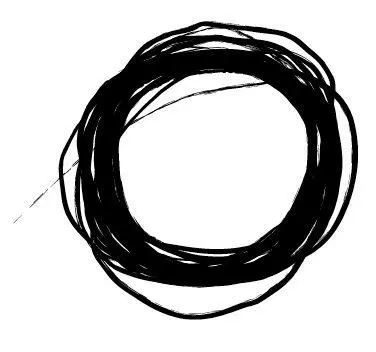
Seated in his station chair now, recalling the image of those gleaming, whirling plates, Radar picked up a pen and slowly started to trace a little oblong circle onto a legal notepad. With each added revolution, the circle became more and more perfectly circular, all those wonky, globular loops adding up to something whole and proportional and right, and this summation comforted him.
Rule #49: Many imperfections can and may lead to perfection.
Soon the flimsy yellow paper grew thick with ink and finally tore open, so that now he was drawing circles on the page beneath. If he drew enough circles, maybe he could burrow right through the earth into its molten center and then through to the other side, into the V-necked alpine valleys of Kyrgyzstan. That could be nice. Maybe he could start over again there. He could be a more perfect version of himself.
Distracted by his existential malaise, he wandered into the engine room and lay down next to the big, purring vacuum capacitors that expelled so much electromagnetic energy into the air that the temperature of your skin went up by two degrees and began to tingle. This was the voltaic green room where the radio signal huffed and puffed and readied itself for the great scream. The station’s transmitters took the thinnest trickle of signal and blew it wide open, turned it into a hundred-mile-wide fire hose, an explosion of invisible waves licking the surface of the city, shooting through seawater and brickwork and grocery bags and into the antennae of the thirsty radios, their transistors reshaping the signal into a wiry, pulsing frequency that sent speakers quivering into long streams of S&P numerals.
Radar lay on his back eating an apple and swinging a fluorescent light tube through the air like a lightsaber. The tube lit up magically every time it swung close to the huge, humming induction box.
Dim.
Now glowing.
The world, thick with current.
Dim.
Now glowing.
Like a heartbeat. He wanted to make Ana Cristina glow like this.
Radar sighed. He pulled himself off the ground and was just about to go check on control when it came. Usually, he had an inkling that a seizure was on its way as he was filled with a fleeting sensation akin to reverse déjà vu — a remembrance of things future — but this time he had only a whiff of lemony lilac in the back of his throat and not even a pretense of falling before he was already out, down this time— really, really down . As in: kill the lights down . Not a petit mal, but the full monty. Usually petits came and went, but sometimes they were a sign that a storm was on the horizon, and apparently this was the case today. His last thought was of the cruel misfortune of life: Oh, why today of all days should I suffer such a fate? On this day of imminent empanada conquest? Please don’t let me hurt myself too—
Читать дальшеИнтервал:
Закладка:
Похожие книги на «I Am Radar»
Представляем Вашему вниманию похожие книги на «I Am Radar» списком для выбора. Мы отобрали схожую по названию и смыслу литературу в надежде предоставить читателям больше вариантов отыскать новые, интересные, ещё непрочитанные произведения.











Обсуждение, отзывы о книге «I Am Radar» и просто собственные мнения читателей. Оставьте ваши комментарии, напишите, что Вы думаете о произведении, его смысле или главных героях. Укажите что конкретно понравилось, а что нет, и почему Вы так считаете.