Reif Larsen - I Am Radar
Здесь есть возможность читать онлайн «Reif Larsen - I Am Radar» весь текст электронной книги совершенно бесплатно (целиком полную версию без сокращений). В некоторых случаях можно слушать аудио, скачать через торрент в формате fb2 и присутствует краткое содержание. Год выпуска: 2015, Издательство: Penguin Press, Жанр: Современная проза, на английском языке. Описание произведения, (предисловие) а так же отзывы посетителей доступны на портале библиотеки ЛибКат.
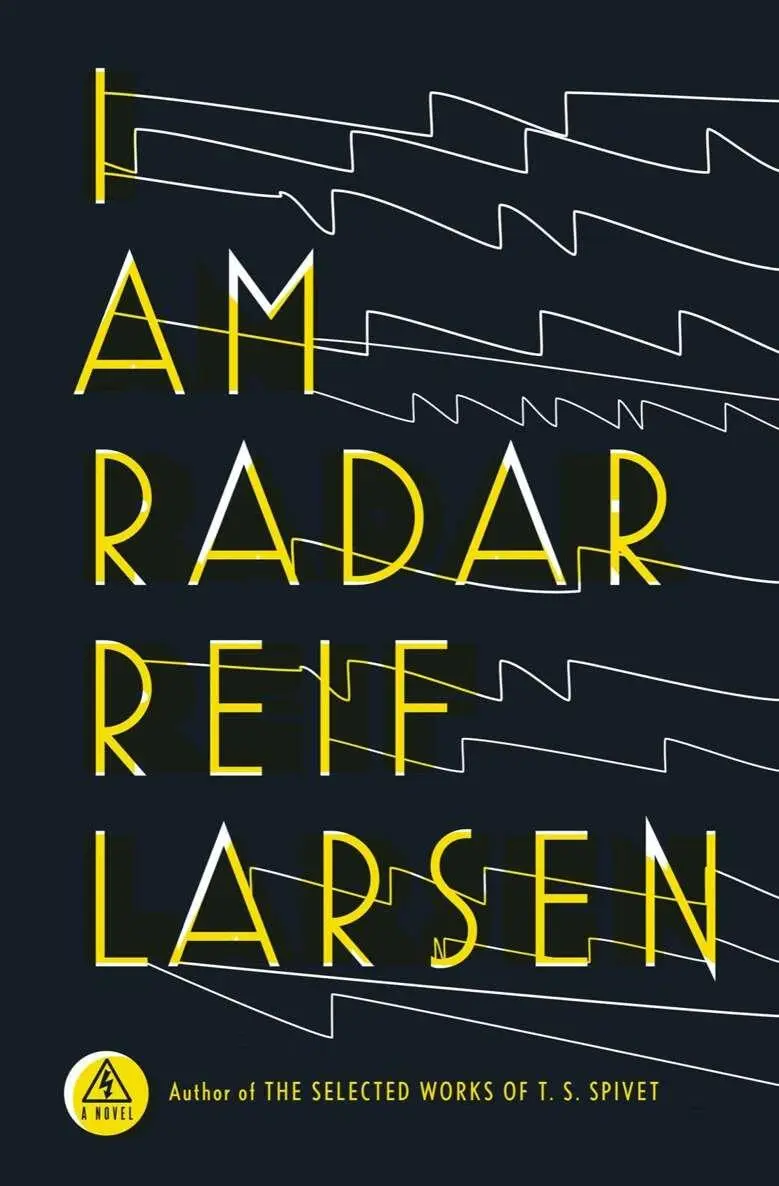
- Название:I Am Radar
- Автор:
- Издательство:Penguin Press
- Жанр:
- Год:2015
- ISBN:нет данных
- Рейтинг книги:3 / 5. Голосов: 1
-
Избранное:Добавить в избранное
- Отзывы:
-
Ваша оценка:
I Am Radar: краткое содержание, описание и аннотация
Предлагаем к чтению аннотацию, описание, краткое содержание или предисловие (зависит от того, что написал сам автор книги «I Am Radar»). Если вы не нашли необходимую информацию о книге — напишите в комментариях, мы постараемся отыскать её.
I Am Radar Deep in arctic Norway, a cadre of Norwegian schoolteachers is imprisoned during the Second World War. Founding a radical secret society that will hover on the margins of recorded history for decades to come, these schoolteachers steal radioactive material from a hidden Nazi nuclear reactor and use it to stage a surreal art performance on a frozen coastline. This strange society appears again in the aftermath of Cambodia’s murderous Khmer Rouge regime, when another secret performance takes place but goes horrifically wrong. Echoes of this disaster can be heard during the Yugoslavian wars, when an avant-garde puppeteer finds himself trapped inside Belgrade while his brother serves in the genocidal militia that attacks Srebrenica. Decades later, in the war-torn Congo, a disfigured literature professor assembles the largest library in the world even as the country around him collapses. All of these stories are linked by Radar — now a gifted radio operator living in the New Jersey Meadowlands — who struggles with love, a set of hapless parents,and a terrible medical affliction that he has only just begun to comprehend.
I Am Radar — читать онлайн бесплатно полную книгу (весь текст) целиком
Ниже представлен текст книги, разбитый по страницам. Система сохранения места последней прочитанной страницы, позволяет с удобством читать онлайн бесплатно книгу «I Am Radar», без необходимости каждый раз заново искать на чём Вы остановились. Поставьте закладку, и сможете в любой момент перейти на страницу, на которой закончили чтение.
Интервал:
Закладка:
“Good day, Javier. Sorry about the guaca ma- ole,” said Radar, completely butchering the Spanish accent.
Javier looked up and smirked at him, but Radar did not mind the smirk, nor anything at all, really, for he felt as if he were walking on air.
“And I will call you later,” he said to Ana Cristina, loud enough so that he could be sure Javier heard it. “About the empanadas .”
Then he turned around in slow motion, imagining that he was in a movie with a band of Guca trumpeters serenading his exit.
But he had not gone more than two steps before he became fearful that this whole scene had not really happened, that he had imagined it all, and that he was actually still standing in the doorway experiencing another one of his little deaths.
3
As Per Røed-Larsen notes in his introduction to Spesielle Partikler, the diligent historian often “struggles to work out the details of the hazy then when all we have is its faint, dying echoes in the muddled now ” (28). How, then, to accurately capture all the twists and turns of young Radar’s life when the public record offers us such scant insight into the mechanics of our character’s psyche? There are really only a handful of sources we can turn to after the relative supernova of his birth, a few specks of data rather than a rich portrait of a New Jersey juvenescence, and, lest we wade into total conjecture, we must make do with what we have.
After Dr. Fitzgerald’s article in the Journal of Investigative Dermatology, there were no more professional writeups concerning Radar — a search for “Radar’s syndrome” in the medical databases turns up a giant, singular blank. His haphazard medical file does indicate a long history of epilepsy, dating back to a first episode at age four, with several major hospitalizations following his grand mal seizures, approximately once every four or five years. The doctors’ notes for these hospitalizations are cursory, noting “left-centered asymmetric claudication,” “near alopecia totalis,” and a “jaundiced xanthoderma,” though from the lack of follow-up on these slightly disturbing observations, it seems clear that Radar was not under the care of any single primary pediatrician, but rather a revolving cast of disparate emergency room doctors, who had neither the time nor the inclination to assemble a working medical history. At age twenty-three, after a particularly vicious grand mal in which Radar almost bit his tongue in half, he did have an MRI at St. Elizabeth’s, the results of which showed some “abnormal dark spots” on his temporal lobe, the part of the brain concerned with, among other things, temporal perception, spatial organization, and object recognition. Following this MRI, it appears he began taking a prescription for Zarontin (ethosuximide), an anticonvulsant, for a period of approximately ten years, though this prescription ended with no follow-up medications prescribed.
Beyond this, there is only a cluster of peripheral sources, which, when viewed in sequence, offers the briefest of glimpses into a restless teenager testing the limits of his great, strange electromagnetic gift.

Fig. 3.2. “Blue Box from Modified Western Electric Test Equipment”
From R. Radmanovic’s NJ Science Fair Project, 1988 (disqualified)
Exhibit A:
During the summer of 1990, the New Jersey Bell pay phone on the corner of Midland Avenue and Forest Street was the target of repeated “phreak attacks,” whereby more than two hundred free long-distance calls were made over the course of three months. The pay phone was eventually removed. “Phone phreaking”—the practice of exploiting the telephone system via unauthorized means — was invented in 1959 by Joe Engressia Jr., a.k.a. “Joybubbles,” a seven-year-old blind boy with perfect pitch who discovered that when he whistled a 2,600-Hz tone into the phone, the call would temporarily disconnect and then search for a new trunk line, allowing him to make another connection to any number in the world, completely free of charge. Joe also figured out how to dial a number entirely by whistling — in essence, he had taught himself how to speak a rudimentary form of “telephone.” Based on Engressia’s breakthrough and several technical documents inadvertently leaked by Bell Systems, subsequent phreaks in the 1960s and ’70s developed and refined a device called the “blue box,” which utilized the 2,600-Hz trunk switch tone to quickly and easily reroute calls from one line to another.
In the case of the Midland Avenue pay phone, calls were made to nearly every corner of the globe, including New Zealand, Norway, France, Thailand, Kenya, Brazil, and Ascension Island, in the middle of the Atlantic. Numerous “reverse link-ups” were also placed from this phone, in which the system was manipulated so that two distant pay phones would call each other, ringing continuously until a bystander on the street picked up the phone and found himself or herself talking to an equally confused citizen on a completely different continent. Officer Burberry, the author of the Kearny Police report on the incident, writes that “[the] perp dialed [a] 1-800 number repeatedly using [a] so-called ‘blue box’ to switch to [a] different number, e.g. in Texas.” As if Texas were as far as Officer Burberry could imagine. What Officer Burberry did not mention was that a traditional phone phreak’s blue box no longer worked on the New Jersey Bell system in 1990. In the Midland Avenue case, the perpetrator must have been using either a highly sophisticated terminal device or — in the tradition of Joybubbles — some other unprecedented means to communicate with the vast inner workings of the telephone network. The case would remain unsolved, and though the phone itself was removed, the phone booth remained, becoming a kind of obscure mecca for certain members of the phone phreaking scene.
Exhibit B:
On the evening of June 17, 1990, approximately seventy-eight separate car alarms were set off, which led Officer Burberry (who was not having a good summer) to conclude that “an individual or group of perps” was going around “disrupt[ing] or tamper[ing] with the vehicles’ anty-theft [sic] devices.” Yet none of the vehicles in question were found to have any damage or exhibited any signs of tampering. Stranger still, the alarms themselves could not be turned off by normal means. Mechanics were required to physically disconnect the alarms from the batteries in order to quiet the cacophony of sirens that had begun to drive Kearny residents into hysterics. It was as if the alarms had been instructed to simply wail of their own accord. It is unclear whether Officer Burberry and his team (Johnson, Altez, et al.) connected this incident with the ongoing investigation of the Midland Avenue phone phreak case. A simple map, however, might have provided them with valuable evidence: if they had merely traced the route of these car alarm incidences, they might have noticed that the path of aural carnage forms a slightly deflated horseshoe beginning and ending at the Forest Street block between Midland and Oakwood Avenues, adjacent to the phreaked pay phone and also the location of the Radmanovic residence.

Fig. 3.3. Car Alarm Incidents in Kearny, N.J. June 17, 1990
From Radmanovic, R., I Am Radar, p. 297
Читать дальшеИнтервал:
Закладка:
Похожие книги на «I Am Radar»
Представляем Вашему вниманию похожие книги на «I Am Radar» списком для выбора. Мы отобрали схожую по названию и смыслу литературу в надежде предоставить читателям больше вариантов отыскать новые, интересные, ещё непрочитанные произведения.










Обсуждение, отзывы о книге «I Am Radar» и просто собственные мнения читателей. Оставьте ваши комментарии, напишите, что Вы думаете о произведении, его смысле или главных героях. Укажите что конкретно понравилось, а что нет, и почему Вы так считаете.