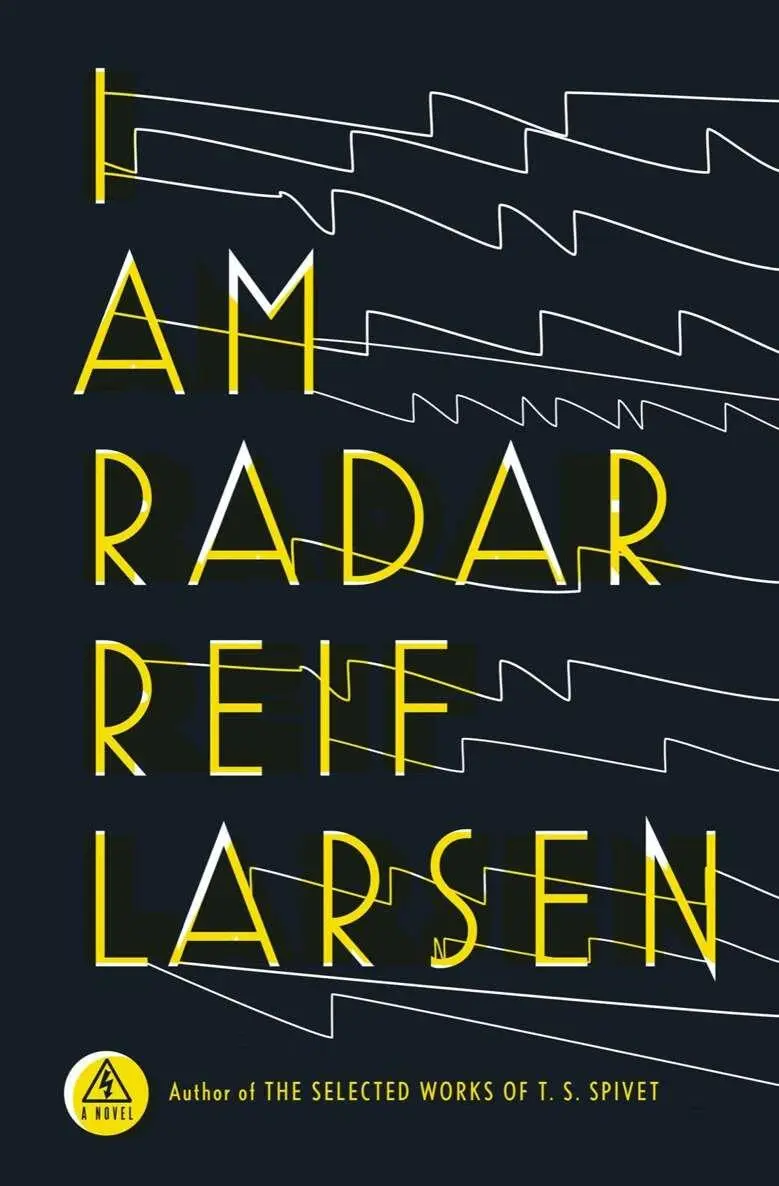
Reif Larsen - I Am Radar
Здесь есть возможность читать онлайн «Reif Larsen - I Am Radar» весь текст электронной книги совершенно бесплатно (целиком полную версию без сокращений). В некоторых случаях можно слушать аудио, скачать через торрент в формате fb2 и присутствует краткое содержание. Год выпуска: 2015, Издательство: Penguin Press, Жанр: Современная проза, на английском языке. Описание произведения, (предисловие) а так же отзывы посетителей доступны на портале библиотеки ЛибКат.
- Название:I Am Radar
- Автор:
- Издательство:Penguin Press
- Жанр:
- Год:2015
- ISBN:нет данных
- Рейтинг книги:3 / 5. Голосов: 1
-
Избранное:Добавить в избранное
- Отзывы:
-
Ваша оценка:
I Am Radar: краткое содержание, описание и аннотация
Предлагаем к чтению аннотацию, описание, краткое содержание или предисловие (зависит от того, что написал сам автор книги «I Am Radar»). Если вы не нашли необходимую информацию о книге — напишите в комментариях, мы постараемся отыскать её.
I Am Radar Deep in arctic Norway, a cadre of Norwegian schoolteachers is imprisoned during the Second World War. Founding a radical secret society that will hover on the margins of recorded history for decades to come, these schoolteachers steal radioactive material from a hidden Nazi nuclear reactor and use it to stage a surreal art performance on a frozen coastline. This strange society appears again in the aftermath of Cambodia’s murderous Khmer Rouge regime, when another secret performance takes place but goes horrifically wrong. Echoes of this disaster can be heard during the Yugoslavian wars, when an avant-garde puppeteer finds himself trapped inside Belgrade while his brother serves in the genocidal militia that attacks Srebrenica. Decades later, in the war-torn Congo, a disfigured literature professor assembles the largest library in the world even as the country around him collapses. All of these stories are linked by Radar — now a gifted radio operator living in the New Jersey Meadowlands — who struggles with love, a set of hapless parents,and a terrible medical affliction that he has only just begun to comprehend.
I Am Radar — читать онлайн бесплатно полную книгу (весь текст) целиком
Ниже представлен текст книги, разбитый по страницам. Система сохранения места последней прочитанной страницы, позволяет с удобством читать онлайн бесплатно книгу «I Am Radar», без необходимости каждый раз заново искать на чём Вы остановились. Поставьте закладку, и сможете в любой момент перейти на страницу, на которой закончили чтение.
Интервал:
Закладка:
Danilo sat. The breath was gone from his lungs.
“Danilo,” said Ilija. “I can drive you.”
“No,” said Danilo. “I’ll go myself.”
“This is no time to be alone, my friend. Life’s too short for this. We must be together.”
“Please,” said Danilo.
Ilija stood and then bowed in the old way. “Well, you know where to find me. Anything you need. I am here for you. No joke. Anything I can do.” He walked over to Gazur, and the two men talked and shook hands.
Danilo left money on the table, even though he knew that the juice, as always, was on the house. As he was leaving, Gazur approached, but Danilo ignored him. He kept walking across the road to the railing overlooking the Sava. A tugboat was crawling upstream, tugging nothing but itself.
Danilo imagined the river inside a great box. Imagined himself in the box. Imagined men beneath a black curtain looking in at him as they stood on a street corner.
He began to take off his clothes. Piece by piece, until he was in only his underwear. Then he climbed over the railing, struggling with his stiff leg. He jumped. The water was cold, not entirely clean, syrupy against his skin. He pushed himself out to where the current was and then floated on his back and thought about letting himself sink.
When he looked back at the bank, he could see Gazur, waving his hands, the white city rising up behind him.
• • •
SOMEWHERE ALONG THE WAY, Danilo had lost the policeman’s number. He did not go to the morgue as he knew he should. Instead he went to Miroslav’s flat in Voždovac. A small part of him hoped that Ilija had been mistaken, that the police had been mistaken, that someone had to be mistaken and that he would knock on the door and Miroslav would be sleeping and he would take a while before he opened the door, blurry-eyed, angry at the awakening, and Danilo would gaze upon him and the two would embrace and everything would be as it once was.
The door to the flat was just a door. Nothing to indicate that anything unusual had occurred on the other side. Danilo realized he had never actually been inside the flat. On several occasions he had met Miroslav here and they had gone out together on a walk, but Miroslav had never invited him to come in, a fact that now seemed odd.
Danilo knocked. There was no answer. He tried the doorknob and, to his surprise, found it to be open.
The flat was nearly spotless. As if someone had come in and swept the place clean. Surely this could not have been how Miroslav lived? If anything, his son thrived in a space bordering on the edge of chaos. Getting him to clean his room as a child had always been an affront to his sensibilities.
Danilo walked through the flat, laying his hands on the surfaces. There was a table with an empty bowl on it. A bottle of old milk in the fridge. The bookshelves were empty, save a single xeroxed article. Danilo picked it up. Something by Werner Heisenberg.
Where were all of his son’s books? He must’ve had books. He remembered seeing many books through the door the last time he was here.
A typewriter sat on a desk, a blank sheet of paper tucked in its roll. Danilo pulled out the sheet and found on its reverse side a small eye printed on the top of the page:

In the bedroom, a cheap bureau reinforced with tape. Also empty. The bed had been stripped. Danilo got down on all fours and looked beneath it. Nothing, except a landscape of lint and a stray yellow tube sock. He reached out and took hold of the sock. Squeezed it.
Danilo stood up. He sighed. He tried to imagine his son sleeping on this bed, opening the refrigerator, spending many late nights working on his black boxes. Had he made them here? Had he assembled all of the little pieces on this carpet? Had he breathed in his magic, closed the lid of the box, watched the elephant leap from the bridge for the first time?
Such miracles in such an ordinary place. He suddenly felt very close to Miroslav, closer than he had ever felt before. He rubbed his beard and inhaled.
On his way out, he opened the closet. Like everything else in the flat, it was empty. There was only the top of a yellow tracksuit hanging from a plastic hanger. Danilo was just about to close the door when something caught his eye.
On the shelf behind, in the shadows. He leaned in closer, blinked.
It was him. It was Miroslav. Tiny and true, no more than two centimeters tall, as if he had escaped from one of his boxes.
“Miroslav!” he said.
Miroslav did not move. He was lying on his side, his expression frozen in amused wonderment. Danilo saw then that a little white string was attached to his belly button. He followed the string. It ran down to the floor of the closet. Danilo got down on his knees. The string ended at the belly of another tiny man, also lying on his side.
“Miša!” he whispered.
Miša was in his uniform. His eyes were open but contained no life.

Fig. 2.9. “Danilovic´’s Umbilical Mirror”
From Røed-Larsen, P., Spesielle Partikler, p. 973
For the second time in his life, death would not reveal itself to Danilo Danilovic. The pretty young mortician at the morgue in St. Sava’s smiled sympathetically and said that his son’s case was still under review, and the body was not able to be viewed. This was how she put it: “not able to be viewed.”
“But he’s my son,” said Danilo, a level of desperation in his voice. “He’s my son. Do you understand? Please. If I cannot see him, how do I know he’s dead? You must understand.” He looked around at the rows of metal drawers. “Which one is he in?”
“He’s not here,” the mortician said kindly.
“Then where is he?”
“I’m not sure,” she said. “He’s with some specialists.”
“Are you not a specialist?”
The mortician gave him a strained smile. “You will see him soon,” she said reassuringly.
This turned out not to be true. According to the records, an error in the paperwork had caused the corpse to be transferred to Višegrad, and it was subsequently lost in transit. But in that moment, against all his instincts, which wailed for some kind of proof, Danilo brought his hands together and tried to believe what she told him.
The mortician showed him to the exit. They paused in the hospital lobby.
“Do you know how he died?” asked Danilo. “He was younger than he looked. He was still very young. Maybe he wasn’t eating well. His mother was always worrying about this.”
“We don’t know yet,” said the mortician. Her mascara was smudged beneath her left eye. “It looks like he just stopped breathing.” She touched his arm in the same way Stoja once had. “I will try and find you some answers, Mr. Danilovic. I know how hard it can be.”
Danilo nodded. He wondered what life would’ve been like if he had had a daughter instead of a son. If this woman with her smudged mascara were his daughter; if they could have dinner together later at the restaurant around the corner as they always did; if she would bring her boyfriend for him to meet for the first time; if this boyfriend were charming but reserved, nervous that he would offend her father, of whom he had heard so much; if, only months after this first dinner, she would announce to him that she would marry this man and he would approve, first in words and later in spirit, ushering her down an aisle before men and God himself; if, barely a year later, there would be a baby cradled in her arms, the husband standing at a safe distance as the grandfather leaned in close, knowing that life spills across generations in the simplest of ways, and as Danilo touched his grandson’s tiny sea-creature fingers, his daughter would look up at him and say, “His name is Danilo.”
Читать дальшеИнтервал:
Закладка:
Похожие книги на «I Am Radar»
Представляем Вашему вниманию похожие книги на «I Am Radar» списком для выбора. Мы отобрали схожую по названию и смыслу литературу в надежде предоставить читателям больше вариантов отыскать новые, интересные, ещё непрочитанные произведения.









Обсуждение, отзывы о книге «I Am Radar» и просто собственные мнения читателей. Оставьте ваши комментарии, напишите, что Вы думаете о произведении, его смысле или главных героях. Укажите что конкретно понравилось, а что нет, и почему Вы так считаете.