Reif Larsen - I Am Radar
Здесь есть возможность читать онлайн «Reif Larsen - I Am Radar» весь текст электронной книги совершенно бесплатно (целиком полную версию без сокращений). В некоторых случаях можно слушать аудио, скачать через торрент в формате fb2 и присутствует краткое содержание. Год выпуска: 2015, Издательство: Penguin Press, Жанр: Современная проза, на английском языке. Описание произведения, (предисловие) а так же отзывы посетителей доступны на портале библиотеки ЛибКат.
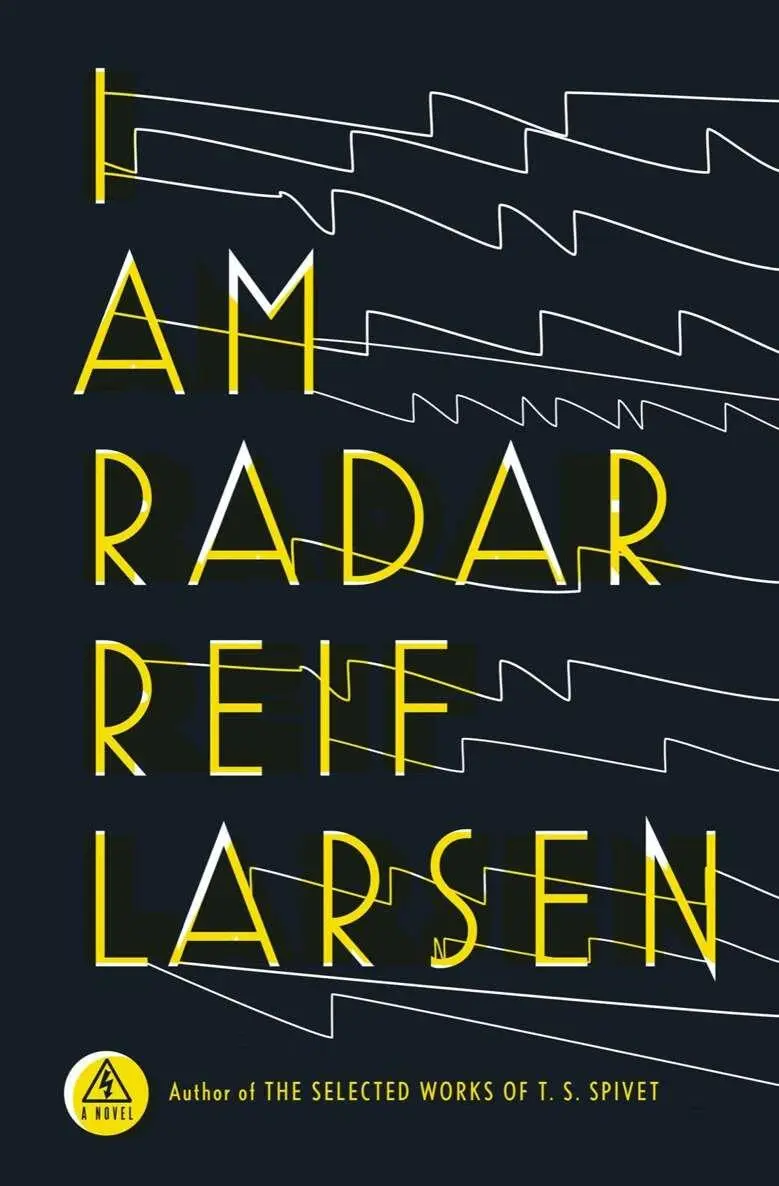
- Название:I Am Radar
- Автор:
- Издательство:Penguin Press
- Жанр:
- Год:2015
- ISBN:нет данных
- Рейтинг книги:3 / 5. Голосов: 1
-
Избранное:Добавить в избранное
- Отзывы:
-
Ваша оценка:
I Am Radar: краткое содержание, описание и аннотация
Предлагаем к чтению аннотацию, описание, краткое содержание или предисловие (зависит от того, что написал сам автор книги «I Am Radar»). Если вы не нашли необходимую информацию о книге — напишите в комментариях, мы постараемся отыскать её.
I Am Radar Deep in arctic Norway, a cadre of Norwegian schoolteachers is imprisoned during the Second World War. Founding a radical secret society that will hover on the margins of recorded history for decades to come, these schoolteachers steal radioactive material from a hidden Nazi nuclear reactor and use it to stage a surreal art performance on a frozen coastline. This strange society appears again in the aftermath of Cambodia’s murderous Khmer Rouge regime, when another secret performance takes place but goes horrifically wrong. Echoes of this disaster can be heard during the Yugoslavian wars, when an avant-garde puppeteer finds himself trapped inside Belgrade while his brother serves in the genocidal militia that attacks Srebrenica. Decades later, in the war-torn Congo, a disfigured literature professor assembles the largest library in the world even as the country around him collapses. All of these stories are linked by Radar — now a gifted radio operator living in the New Jersey Meadowlands — who struggles with love, a set of hapless parents,and a terrible medical affliction that he has only just begun to comprehend.
I Am Radar — читать онлайн бесплатно полную книгу (весь текст) целиком
Ниже представлен текст книги, разбитый по страницам. Система сохранения места последней прочитанной страницы, позволяет с удобством читать онлайн бесплатно книгу «I Am Radar», без необходимости каждый раз заново искать на чём Вы остановились. Поставьте закладку, и сможете в любой момент перейти на страницу, на которой закончили чтение.
Интервал:
Закладка:
Buried at the end of a long footnote on page 845 of Røed-Larsen’s book, there is a subtle shift in perspective that is quite easy to overlook:
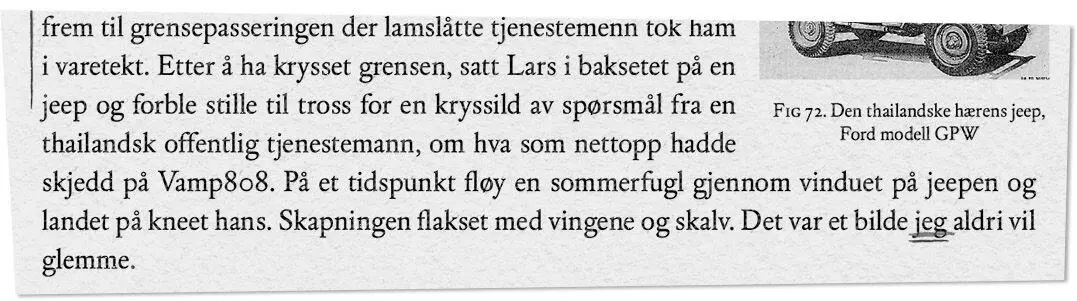
(Once across the border, Lars sat in the backseat of the government jeep and remained quiet, despite the barrage of questions coming from a Thai official, who was demanding to know exactly what had just transpired at Camp 808. At some point, a butterfly flew through the jeep’s window and alighted on his knee. The creature flexed its wings and shivered. It was an image I would never forget.)
Did you hear it? The sudden presence of that “ jeg ” haunts me. The rattle in the engine. Perhaps I am misreading what was only a minor typographical error, but the appearance of the first person is so unexpected and so out of place in the context of the book’s fifteen hundred pages that it calls into question nearly everything that has come before and everything that comes after. It was an image I would never forget. Who, may I ask, is the I here? Is it Per, the author? Is it Lars, the subject and stepbrother? Is it both author and subject? Or is it someone else entirely? That lone I, sounded like a trumpet at dusk, makes me long for a voice, a motive, a warm body beneath this ocean of words.
PART 5. THE CONFERENCE OF THE BIRDS
1. NEW JERSEY
August 10, 2010

All that night, Radar scoured the land. The blackout and the ensuing curfew lent an eerie post-apocalyptic backdrop to his searchings. He dodged police barricades and wove around checkpoints, using his recumbent’s low profile and the cover of darkness to glide through the abandoned streets undetected. He visited four local hospitals, all of them overrun with patients and non-patients simply seeking out the comforts of electricity’s embrace. His father was not among them.
How intimate, to trace a person’s geography . It was almost like looking through his father’s wallet. Though it was the middle of the night, Radar still followed the route of Kermin’s favorite constitutional along the industrial shores of the Passaic, searching for that familiar hunched profile. He rode past the ghostly rail bridge, permanently frozen in a raised salute, but did not see his father seated at any of his customary benches. He visited J&A Specialties Electrics, in Belleville, site of Kermin’s semi-frequent pilgrimages for obscure radio parts. He swung by the Arlington Diner, where his father would eat exactly three-quarters of a Reuben and half of his slaw before casually dismissing the plate with a swipe of his hand.
Everything was closed, shuttered, dark. Humanity a distant dream.
He even crossed the Passaic and headed south, to his grandfather’s gravesite in Elizabeth, on the off chance that Kermin had sought out his father’s resting place for guidance.
Radar’s flashlight illuminated the engraved letters of the headstone:
DOBROSLAV RADMANOVIC
1910–1947
A GOOD MAN.
Radar had always found this summary a touch dismissive, but Kermin had explained that this was the state’s default epitaph when little was known about the deceased.
“Your son has gone missing,” Radar said to the gravestone.
Dobroslav, the good man, offered no reply.
With each successive foray, it became increasingly clear that he was not going to find his father in any of these places — that his father would not be found simply by looking for him. And yet, in spite of this, he kept looking. Just the act of looking made Radar feel productive, even if he knew he would most likely come up empty-handed. It also gave him time to process all that he had learned in that strange little cottage beneath the mall.
Kermin — the international puppeteer. Kermin — the genius designer. His pride at learning these descriptors was tempered by a certain sadness that he massaged with his velocity. He could not help but feel cheated, as if he had never actually experienced the real Kermin. He had only known his father as his closeted, curmudgeonly progenitor — who had gambled on the tiny television and lost, who had built a monstrous antenna in their backyard so he could communicate only with those farthest away from him and in doing so had shut out those who loved him the most. But Radar had never known his father as this . As a doer. A maker . One who had changed the course of history.
“Oh, Tata,” he whispered to the moonless sky. “I could’ve helped you. We could’ve done it together.”
• • •
FINALLY, EXHAUSTED, BLEARY-EYED, he returned home to Forest Street. He looked at his watch. It was just after 2:00 A.M.
He was almost at their driveway when he noticed the white van parked in front of their house. His system went cold and he swerved wildly, nearly crashing into his mother’s Olds.
The authorities. The authorities were here. He had left his mother all alone, and now she was being handcuffed and questioned by some secret terrorism task force. He only briefly considered the possibility of fleeing before he took a deep breath and surveyed the situation. No. He was the man of the house now. He couldn’t leave her. He would claim all responsibility for the blackout. He would take the fall for his family.
Radar hid his bicycle behind the viburnum and quietly unlocked the front door, readying himself to be tackled by a SWAT team.
All was quiet. The house was dark.
“Mom?” he called tentatively. “It’s me.”
There was no response.
Upstairs in her room, he found the bed empty. Or not exactly empty: his flashlight caught sight of the little wooden figure lying among the sheets.
“Mom?” he said again.
The flashlight’s beam searching the room. Sweeping past a sheeted bookshelf.
“Mom?” An edge of panic rising in his voice.
The record player silent on the rug. The burned-out stub of the candle on the bedside table, a thicket of wax spilling down the wood. The darkened hole in the floor.
He picked up the figurine. Carved-out eyes, the hint of a mouth. A ghastly little thing.
“Charlene?”
“Radar?” said a voice.
He whirled around, the flashlight beam finding her squinting at him from the doorway. She was holding a candle in one hand and a fire poker in the other.
“Jesus, Mom . You scared me.”
“There’s somebody out there!” she hissed.
“Where?”
“In the shack. I can see their lights. I was too scared to go outside.”
He peered out the window. Sure enough, he could see the glint of light through the shack’s open door.
“Maybe it’s Kermin,” said Radar.
“It didn’t look like him, but I couldn’t be sure,” she whispered. “There’s at least two of them.”
They watched the shack but didn’t see any movement.
“You didn’t find him, did you?” she whispered.
Radar shook his head. “I looked everywhere.”
“What should we do?”
Radar took a breath. “I’ll go down.”
“I’m coming with you.”
“No,” he said. “It’s better if you stay here.”
She grabbed his wrist. “I’m not letting you go out there alone!”
And so — she with fire poker and he with a flashlight and a hastily retrieved coatrack that he was brandishing like a spear — together they cautiously ventured through the sliding double doors and into the backyard.
Читать дальшеИнтервал:
Закладка:
Похожие книги на «I Am Radar»
Представляем Вашему вниманию похожие книги на «I Am Radar» списком для выбора. Мы отобрали схожую по названию и смыслу литературу в надежде предоставить читателям больше вариантов отыскать новые, интересные, ещё непрочитанные произведения.










Обсуждение, отзывы о книге «I Am Radar» и просто собственные мнения читателей. Оставьте ваши комментарии, напишите, что Вы думаете о произведении, его смысле или главных героях. Укажите что конкретно понравилось, а что нет, и почему Вы так считаете.