Juan José Saer - La Grande
Здесь есть возможность читать онлайн «Juan José Saer - La Grande» весь текст электронной книги совершенно бесплатно (целиком полную версию без сокращений). В некоторых случаях можно слушать аудио, скачать через торрент в формате fb2 и присутствует краткое содержание. Год выпуска: 2014, Издательство: Open Letter Books, Жанр: Современная проза, на английском языке. Описание произведения, (предисловие) а так же отзывы посетителей доступны на портале библиотеки ЛибКат.
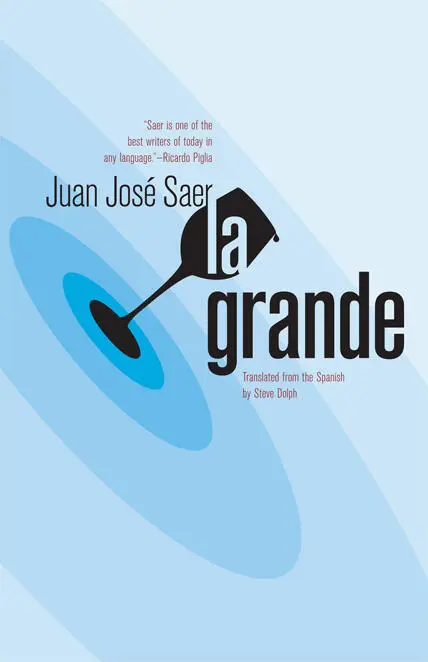
- Название:La Grande
- Автор:
- Издательство:Open Letter Books
- Жанр:
- Год:2014
- ISBN:нет данных
- Рейтинг книги:5 / 5. Голосов: 1
-
Избранное:Добавить в избранное
- Отзывы:
-
Ваша оценка:
La Grande: краткое содержание, описание и аннотация
Предлагаем к чтению аннотацию, описание, краткое содержание или предисловие (зависит от того, что написал сам автор книги «La Grande»). Если вы не нашли необходимую информацию о книге — напишите в комментариях, мы постараемся отыскать её.
Moving between past and present, La Grande centers around two related stories: that of Gutiérrez, his sudden departure from Argentina 30 years before, and his equally mysterious return; and that of “precisionism,” a literary movement founded by a rather dangerous fraud. Dozens of characters populate these storylines, incluind Nula, the wine salesman, ladies’ man, and part-time philosopher, Lucía, the woman he’s lusted after for years, and Tomatis, a journalist whoM Saer fans have encountered many times before.
Written in Saer’s trademark style, this lyrically gorgeous book — which touches on politics, artistic beliefs, illicit love affairs, and everything else that makes up life — ends with one of the greatest lines in all of literature: “With the rain came the fall, and with the fall, the time of the wine.”
La Grande — читать онлайн бесплатно полную книгу (весь текст) целиком
Ниже представлен текст книги, разбитый по страницам. Система сохранения места последней прочитанной страницы, позволяет с удобством читать онлайн бесплатно книгу «La Grande», без необходимости каждый раз заново искать на чём Вы остановились. Поставьте закладку, и сможете в любой момент перейти на страницу, на которой закончили чтение.
Интервал:
Закладка:
— Do you drink wine? Nula says.
— Why not? Virginia says. For me, first a glass of white and then a red.
— Very good, he says. The cellar is good here; we’re partial suppliers.
And, as they wait for the wine to arrive, they start to talk. When she was twenty-nine, Virginia, who studied French at the Alianza, went to France, to Bordeaux, to perfect the language, thinking she’d come back to the city to teach, but when her grant finished the following year she started to take an interest in wine, and as her French improved, her desire to teach it waned. She enrolled in enology courses and eventually found work with a supplier. Everything was going well: she’d been in Europe for four years and she was unsure if she would stay forever, but when she got pregnant it seemed, though it was never clear why, that she had to return. She waited for her daughter to be born so she’d be French. The girl’s father, who had another family, offered to recognize her, but Virginia refused; she respected the father, admired him even, but she didn’t love him. Recognizing Muriel would have created enormous complications for him, Virginia was convinced that he was relieved when she said no. For seven years he sent her money every month, until suddenly, one day, the money orders stopped. Eventually she got a letter from a friend in Bordeaux, saying that the man had died in a car accident. At the time, Virginia was giving private French classes, and sometimes the Alianza asked her to fill in, but wine, as a profession, attracted her: in Bordeaux, she’d seen the business side up close, of course, and also a lot of scheming and fraud, but wine itself, the successive transformations of the fruit into a drink and then into madness, sacred or otherwise, fascinated her. She’d promoted a few lesser-known Mendoza wineries around the littoral region, and had taken other courses (like the one where she’d seen Nula for the first time), but she wasn’t that interested in traveling, so when they built the supercenter , she applied to manage the beverage section. And him? Nula hesitates a few seconds before responding. Him? Nothing special: he started out in medical school and after a while got bored with it and transferred to philosophy. Then, because he was about to be a father, he had to get serious about work, and, well, the chance to work in wine presented itself unexpectedly. It’s not that bad, but since he has two kids now — a boy and a girl, Yussef and Inés, four and two, respectively — it would be impossible to stop working and commit himself to philosophy. (Nula’s interest in philosophy is amusing, and somewhat surprising, to Virginia.) In any case, Nula says, philosophy isn’t strictly speaking a profession; one is a philosopher in any situation, and any object in the world can be of interest to a true philosopher. Furthermore: any object in the world is the cipher for the whole world; if one discovers its essence, the whole world is revealed. And, considered properly, wine could be, after all, an optimal object of study. And, with a theatrical gesture, Nula raises a glass of white wine and makes a silent and delicate toast before taking a sip. When he places the glass back onto the tablecloth, he looks Virginia in the eyes and asks her gently:
— Aren’t you worried about having deprived your daughter of a father?
— Yes, very, Virginia says without hesitating, but she doesn’t elaborate on her response.
Nula doesn’t insist, though he thinks again about his mother, his brother, his murdered father. Still, he doesn’t really want to discuss the topic, first of all because it’s too intimate and painful to describe immediately to someone who’s practically a stranger, but especially because he prefers to avoid disclosures, not out of caution or discretion, but rather because he doesn’t want them to become too human; he’d rather avoid opening the fissure through which shame and compassion might pass, the first being confused for the second in a swamp of relativity, removing them from that limbo of exteriority where their desire, sheltered from shame and reluctance, moving with ease, irrational, makes pleasure from ghostly stereotypes. Thus the meal passes with the kind of polite and expectant formality where each of them — at least this is how Nula imagines it — tries to discern, analyzing, in transit, the other’s intentions. They try the red wine and say some things about it, attempting to describe with everyday images the incommunicable depths of the experience, and when they coincide in some detail they reveal an excessive, childish enthusiasm that in Nula is not simulated in the least, though its excessiveness may come from the anticipated pleasure of what, though it hasn’t been named once all night — maybe they’ve both decided it without they themselves deliberating it, each of them possibly unaware of their own decision — inexorably, approaches. Every time that Nula thinks of the possibility, a violent emotion overwhelms him, and he has to concentrate so intensely to keep it from manifesting outwardly that, from time to time, he loses the thread of the conversation and can only respond with vague monosyllables and slow, indistinct nods, projecting into the immediate future the intense disorder, impenetrable to the words that Virginia, concentrating on the thoughts that those words attempt to translate, speaks in the present. Though she protests energetically, Nula pays the bill, and when they finish their last sip of wine, he gets up, says he’ll be right back, and starts walking toward the bathrooms. Because it’s Friday night, the restaurant is packed, and Nula sidesteps the tables with an unhurried, distracted agility. Two large tables of older women who get together, without their husbands, on Fridays, exude a singular energy, an overblown joy, possibly because they’ve freed themselves, for a few hours or forever, from the protection, tender or despotic, it makes no difference, of the men who, for decades, imagined that they possessed them. And a few meters beyond them, in a discreet corner in the back of the room, where the waiter, because of his experience, though he was ignorant to Nula’s private custom — hiding in plain sight — offered to seat them when he came in with Virginia, sits Gutiérrez in the company of a woman of a certain age, older than him — or at least that’s the impression that Nula gets as he approaches.
Gutiérrez has seen him approach, and because he’s also seen Nula notice him, he waits for him smiling, half-standing. When he sees him, Nula thinks that if there were a restaurant that Gutiérrez, having returned to the city after more than thirty years away, would definitely pick, it would have to be the Hotel Palace, which already existed, very similar to how it is now, before his mysterious departure. Gutiérrez might be unaware that, like the tumultuous history of the country and the city, the restaurant, so similar to how he left it, suffered many setbacks, changes of fortune, decline, death and rebirth, successive closures and triumphant but ephemeral reopenings, periods when it was even a ruins and a house of ill repute, until a few years ago an international consortium of hotels bought and restored it, improved by the prestige that age inexplicably endows, to the same look it had the day it first opened in the mid forties. I’d bet my life that he couldn’t have paid for it back then, but the real reason he’s here tonight is that he’d wanted to be here during those years, doing the things that he imagined that the ones who were here kept doing, as though he’d never left, as though nothing had happened in all that time, and the Hotel Palace, with its most recent and umpteenth inauguration, must shore up that illusion, given its attachment, according to everyone who knows him better than I do, to that same world that was his until the day he left , Nula thinks, constantly smiling, as he approaches the table, holding out his hand to Gutiérrez, who waits with his own extended.
Читать дальшеИнтервал:
Закладка:
Похожие книги на «La Grande»
Представляем Вашему вниманию похожие книги на «La Grande» списком для выбора. Мы отобрали схожую по названию и смыслу литературу в надежде предоставить читателям больше вариантов отыскать новые, интересные, ещё непрочитанные произведения.







Обсуждение, отзывы о книге «La Grande» и просто собственные мнения читателей. Оставьте ваши комментарии, напишите, что Вы думаете о произведении, его смысле или главных героях. Укажите что конкретно понравилось, а что нет, и почему Вы так считаете.