Juan José Saer - La Grande
Здесь есть возможность читать онлайн «Juan José Saer - La Grande» весь текст электронной книги совершенно бесплатно (целиком полную версию без сокращений). В некоторых случаях можно слушать аудио, скачать через торрент в формате fb2 и присутствует краткое содержание. Год выпуска: 2014, Издательство: Open Letter Books, Жанр: Современная проза, на английском языке. Описание произведения, (предисловие) а так же отзывы посетителей доступны на портале библиотеки ЛибКат.
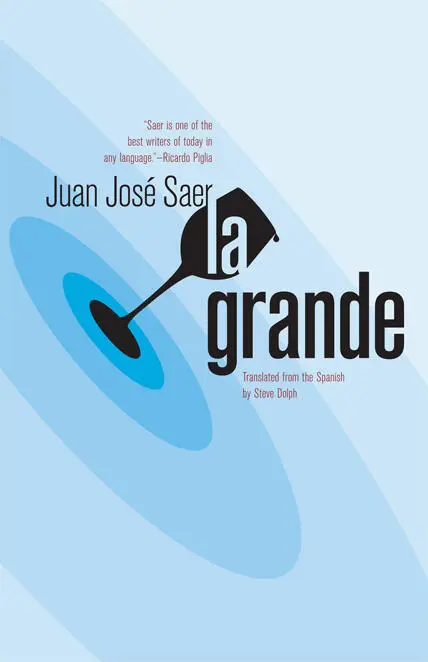
- Название:La Grande
- Автор:
- Издательство:Open Letter Books
- Жанр:
- Год:2014
- ISBN:нет данных
- Рейтинг книги:5 / 5. Голосов: 1
-
Избранное:Добавить в избранное
- Отзывы:
-
Ваша оценка:
La Grande: краткое содержание, описание и аннотация
Предлагаем к чтению аннотацию, описание, краткое содержание или предисловие (зависит от того, что написал сам автор книги «La Grande»). Если вы не нашли необходимую информацию о книге — напишите в комментариях, мы постараемся отыскать её.
Moving between past and present, La Grande centers around two related stories: that of Gutiérrez, his sudden departure from Argentina 30 years before, and his equally mysterious return; and that of “precisionism,” a literary movement founded by a rather dangerous fraud. Dozens of characters populate these storylines, incluind Nula, the wine salesman, ladies’ man, and part-time philosopher, Lucía, the woman he’s lusted after for years, and Tomatis, a journalist whoM Saer fans have encountered many times before.
Written in Saer’s trademark style, this lyrically gorgeous book — which touches on politics, artistic beliefs, illicit love affairs, and everything else that makes up life — ends with one of the greatest lines in all of literature: “With the rain came the fall, and with the fall, the time of the wine.”
La Grande — читать онлайн бесплатно полную книгу (весь текст) целиком
Ниже представлен текст книги, разбитый по страницам. Система сохранения места последней прочитанной страницы, позволяет с удобством читать онлайн бесплатно книгу «La Grande», без необходимости каждый раз заново искать на чём Вы остановились. Поставьте закладку, и сможете в любой момент перейти на страницу, на которой закончили чтение.
Интервал:
Закладка:
— Everything alright? he says.
— Perfect. There’s barely enough to go around, the girl says.
— Do you need a hand? Nula says.
— No, no. Don’t worry about us. Ms. Virginia is sending someone at nine to help us pack everything up. You can leave if you like, she says, handing a cup of red wine to a man who was watching every one of her movements carefully.
Nula looks at his watch: it’s five after eight.
— Alright, Nula says. I’ll leave before the return of Affife.
The girl doesn’t get the joke, but she laughs politely and starts to fill another cup, this time of white wine. Nula turns around and starts walking toward the exit. The infinite loop of musical soundtracks heard in every elevator of every luxury hotel, in every supermarket, in every mall, in the variety shows on planes and in airports, the infinite wave of saccharine music that has been assaulting the West, and probably the East as well, for decades, like a soft requiem for the slow extinction of a species dying from a plague of conformism punctuated here and there by a marketing campaign, the thin molasses propelled by a plethora of violins, at the very moment when Nula crosses the exit, is playing “The Godfather,” and as if he’d been infected, without knowing it, by the virus of that same plague, as he steps into his car, Nula starts, softly, humming the melody. Because he still has time, he decides to get in line for gas at the service station, which takes awhile, and then he drives on, not really knowing what to do. After crossing the road bridge, rather than continuing along the boulevard, he turns up the waterfront along the edge of the lagoon, all the way to Guadalupe. At a bend, he sees the water glowing through the trees; it makes him want to get out and he starts to slow down but immediately changes his mind and drives on. At the Guadalupe roundabout he turns west and then back onto the same road, to the south. Thirty blocks later he reaches the boulevard, and, two blocks west, the bar Déjà Vu, but because he can’t park on the boulevard he turns at the corner, to the north, and parks halfway down the block. He walks slowly under the trees, in the warm night air. At nine fifteen on the dot he walks into the bar; Virginia is already there, not at a table but rather behind the counter, talking on the phone.
The bar is full, and although it’s been open for over a year and Nula has passed it many times in his car, looking at it curiously, it’s his first time inside. It’s a simple and pleasant bar, with French posters on the ochre walls and wooden tables and chairs. It’s full of young people— a hip place , Nula thinks with a hint of arrogance that he immediately regrets, and sidestepping the tables, which are all full, he walks toward the counter. Virginia sees him arrive, and as she talks on the phone she gestures for him to wait. As she talks she looks through the window at some vague spot on the dark boulevard, and Nula is able to examine her ample, firm body, her wide back and her well-proportioned, slender arms, their tanned, smooth skin revealing, discreetly, below the short sleeves of her marble-colored shirt, hard muscles. After a couple of minutes, Virginia hangs up.
— Muriel, my daughter; on Fridays she and her five friends all sleep over at someone’s house, Virginia says. Like old ladies getting together without their husbands.
— Like some of them, enjoying the liberties of widowhood, Nula says.
— What are you drinking? Virginia says, using tú unexpectedly. It’s on the house.
Nula, with a half smile, slowly shakes his head, unsure. Despite being a wine seller, he has a strong preference for more colorful, eccentric drinks, like Kir Royales, Bloody Marys, screwdrivers, Negronis, San Martín Secos, or Lemon Champs. Finally he decides:
— A Negroni, he says.
Virginia pours the liquors in a cylindrical glass, over three or four ice cubes, mixes them with a long-handled spoon, and, folding a paper napkin in half, puts the glass on top and slides it to the outside edge of the counter. Before touching it, Nula observes, admiringly, the deep red of the liquid mixture that Virginia has just prepared.
— Well? she says.
— Aren’t we going to toast? Nula says.
Virginia pours a small amount of seltzer into a glass and raises it. Nula raises his own, and the glasses, when they touch, produce a faint, momentary tinging. They take a drink, and Nula, with a gesture of approval, pursing his lips, concentrating on the flavor of the drink, looks up slowly.
— Excellent, he says. I didn’t know that you worked here, too.
— I don’t work here. I’m the owner. Well, one of the owners. There’s three of us, Virginia says. Him — she points to the waiter, serving a table — his wife, who should be here soon, and me. Do you mind if we wait for her five minutes before we leave?
— Of course, Nula says. I knew from the first time I saw you that you were a business man.
— No, Virginia says. The first time you saw me was a few years ago, at the enology course at the Hotel Iguazú. That’s the secret that I wanted to tell you: that we already knew each other.
— Seriously? he says, laughing. You’re joking. How could I not have noticed you?
— I was a little fatter then. And in some situations it’s better to go unnoticed, Virginia says. I wanted to approach you, I was very attracted to you. But you seemed so serious back then. And besides, a pregnant girl came to see you two or three times. When I saw you the other day I recognized you immediately. You look better.
— I’m sure you do too. I can’t imagine you looking better than you do tonight.
Virginia laughs lightly, but immediately her expression turns serious.
— Thanks, but it’s not necessary for you to keep repeating that nonsense, she says. Here comes my associate.
Nula, who is taking a sip of his Negroni, turns toward the door, through which he sees a girl in a tight, short-sleeved black dress with a tight band around the knees; a low, rectangular neckline begins at her collarbones and falls to the upper edge of her breasts, leaving her neck exposed. She stops at a table occupied by a couple, says a few words, and then, leaning over, gives each of them a conventional kiss on the cheek. Then she walks to the counter and arrives just at the moment when Nula deposits the glass with the rest of his Negroni on the white paper napkin.
— Flaca, Virginia says. This is the friend I told you about. Nula, La Flaca.
La Flaca approaches Nula and kisses him on the cheek. Then she apologizes for making them wait. Her husband arrives from the other side of the room and now it’s his turn to receive the quick kiss from La Flaca on his left cheek. Virginia picks up her purse from somewhere behind the counter, invisible to Nula, walks to the end of the counter, where the register is, turns around, and comes back in the opposite direction, toward them, along the outside edge of the counter. White pants made of a silky cloth hug her legs, her backside, her hips, her flat belly, her groin. Her white shoes click, evenly and firmly, against the reddish tiles. After a general exchange of perfunctory kisses, Virginia and Nula walk out to the street. They turn at the corner, walking under the shadows of the trees, toward the dark green station wagon parked along the curb a few meters ahead. Before pulling out, in the darkness of the car, with the dashboard lights projecting upward at an angle, their faces, looking in the same direction because of the position of their bodies in the seats, as though each of them was unaware of the presence of the other, reflecting the weak light, covered with highlights and shadows, indecisive and expectant, exaggerate their strangeness. A heavy silence surprises them, unexpected considering the casual relationship they’ve settled into since the beginning, submerging them among rapid, contradictory thoughts for a few seconds, as if the fragile cortex of urbanity whose surface retained the overflow of an indifferent, anarchic substance above turbulent, profound depths had split and both of them, exhibiting their openness up till that moment, assaulted by a sudden flood, were trying desperately to contain it. Nula, his voice coming out slightly hoarse, having to cough a couple of times before he can speak naturally, suggests the restaurant at the Hotel Palace, one of the most popular in the city, where they’re sure to run into at least one person they know, according to the rule whereby he carries out his most suspicious behavior where everyone can see it, precisely with the intention of dispelling those suspicions. Virginia accepts with a quick laugh that, Nula thinks, suggests she intuits his rationale. The mood has changed: their casual, quick humor, their worldly cynicism, their erotic double entendres, have lost their use value , and, without meaning to, they’ve moved inside something, a zone or a dimension that they are less than halfway in control of, and where, however much they pretend to move through it openly, they know that trembling, shudders, moaning, and heaviness are waiting for them. The restaurant is very full, and when the waiter offers them a discreet table in the back, Nula says he prefers a more central one, next to the window that faces the street, so that they’ll be seen easily from anywhere in the room, and from the street as well, a preference that once again provokes Virginia’s laughter, about which, in this new phase of their relationship, where they’re forced, for the moment, to intuit the meaning of each others’ words and reactions, to Nula, not the slightest shadow of a doubt, as they say, remains.
Читать дальшеИнтервал:
Закладка:
Похожие книги на «La Grande»
Представляем Вашему вниманию похожие книги на «La Grande» списком для выбора. Мы отобрали схожую по названию и смыслу литературу в надежде предоставить читателям больше вариантов отыскать новые, интересные, ещё непрочитанные произведения.









Обсуждение, отзывы о книге «La Grande» и просто собственные мнения читателей. Оставьте ваши комментарии, напишите, что Вы думаете о произведении, его смысле или главных героях. Укажите что конкретно понравилось, а что нет, и почему Вы так считаете.