Juan José Saer - La Grande
Здесь есть возможность читать онлайн «Juan José Saer - La Grande» весь текст электронной книги совершенно бесплатно (целиком полную версию без сокращений). В некоторых случаях можно слушать аудио, скачать через торрент в формате fb2 и присутствует краткое содержание. Год выпуска: 2014, Издательство: Open Letter Books, Жанр: Современная проза, на английском языке. Описание произведения, (предисловие) а так же отзывы посетителей доступны на портале библиотеки ЛибКат.
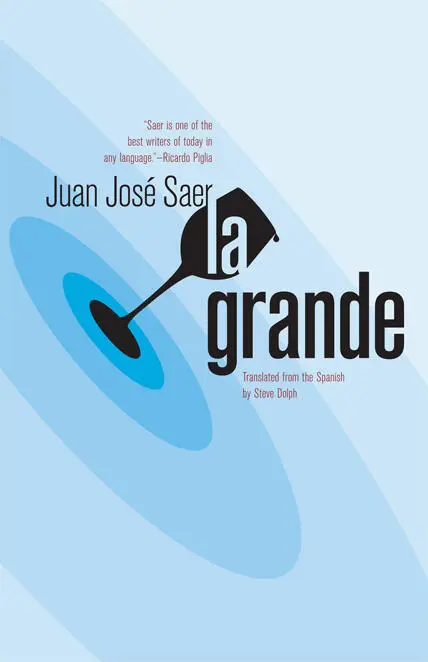
- Название:La Grande
- Автор:
- Издательство:Open Letter Books
- Жанр:
- Год:2014
- ISBN:нет данных
- Рейтинг книги:5 / 5. Голосов: 1
-
Избранное:Добавить в избранное
- Отзывы:
-
Ваша оценка:
La Grande: краткое содержание, описание и аннотация
Предлагаем к чтению аннотацию, описание, краткое содержание или предисловие (зависит от того, что написал сам автор книги «La Grande»). Если вы не нашли необходимую информацию о книге — напишите в комментариях, мы постараемся отыскать её.
Moving between past and present, La Grande centers around two related stories: that of Gutiérrez, his sudden departure from Argentina 30 years before, and his equally mysterious return; and that of “precisionism,” a literary movement founded by a rather dangerous fraud. Dozens of characters populate these storylines, incluind Nula, the wine salesman, ladies’ man, and part-time philosopher, Lucía, the woman he’s lusted after for years, and Tomatis, a journalist whoM Saer fans have encountered many times before.
Written in Saer’s trademark style, this lyrically gorgeous book — which touches on politics, artistic beliefs, illicit love affairs, and everything else that makes up life — ends with one of the greatest lines in all of literature: “With the rain came the fall, and with the fall, the time of the wine.”
La Grande — читать онлайн бесплатно полную книгу (весь текст) целиком
Ниже представлен текст книги, разбитый по страницам. Система сохранения места последней прочитанной страницы, позволяет с удобством читать онлайн бесплатно книгу «La Grande», без необходимости каждый раз заново искать на чём Вы остановились. Поставьте закладку, и сможете в любой момент перейти на страницу, на которой закончили чтение.
Интервал:
Закладка:
A familiar sound interrupts Gabriela’s explanatory gloss: a horse approaching at a slow trot, its hooves striking quietly against the sandy ground, which, before she has time to turn around, starts up the embankment, scratching softly against the slightly inclined surface where the loose gravel left behind by the paving mixes with the sand. The horse and rider appear suddenly, very close to the car, so much so that, to see the rider completely, Gabriela has to lean her head out the window. And she doesn’t regret it, because she immediately recognizes, with that fondness particular to city dwellers, a figure typical of the coastal countryside, so magnified by her young imagination, a figure represented thousands of times in oil, in watercolor, or in pencil or ink, or even in wood or in marble, by every kind of plastic artist, painters, sculptors, weavers, and illustrators, or recalled in verse and in prose, in elevated or popular language, rhapsodized in chamarritas and litoraleñas , captured in movement by documentaries or films of touristic or critical stripe: A boy of ten or twelve, with dark skin and hair, barefoot and shabbily dressed, riding bareback on a compliant horse that he urges on by kicking its sides with his heels, or by whipping it briskly on its flanks with a green branch. At the edge of the asphalt the horse stops, uncertain, though it’s crossed the road countless times in its life, and the whips with the branch and the kicks become more vigorous, forcing it to brave the provincial highway, changing the sound its hooves make, now on the hard and resonant pavement. And when he reaches the other side, the opposite edge, where the saddest and dustiest weeds in the world grow, the sound of the hooves disappears, creating a sharp contrast between the proximity of the animal, its movements, and the silence with which it executes them.
Gutiérrez, according to Gabriela, who’s just put her head back inside the window, noticing, meanwhile, a considerable difference in temperature between the inside and the outside of the car — as unlikely as it may seem, the air is warmer outside — Gutiérrez shows an extreme tolerance for Brando, despite being fully aware, at the same time, of his character traits. He seems to confuse Brando with his own youth, assigning to the former the supposed values of the latter. But he’s a meticulous and scrupulous informant, and when he has some doubt he doesn’t hesitate to consult his library so as to not overlook anything. Between 1956 and 1960, more or less, the years he studied law and worked at the firm, correspond to the third and final era of Nexos , during which three issues were published. Each issue of the magazine had less to do with precisionism and more with Brando’s own literary and political career: though he’d been a cultural attaché in Rome during the first Peronist regime, he eventually withdrew from the government, going so far as to take part in the coup that overthrew it in 1956. Gutiérrez is aware of Brando’s opportunism, but it doesn’t seem to bother him. At first, the precisionists would meet at a bar downtown that they could all get to easily, but when Brando started to have political aspirations he’d choose more discreet locations — according to Tomatis, his goals demanded a group of literary disciples and collaborators, but since most of them had social and economic positions less relevant than his, he compartmentalized his relationships, to one side the rich and powerful philistines, and to the other his disciples, poor but useful for his literary career — Gutiérrez, who doesn’t hesitate to recognize the truth to that statement, doesn’t appear too scandalized by it, as though the years, the actions, and the protagonists of that lost world had lived a kind of mythic existence, drawn with hard lines in immutable roles they were forced to represent, and were therefore resistant to change, to analysis, and, especially, to ethical critique. According to Gutiérrez, around 1959, Brando spent a year working out the problems presented by the translation of a classical sonnet to the language of precisionism, which is true, because there are some examples of this from the last issue, which appeared in 1960. Apart from his remarkable memory and the pleasure he seems to draw from her and Soldi’s incitements to explore it, Gutiérrez offers a number of supplementary qualities as an informant: that he can tell on his own what might interest them, that he’s a talented student of people, an ethnographer almost, at least with regard to that time period. After more than thirty years away he’s able to describe the small world in which the precisionist poets emerged, and where he didn’t belong, with countless unexpected and invaluable details and a curious mix of indulgence and irony. What they’ve heard him say could be summarized and transcribed more or less as follows: The group was an assortment of famous lawyers and public servants, liberals and addicts of the eleven o’clock Mass, philistine patrons and high school teachers, Peronists, conservatives, and radicals, wealthy and poor, led by an ambitious and scrupulous man with a visceral duplicity, and who’d deserve our hatred had his ambitions not been so mean and transparent: to become a minister in the provincial government or land some subaltern post in an embassy and have his name appear every so often in the national press. His most unfortunate trait was his avarice: despite the fact that he’d inherited a fortune from his father, who’d gotten rich from a pasta factory he’d owned in the early part of the century, and had multiplied his assets at the law firm, he always contrived to have his coffee paid for by his disciples, these poor bastards who had meal stipends from the public assistance office or from the national university. But he was a good leader, and when he put aside his darling precisionism he could manage to write a decent sonnet. According to Gutiérrez, his indecent attachment to money had cut short his political career, because in ’56, after the Revolución Libertadora, they’d given him a post as undersecretary of something, Gutiérrez didn’t quite remember what, but Gabriela and Soldi already knew that it was Undersecretary of Public Works, which he was forced to resign from a year and a half later because he’d taken some liberties with public funds.
— He resurfaced in the seventies, Soldi says. In ’76, his brother-in-law, General Ponce, the son of the other General Ponce, his father-in-law, tried to get him a ministership, but Brando pulled out and instead wrote a few articles justifying the coup. When Elisa and El Gato disappeared, Tomatis had gone to see him.
An intense expression appears on Gabriela’s face. Of course, she’d known that story long before she and Soldi started their history of precisionism and the other avant-garde movements in the province. It feels personal to her, and though she never knew either Elisa or Gato Garay, she is aware of how difficult it must’ve been for “Carlitos”—that’s how she’s called him since she learned to talk, sometime before her first birthday — to go see Brando and ask him to intervene for his disappeared friends. That story is part of her family history, she heard it often during those years, whispered by her parents, and much later, after she came back from the U.S., where she’d gone to finish her literature degree, from Tomatis himself, not as a tragedy but rather as a farce whose subject wasn’t his friends’ disappearance but the personality of Mario Brando.
From the other car, Nula carefully studies Gabriela’s expression, while simultaneously considering her, in a sincerely disinterested way, at least consciously, as a sexual object. Earlier, it seemed that she was studying him in the same way, but he’s learned, especially after his marriage, that when other women undertake a similar appraisal they tend to do it simply out of habit, often without feeling at all implicated by it, and it’s therefore the impression of having been observed by her shortly before that sanctions his own sexual consideration of her. Her face is full and attractive, accentuated by wavy chestnut hair and a vivid and mobile gaze. A slight blush had appeared on her cheeks, darkened by the recent summer, in a sudden concentration that caused her lips to pinch slightly and her eyes to glow and then narrow and her head to freeze, as though she were bracing herself against an old injury. But she recovers herself immediately and, returning to the present, adopts a languid and earthly expression and prepares to continue. Nula compares her to his own wife and finds some points in common, though it’s not really surprising since they are the same age and come from similar backgrounds; Diana, though, seems to control her emotions better. Last night, for example, when he’d gotten home after having been with Lucía in Paraná and visiting two clients in the city, it was obvious that Diana would’ve liked more details about the way that he, Nula, had spent is day, but he knew there was no way she’d ask him, and he couldn’t have given them anyway because on his moral spectrum (an extremely subjective one, in fact), silence is permissible but lying isn’t. After dinner, they’d made a game of repurposing lines from Omar Kayyám for the promotional cards, and what made them laugh the most was how hard it was, because in the Rubaiyat the glorification of wine was always followed by the violent critique of one thing or another, power, religion, conformism, death, themes automatically prohibited from advertising language, and though Américo is a self-proclaimed agnostic, he has enough common sense to know that publicity shouldn’t offend anyone’s sensibilities. And it wasn’t hard for him and Diana to realize that the tone of ecumenical tolerance that dominates official discourse in every corner of the planet has the same characteristics as advertising language. For example, one stanza read, This night, two cups of wine, / will make me rich twice over , which works well as a tagline, but the third verse, although before I must reject reason and religion , were useless as ad copy because they’d offend both the religious pretensions and the religious sentiments of the consumer. Another verse, Without wine it’s impossible to live or to drag this body along , were also useless because the marketing fiction about alcohol pretends that wine is a pure pleasure that produces instant joy without creating any sort of dependence. And they couldn’t pick any stanzas (there were many) in which Kayyám refers to death, because its proximity to mentions of wine would give the product a negative image, so instead they amused themselves by cutting and pasting verses and rearranging them in such a way that none of the counterproductive elements would end up on the cards. They had enjoyed themselves after dinner, and when they went to bed they were about to make love, but at the last minute Diana decided she didn’t want to. Nula went to sleep annoyed, not because he wanted her so badly that night, but rather because he believed, without realizing it, that the sexual act with her would erase the consequences of what had happened that afternoon with Lucía, sweeping it more quickly into the past, a superstition that he suffered from every time he had extramarital relations.
Читать дальшеИнтервал:
Закладка:
Похожие книги на «La Grande»
Представляем Вашему вниманию похожие книги на «La Grande» списком для выбора. Мы отобрали схожую по названию и смыслу литературу в надежде предоставить читателям больше вариантов отыскать новые, интересные, ещё непрочитанные произведения.






Обсуждение, отзывы о книге «La Grande» и просто собственные мнения читателей. Оставьте ваши комментарии, напишите, что Вы думаете о произведении, его смысле или главных героях. Укажите что конкретно понравилось, а что нет, и почему Вы так считаете.