Shashi Tharoor - Show Business
Здесь есть возможность читать онлайн «Shashi Tharoor - Show Business» весь текст электронной книги совершенно бесплатно (целиком полную версию без сокращений). В некоторых случаях можно слушать аудио, скачать через торрент в формате fb2 и присутствует краткое содержание. Год выпуска: 2011, Издательство: Arcade Publishing, Жанр: Современная проза, на английском языке. Описание произведения, (предисловие) а так же отзывы посетителей доступны на портале библиотеки ЛибКат.
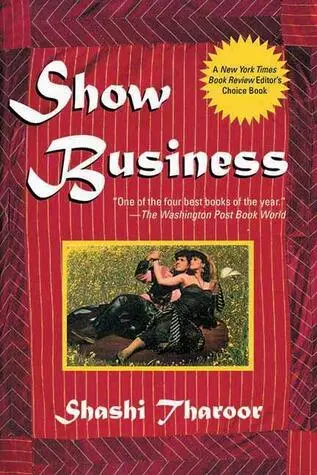
- Название:Show Business
- Автор:
- Издательство:Arcade Publishing
- Жанр:
- Год:2011
- ISBN:нет данных
- Рейтинг книги:3 / 5. Голосов: 1
-
Избранное:Добавить в избранное
- Отзывы:
-
Ваша оценка:
Show Business: краткое содержание, описание и аннотация
Предлагаем к чтению аннотацию, описание, краткое содержание или предисловие (зависит от того, что написал сам автор книги «Show Business»). Если вы не нашли необходимую информацию о книге — напишите в комментариях, мы постараемся отыскать её.
Show Business — читать онлайн бесплатно полную книгу (весь текст) целиком
Ниже представлен текст книги, разбитый по страницам. Система сохранения места последней прочитанной страницы, позволяет с удобством читать онлайн бесплатно книгу «Show Business», без необходимости каждый раз заново искать на чём Вы остановились. Поставьте закладку, и сможете в любой момент перейти на страницу, на которой закончили чтение.
Интервал:
Закладка:
My heart beats for you,
I’d perform feats for you,
You are the landlord of my soul;
My eyes light for you,
I’d gladly fight for you,
Without you I don’t feel whole.
At the end, as the rapturous audience files out, Ashok battles his way backstage. Mehnaz is in her dressing room removing an earring when Ashok enters and shuts the door behind him. “You dropped a piece of jewelry, Mehnazji,” he says quietly. He stretches out his hand; in it sparkles the silver bracelet with the dancing goddess rampant at the clasp.
Mehnaz looks at it for a long time, her hands frozen in their earlier position at her earlobe. “So you really did keep it for me,” she says at last.
“All these years,” breathes Ashok.
She reaches out a hand to take it from him, and his own closes on hers.
“Mehnaz, I have waited so long for you.”
She doesn’t move. “You haven’t waited,” she says. “You’re a married man.”
“That — that was for my parents,” Ashok pleads. “For society. Besides, you had left me. What could I do?”
“I only left you when I learned about your marriage,” she says.
“That couldn’t be,” Ashok responds. Then it strikes him. “Who told you I was getting married?”
“Your father, of course,” replies Mehnaz. “Wasn’t it you who sent him to me …?”
And then, as the enormity of the deception, and of their own mistakes, dawns on them, explanations give way to a clinging embrace. Mehnaz tries to resist, but Ashok is insistent. “So many wasted years to make up for,” he says. She succumbs, and as they fall upon the bed the camera focuses on the ceiling fan whirring rhythmically above.
The next few scenes show the progress of the relationship, including one more flowery song in a rose garden. But gardens are public places, and their chlorophyllous clinch is seen by Pranay, who grits his teeth in jealous fury. “Can’t give her love to any man, huh?” he snarls. “We’ll see about that.”
It is evening at Ashok’s home. Abha confronts him quietly, with all the deference of the traditional Hindu wife. “You are not home very often these days, my husband,” she says. “Daddy says you are not at the office much either. Is something the matter, Ashok?”
“It doesn’t concern you,” Ashok replies disingenuously.
“I believe it does,” Abha insists. “It is that dancing girl, isn’t it? You’ve been seeing her.”
“Who told you that?”
“Does it matter? But it is true.” Abha sobs.
“Look, Abha, I don’t mean to hurt you. But this is a woman to whom I gave my heart before I married you.”
“I am the woman to whom you gave your vow. What about me and our child? If your heart was already pledged, you had no right to plight it to me.”
“I’m sorry,” Ashok says, looking it.
“This came for you today.” Abha extends a scrap of paper. “Oh, Ashok, please stop what you’re doing. I’m frightened.”
On the paper, in a minatory scrawl, are the words “KEEP YOUR HANDS OFF MY WOMAN OR YOU’RE A DEAD MAN.”
“There must be some mistake,” Ashok says. “Mehnaz has no one else.”
“Oh, Ashok, please stop it,” Abha pleads tearfully. “Promise me you won’t see her again.”
“I can’t.” Ashok looks miserable. “I’m sorry.” And two faces, one tear-stained, the other anguished, stare devastated into the camera.
Another performance by Mehnaz: this time Abha is in the auditorium, defiantly by her husband’s side. Pranay stands in the wings and glowers alternately at his star and her lover. As Mehnaz, payals jingling, describes her feelings with fluid, circular motions of her arms, she trills:
So we have loved, why be afraid?
We have loved, we haven’t robbed a bank.
For our love, we’ve just ourselves to thank.
It’s ours, not for others to trade.
So we have loved, why be afraid?
So we have loved, where lies the shame?
We have loved, we haven’t hit and run.
Our love’s as natural as the sun.
Just the two of us need breathe its name.
So we have loved, where lies the shame?
Abha, stony-faced, nestles closer to Ashok in her seat. Mehnaz addresses the song directly to him. Pranay takes time off from gritting his teeth to take generous swigs from a bottle of Vat 69 in the wings.
After the show the inevitable occurs. (This is, after all, a Hindi film.) Overruling Abha, Ashok goes to greet Mehnaz. Pranay, his speech slurred, accosts him. Ashok tells him to sleep off his drunkenness. Pranay lashes out. There is a fistfight, the only one in the film. Ashok shows his stuff, and Pranay is left considerably the worse for wear. “Next time,” he whispers as the blood dribbles down his chin, “next time I will use a gun.”
The following day: Abha goes to Mehnaz, who admits her in courteous surprise. “I am his dharampatni, ” Abha says, his eternal wife. They have a child, Ashok has a future in his father’s business. The lives of so many are at stake, above all the happiness of an innocent infant. She earnestly pleads with Mehnaz to relinquish her husband.
Mehnaz is moved. “I have been selfish in seeking to extract a small bit of happiness for myself and Ashok. But I now see that it is at your expense, and that of your child. Never fear, Abha. As a woman I know what love means. I will do the right thing.” (If there are still any dry eyes in the house, the strains of violins on the sound track should be enough to produce tears in them.)
The climactic scene: Ashok and Mehnaz are on stage, performing together. Our hero sits on a dhurrie, singing, while Mehnaz dances around him. The song is familiar, but the lyrics have changed:
ASHOK:
Where are you, my love?
Of you I can’t have enough.
You have taken my heart
And kept it with you,
Now no one can start
To part me from you.
Wh-e-e-re are you, my love?
MEHNAZ:
Where are you, my love?
You float away like the clouds above.
You have taken my heart
And made my life new,
But now we must part
For Í must give you your due.
Wh-e-e-re are you, my love?
Ashok looks troubled by this departure from the script, but Abha, in the audience, understands the sacrifice Mehnaz will make, and her eyes fill with tears.
But it’s not yet over. As the song goes on, Pranay appears in the wings, his eyes bloodshot, his feet unsteady. He is carrying a gun.
The audience of extras cannot see him; the movie audience can. Ashok, his back to the wings, cannot see him either; nor at first can Mehnaz. But as she turns in her dance, she realizes to her horror that Pranay has raised his weapon and is aiming it directly at Ashok. She throws herself directly on her lover as Pranay fires — once, twice, the bark of the revolver punctuating the music and bringing the sound track to a screeching halt.
There are screams, Abha’s the loudest. She rushes up onto the stage. Mehnaz lies in Ashok’s arms, blood oozing from her wounds. Pranay breaks down, crying, “Oh, Mehnaz, what have I done?” He is promptly handcuffed by two culturally inclined policemen. Ashok cradles our heroine’s head in his hands. Abha kneels by her side. “Call a doctor!” Ashok shouts. But Mehnaz smiles poignantly and shakes her head.
“It’s too late,” she says faintly. “I don’t have much longer. Give me your hand.” Abha obliges. With difficulty, Mehnaz moves Abha’s hand toward Ashok’s and joins them. Close-up: husband and wife’s hands linked forever, smeared by the blood of the Other Woman.
Читать дальшеИнтервал:
Закладка:
Похожие книги на «Show Business»
Представляем Вашему вниманию похожие книги на «Show Business» списком для выбора. Мы отобрали схожую по названию и смыслу литературу в надежде предоставить читателям больше вариантов отыскать новые, интересные, ещё непрочитанные произведения.








Обсуждение, отзывы о книге «Show Business» и просто собственные мнения читателей. Оставьте ваши комментарии, напишите, что Вы думаете о произведении, его смысле или главных героях. Укажите что конкретно понравилось, а что нет, и почему Вы так считаете.