Shashi Tharoor - Show Business
Здесь есть возможность читать онлайн «Shashi Tharoor - Show Business» весь текст электронной книги совершенно бесплатно (целиком полную версию без сокращений). В некоторых случаях можно слушать аудио, скачать через торрент в формате fb2 и присутствует краткое содержание. Год выпуска: 2011, Издательство: Arcade Publishing, Жанр: Современная проза, на английском языке. Описание произведения, (предисловие) а так же отзывы посетителей доступны на портале библиотеки ЛибКат.
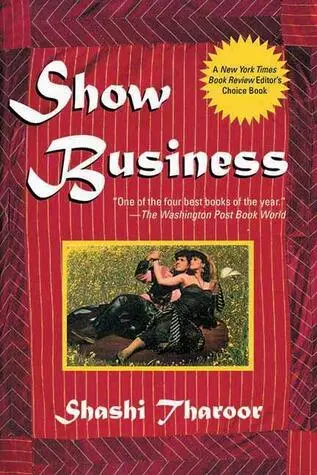
- Название:Show Business
- Автор:
- Издательство:Arcade Publishing
- Жанр:
- Год:2011
- ISBN:нет данных
- Рейтинг книги:3 / 5. Голосов: 1
-
Избранное:Добавить в избранное
- Отзывы:
-
Ваша оценка:
Show Business: краткое содержание, описание и аннотация
Предлагаем к чтению аннотацию, описание, краткое содержание или предисловие (зависит от того, что написал сам автор книги «Show Business»). Если вы не нашли необходимую информацию о книге — напишите в комментариях, мы постараемся отыскать её.
Show Business — читать онлайн бесплатно полную книгу (весь текст) целиком
Ниже представлен текст книги, разбитый по страницам. Система сохранения места последней прочитанной страницы, позволяет с удобством читать онлайн бесплатно книгу «Show Business», без необходимости каждый раз заново искать на чём Вы остановились. Поставьте закладку, и сможете в любой момент перейти на страницу, на которой закончили чтение.
Интервал:
Закладка:
“And she is giving it back to you,” Mehnaz’s father, Ramkumar, replies. “She doesn’t want it anymore.”
“I don’t understand.” Ashok’s eyes are hot with tears. “I don’t know what’s come over your daughter, but you can tell her I shall always keep this bracelet for her — till the day she comes back to me.”
“I shall tell her,” replies the kindly mother, “but she isn’t coming back, Ashok. She has gone to make her career in Bombay.”
Sad, portentous music. The screen intercuts two sets of images: one of Ashok’s wedding ceremony, complete with demure bride dripping with gold, sneezy guest dripping with cold, and overweight mother-in-law dripping with tears, the other of elegiac soft-focus shots showing Mehnaz in Bombay, gazing wistfully at the horizon, her sari billowing in the sea breeze, and singing the refrain of Ashok’s song:
Where are you, my love?
I wait for light from the stars above.
You have taken my heart
And hid it from view,
Now no one can start
To rid me of you.
Wh-e-e-re are you, my love?
It is some years later. Ashok is seated on a dhurrie on the floor, taking music lessons from a maestro with a harmonium. “Very good,” says the maestro, Asrani, an actor seen more often in the role of stock comedian. “Now once again: sa-ri-ga-ma-pa-da-ni-sa.” He tosses his head back with a tonal flourish as he runs through the scale. “Now you.”
Ashok dutifully echoes his guru: “Sa-ri-ga-ma-pa-da-ni-sa.”
“Not bad,” says the maestro. “But there is something missing.” He taps his belly, producing a percussion note like a cork being pulled out of a bottle, and resumes. “Sa-ri-ga-ma-pa-da-ni-sa.”
Ashok also tosses his head. “Sa-ri-ga-ma-pa-da-ni-sa.”
“You’re getting it,” says the maestro. “See, it’s simple:
Sa, sambar, a Southie dish,
Ri, what the Frenchies call our rice;
Ga, gaga, as the Bongs are about fish,
Ma, mother, ain’t her cooking nice?
Pa, the man always served first,
Da, daal, the food for healthy chaps,
Ni, nimbu pani for our thirst,
and that brings us back to sa — saag paneer perhaps?
Ashok’s brow unfurrows in comprehension. “You’re hungry,” he says.
“I thought you’d never get it,” sighs the maestro. “Music may be the food of love, but the love of music requires food. Let’s eat.”
As they wrap themselves around the contents of a thali served by uniformed menials, Ashok asks the maestro how good he really is. “Really, not bad at all,” replies his instructor, professionally noncommittal. “What made you want to take up singing?”
The camera lingers in close-up on Ashok’s poignantly inexpressive face. “A friend left me once, some years ago,” he says, a faraway gaze in his eyes. “When she left, I felt she had taken the music out of my life. I decided to replace her somehow within myself.”
”Wah, wah,” responds Asrani heartily. It is not clear whether his appreciation is for the sentiment or the food.
There follow a couple of scenes that establish Ashok in conventional domesticity: scenes involving his dutiful wife and beautiful children. (Note: to be fleshed out if Mr. Banjara accepts the role.) Meanwhile, Mehnaz goes from success to success. She is shown dancing in overflowing halls to standing ovations, receiving prizes and awards, and being featured on posters and in neon lights. (Note: at least one very good song here showing Ms. Elahi dancing, with five costume changes to mark her progress and establish different occasions.)
In some scenes Mehnaz is accompanied by her manager, Pranay, an energetic operator who is seen organizing backstage, berating auditorium managers, arranging for Mehnaz to be garlanded. One day, as Mehnaz emerges fresh from a stage triumph, Pranay clasps her in a joyous embrace. “Wonderful!” he exclaims. “I say, Mehnaz, why don’t you and I do something?”
“What?” she asks innocently.
“Get married.”
Mehnaz averts her exquisite face so only the camera can see the pain in her eyes. “I am sorry, Pranay, but I cannot.”
“Why not? Do you have a better friend than me in the whole world?”
“No, of course not, Pranay,” says Mehnaz. “You’re a wonderful friend, and a great manager. It’s not you. I shall never marry — anybody.”
Pranay is bewildered. “But why?” “I gave my heart once to a man, many years ago,” she says. “I cannot love anyone else ever again.” “Who is this man?” asks Pranay angrily.
Mehnaz does not answer. But in the very next scene the man in question is about to give his first public performance as a singer. And he is introduced fulsomely to a large audience by none other than his own father, Old Mr. Anti-Entertainers himself, Seth Godambo.
“As you know, my son’s profession is business,” Godambo orates. “And in this domain he has worked with me to create a place for himself in this community as an upstanding citizen. But what is not so widely known is that he also has a musical soul. And he has kindly agreed today, under the able guidance and instruction of Pandit Asrani”—the maestro, his mouth full of paan, takes an affable bow— “to sing for you today, all in the cause of charity, of course.” Godambo nods, and on cue, the extras break into thunderous applause.
His aesthetic inclinations thus rendered respectable, Ashok launches into his lament:
Where are you, my love?
I wait for light from the stars above.
You have taken my heart
And hid it from view,
They have kept us apart
And rid me of you.
Wh-e-e-re are you, my love?
Where she is, is right there, for, unnoticed by the singer, Mehnaz Elahi has slipped into the audience, and she listens to him sing with tears glistening in her eyes.
The show is over, and Ashok is standing, palms joined in respectful namaskar, as a succession of elders and strangers congratulate him on his performance. Abha and Godambo are in another part of the hall, conversing animatedly. Suddenly the look of distant politeness on Ashok’s face vanishes as a soft voice cuts through the hubbub near him. “You sang beautifully, Ashok.” Our hero looks up in shock at Mehnaz standing among the throng, which considerately melts away.
“You! What are you doing here?”
“I’m supposed to be dancing on this stage tomorrow,” she says. (Note: perhaps we ought to give her a stage name as well, to explain why Ashok hasn’t heard of her coming.) “I got here early and thought I would look at the auditorium. And I heard you.”
Their eyes meet, and it is obvious even to the villagers in the twenty-five-paisa seats that nothing has changed between them. “Why did you leave me that day, without even a word?” he asks urgently. “Because you were getting married to someone your parents had arranged and you didn’t even tell me,” Mehnaz replies. “Me? But — that’s not true!” Ashok exclaims. “You mean you’re not married?” she asks. “To Lala Chhoturmal’s daughter?” Ashok admits he is, “but only because you left me …”
Before they can go much further, Abha calls, “Ashok?” She walks up to them. “Ashok, some people there are waiting to see you, friends of Daddy’s,” she announces. “Come along now.” There is time for the women to exchange a formal namaskar before Abha drags her husband away. Mehnaz stares after them for a long moment, then turns and leaves.
The next evening: another Mehnaz dance, another song with a familiar echo:
Читать дальшеИнтервал:
Закладка:
Похожие книги на «Show Business»
Представляем Вашему вниманию похожие книги на «Show Business» списком для выбора. Мы отобрали схожую по названию и смыслу литературу в надежде предоставить читателям больше вариантов отыскать новые, интересные, ещё непрочитанные произведения.








Обсуждение, отзывы о книге «Show Business» и просто собственные мнения читателей. Оставьте ваши комментарии, напишите, что Вы думаете о произведении, его смысле или главных героях. Укажите что конкретно понравилось, а что нет, и почему Вы так считаете.