Shashi Tharoor - Show Business
Здесь есть возможность читать онлайн «Shashi Tharoor - Show Business» весь текст электронной книги совершенно бесплатно (целиком полную версию без сокращений). В некоторых случаях можно слушать аудио, скачать через торрент в формате fb2 и присутствует краткое содержание. Год выпуска: 2011, Издательство: Arcade Publishing, Жанр: Современная проза, на английском языке. Описание произведения, (предисловие) а так же отзывы посетителей доступны на портале библиотеки ЛибКат.
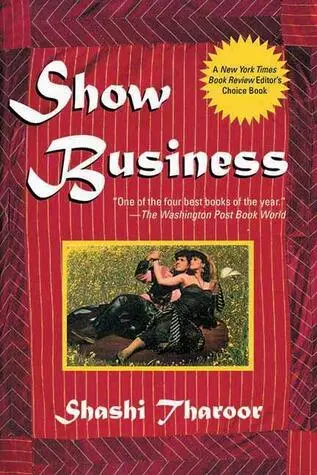
- Название:Show Business
- Автор:
- Издательство:Arcade Publishing
- Жанр:
- Год:2011
- ISBN:нет данных
- Рейтинг книги:3 / 5. Голосов: 1
-
Избранное:Добавить в избранное
- Отзывы:
-
Ваша оценка:
Show Business: краткое содержание, описание и аннотация
Предлагаем к чтению аннотацию, описание, краткое содержание или предисловие (зависит от того, что написал сам автор книги «Show Business»). Если вы не нашли необходимую информацию о книге — напишите в комментариях, мы постараемся отыскать её.
Show Business — читать онлайн бесплатно полную книгу (весь текст) целиком
Ниже представлен текст книги, разбитый по страницам. Система сохранения места последней прочитанной страницы, позволяет с удобством читать онлайн бесплатно книгу «Show Business», без необходимости каждый раз заново искать на чём Вы остановились. Поставьте закладку, и сможете в любой момент перейти на страницу, на которой закончили чтение.
Интервал:
Закладка:
“I would like to bring her here to meet you,” Ashok suggests.
“Wait!” Godambo is a man of procedure. “Before you bring any such person to our house, let me make some inquiries. Tell me everything you know about her. Who is the girl? What is her name? Is she of good family? Who are her parents? Do we know them, and if not, why not? Where does she live? How did you meet her?” And Amma adds, “Is she fair?”
“Yes, she is,” Ashok answers his mother, but one useful response does not get him off the hook. Godambo is not to be diverted. Squirming under his relentless probing, Ashok has to admit that his ladylove is neither rich nor well connected. “But she is a wonderful girl,” he says with deep-pupiled intensity. “And I love her.”
“Love?” Godambo barks. “What is love?”
“Love,” Amma explains maternally, “is something that comes after marriage, Ashok. I love you, I love your father. How can you love a stranger?”
“She’s not a stranger, Mother,” Ashok begins, then realizes it is hopeless. “Look, if only you both would meet her, you would see immediately what I mean.” But his father is reluctant to take matters so far as to welcome this impecunious interloper into his own living room. Then Ashok has an idea. “Come and see her at the Cultural Evening tonight,” he pleads.
Godambo is not interested, but Amma, ever the obliging mother, persuades him on behalf of her son.
Scene: an auditorium, every seat full. Ashok and his parents are escorted to a front row. The curtain parts to reveal a stage with the painted backdrop of a flowering garden. Mehnaz enters in a cascade of anklets, covered head to foot in kathak costume of billowing red skirt, long-sleeved red blouse, red head scarf, and red leggings, all spangled with silver. Godambo grunts appreciatively. Mehnaz bursts into song:
My heart beats for you,
I’d perform feats for you,
You are the landlord of my soul;
My eyes light for you,
I‖d gladly fight for you,
Without you I don’t feel whole.
As she sings and dances, all arched hip and elegant fingertips, she manages to exchange meaningful glances with Ashok, making it clear every word of the playback applies to him. Meanwhile, Godambo, oblivious to this byplay, appears to enjoy himself hugely. When the song is over the audience bursts into well-rehearsed applause, and Ashok rises to his feet to clap vigorously.
At the end of the show, Godambo, in mellow spirits, looks around the hall. “So where is this girl you wanted me to meet?” he asks his son.
“You’ve seen her, Dad. And I could tell you liked her. Mehnaz Elahi, the kathak dancer. Wasn’t she something?”
“What!” Godambo’s eyes bulge in horror. “An entertainer! My son wants to marry an entertainer!”
Amma restrains him, but he storms out, wife and son in tow. They are getting into their chauffeur-driven Impala when Mehnaz, now freshly changed into a sari, emerges from the auditorium and walks expectantly toward them. She stops short, though, her pretty face clouded in bewilderment, as Ashok shuts the car door after him with a look of helplessness. Mehnaz is left staring crestfallen into the camera as the Impala drives away in a cloud of dusty intolerance.
Inside the house the scene is Godambo’s: rage and outrage alternating with advice about vice. He is furious that his son wants to marry the first plausible hussy who has allowed him to embrace her. Of course young men must sow their wild oats, but marriage has nothing to do with sexual attraction. The girl might be pretty, she might be talented, but she was completely unsuitable for the son of Seth Godambo. When Ashok marries, it will be a social event; his bride will be handpicked from a dazzling array of well-endowed virgins from well-endowed families. There is the business to be considered, the family’s standing in the community, the expectations of the society in which they live. If Ashok married — the word makes Godambo choke— married Mehnaz Elahi, he and his parents would be laughingstocks. “I understand your needs,” Godambo adds in gruff paternalism. “I was a young man myself once. But marriage is another matter altogether.”
Yes, Amma explains. Marriage is not just a relationship between individuals, but an arrangement between families. Ashok would not just be marrying one woman, he would be acquiring another family. Can he see Mehnaz’s simple father and shrouded mother socializing in Seth Godambo’s living room? Ashok has to admit he cannot.
Yet when his parents have finished with him, Ashok is defiant. “Mehnaz is the woman of my heart,” he declaims. “I will not let her down.”
“Why don’t you talk this over with her?” Godambo is surprisingly reasonable. “She may well prove more sensible than you. When are you seeing her next?”
“Tomorrow evening,” Ashok replies. “She was supposed to join a show in Bombay, but I persuaded her not to. Dad, I’m not sure I can live without her.”
“Don’t be so sure she can’t live without you,” Godambo says meaningfully.
Next scene: Godambo with our heroine, in her lower-middle-class home. Peacock-green walls, peeling ceiling, plastic-covered sofa, garish calendars of androgynous deities. “Miss Mehnaz, I enjoyed your performance at the Cultural Evening last night,” he says gutturally. “I would like to engage you for a very special occasion.”
Mehnaz is all pretty and obliging.
“You see, my son is getting married,” Godambo goes on. “And we are celebrating it in a big way, as befits an alliance between two of the city’s biggest families. I would like to have an entertainment show worthy of the occasion. And I would like you to sing and dance for my son’s wedding.”
“Your son?” Mehnaz asks.
“Ashok Banjara,” Godambo says with pride. “Why, do you know him?”
“And he is … getting … married?”
“Yes, to Lalaji Chhoturmal’s daughter, Abha,” Godambo replies. “Ashok has liked her for a long time. You see, they were in the same school, and of course we know the family very well.”
“Of course.” Mehnaz’s tone is dull.
“So — will you come for the event? Three weeks from now. I hope you are free, and I would of course be happy to double your fee on this happy occasion.”
“No,” Mehnaz says quietly. “No, I am afraid I cannot accept your invitation, Sethji. You see, I have a prior commitment in Bombay. In fact, I am leaving tonight.”
“I am most disappointed,” Godambo says, but he cannot conceal the gleam of triumph in his bulging eyes.
It is later, at dusk; Ashok is waiting at a palm grove near the beach, wearing jeans and a troubled expression. He looks at his watch, then up at the darkening sky. Studio stars twinkle at him. He sings plaintively:
Where are you, my love?
I wait for light from the stars above.
You have taken my heart
And hid it from view,
Now no one can start
To rid me of you.
Wh-e-e-re are you, my love?
There is, of course, no answer.
Song finished, and with one more futile look at his watch, Ashok leaps into his two-seater sports car and drives to Mehnaz’s house. “Where is she?” he demands of her poor but dignified parents, as the calendars flap omnisciently on the walls.
“She has gone to Bombay,” replies the mother. “And she specifically told me to tell you, if you came by, that she has nothing to say to you. Except to give you this.” She puts a crumpled envelope into Ashok’s hand. Out of it emerges a silver bracelet, with the image of a dancing goddess on a medallion at its clasp.
“But I gave her this,” Ashok protests in dismay.
Читать дальшеИнтервал:
Закладка:
Похожие книги на «Show Business»
Представляем Вашему вниманию похожие книги на «Show Business» списком для выбора. Мы отобрали схожую по названию и смыслу литературу в надежде предоставить читателям больше вариантов отыскать новые, интересные, ещё непрочитанные произведения.








Обсуждение, отзывы о книге «Show Business» и просто собственные мнения читателей. Оставьте ваши комментарии, напишите, что Вы думаете о произведении, его смысле или главных героях. Укажите что конкретно понравилось, а что нет, и почему Вы так считаете.