Shashi Tharoor - Show Business
Здесь есть возможность читать онлайн «Shashi Tharoor - Show Business» весь текст электронной книги совершенно бесплатно (целиком полную версию без сокращений). В некоторых случаях можно слушать аудио, скачать через торрент в формате fb2 и присутствует краткое содержание. Год выпуска: 2011, Издательство: Arcade Publishing, Жанр: Современная проза, на английском языке. Описание произведения, (предисловие) а так же отзывы посетителей доступны на портале библиотеки ЛибКат.
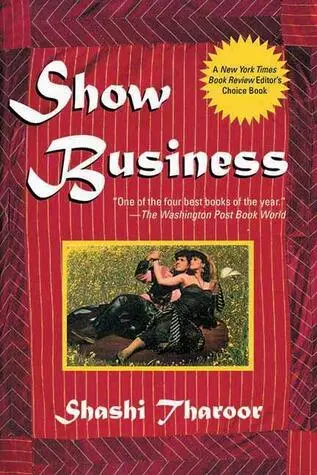
- Название:Show Business
- Автор:
- Издательство:Arcade Publishing
- Жанр:
- Год:2011
- ISBN:нет данных
- Рейтинг книги:3 / 5. Голосов: 1
-
Избранное:Добавить в избранное
- Отзывы:
-
Ваша оценка:
Show Business: краткое содержание, описание и аннотация
Предлагаем к чтению аннотацию, описание, краткое содержание или предисловие (зависит от того, что написал сам автор книги «Show Business»). Если вы не нашли необходимую информацию о книге — напишите в комментариях, мы постараемся отыскать её.
Show Business — читать онлайн бесплатно полную книгу (весь текст) целиком
Ниже представлен текст книги, разбитый по страницам. Система сохранения места последней прочитанной страницы, позволяет с удобством читать онлайн бесплатно книгу «Show Business», без необходимости каждый раз заново искать на чём Вы остановились. Поставьте закладку, и сможете в любой момент перейти на страницу, на которой закончили чтение.
Интервал:
Закладка:
But I’m digressing again about myself, like a typical politician, and that won’t do at all, will it? The doctor had told us to speak to you about things that would directly interest you, and I can’t pretend that my political career has ever been of much interest to you, eh, Ashok? See, your expression hasn’t changed at all. When Pranay came out of your room he swore he had seen you react a couple of times, and that’s what gave us all hope to go on with this strange hospital experiment. But then I suppose your filmi friends have so much more to tell you about what you want to know.
Even so, I want to finish the point I was trying to make about your world and mine. Which is that we are both involved in pretense. Politicians make speeches in which they pretend that their actions and positions are motivated by policy, principle, ideology, the interests of their constituents, their vision of India, whatever; and they pretend that they expect people to support them, vote for them, give them money, on that basis. But of course issues and values determine little of their actual actions and less of the support they really get: they win on caste calculations, they get money for suborning laws they have enthusiastically passed, they switch parties and abandon platforms at the dangling of a lucrative post or a ministerial berth. And yet why should anyone be surprised? Politics is the art of the expedient: no politician can afford to look beyond the next election and the means that will help him win it. Politics is an end in itself, just like the Hindi film. You cannot judge either by external standards.
And then politics has changed so much since I began my career, just as your motion pictures have. When I used to enjoy seeing Hindi films, the heroes were like Dilip Kumar, intense, sincere, full of dignity, nobility, a willingness to suffer and make sacrifices. Just like the heroes of our national movement, the men inspired by the Mahatma. Look at the men in power today — hustlers, smugglers, fixers, men who can rent a crowd, accept a bribe, threaten or co-opt a rival, do a deal; men who would say that they have risen by dint of their energy, their drive, their refusal to be cowed by the rules. With people like this at the top of our politics, is it any surprise that the heroes of our films are men of the same stamp? And seeing the connection, can I be surprised that this is the kind of hero you’ve always portrayed?
I’m sorry, Ashok, I’m lecturing you. You never liked that, did you? I often wondered how I had lost you, where my hold on your allegiance, your admiration, had slipped. I was always aware of the risk that with my busy political life I might neglect my children, so I went out of my way to make sure I spent enough time with you — well, “enough” is a subjective word, but certainly a lot more time than I could easily spare. And yet when we were together I constantly felt you would rather be somewhere else, even that my contact with you distanced you from me rather than drew us closer. I asked your mother about that once, and she replied, “You’re always lecturing him, KB. How do you expect the boy to enjoy being with you if all the time you’re lecturing him?” I had no answer, because what she called lecturing I saw as the essential transmission of paternal wisdom from father to son, and my advice and guidance was always given with love, Ashok. Your brother listened dutifully: you switched off your mind and withdrew yourself from me even before you had left the room.
Once when I took my disappointment and hurt to your mother, she said in that quiet voice of hers, “Why are your surprised, KB? Love, like water, always flows downward.” Of course: we can never expect our children to love us as much as we love them. We can’t help loving you, the products of ourselves; we have known you when you were tiny and weak and vulnerable and have loved you when there was no real you to love. But your love, every child’s love for his parents, is born out of need and dependence. That need decreases with every passing year, while ours, the parents’, only grows. It’s an uneven emotional balance, Ashok, and always it’s the children who enjoy the position of strength in the equation of needs. The pity of it is that you don’t see that; you think yourself the weaker and react to my imagined strength, whereas if you only saw how great is my need for your love, you might find loving me so much easier. Ashok, I don’t want to believe it’s too late for that now.
No, I’m not here to upset you. Though the doctor did say that it could do no harm: “We think he can hear, we believe he can even understand what is being said to him, but he is either unable or unwilling” — can you imagine that, Ashok, unwilling? — “to respond. But it is important to keep talking to him, to help him recall things, to provoke and stimulate him, yes, even to make him angry. The important thing is to get a reaction.” But I don’t seem to have succeeded there, have I, Ashok? You’re not reacting to me at all. As usual. I have never been able, all these years, to get you to react to me.
Though sometimes you say or do something that prompts your mother to smile at me and say, “See, he’s your son after all, KB.” I won’t hide what the first of those was, at least after you became an adult. You made us very happy, Ashok, when you decided to marry Maya. Your mother and I could scarcely believe that, after all those years of squiring completely unsuitable girls at college and in Delhi and (we imagine) in your early years in the Bombay film world, you actually brought home the kind of girl we would have been happy to arrange your marriage with. “We can’t have done everything wrong,” I said to your mother, “if these are the qualities he voluntarily looks for in a wife.” And everything since then has, of course, only vindicated our enthusiastic endorsement of your choice. The girl has been a saint, Ashok. To put up with all the things you made her put up with, without complaint, at least without public complaint, and to continue being a good wife and mother to your children. Really, you should give thanks to your Maker every day for the good luck He brought your way in the form of that remarkable woman, your wife.
It is strange, isn’t it, how so many of the events of your life seemed to parallel your films, and vice versa. Life imitating art, perhaps — if Hindi films can be called art. The most astonishing thing was your doing that film in which you played a pair of twin brothers, precisely when Maya was delivering your own triplets! Your mother and I never stopped marveling about that. And yet it was at that very time, was it not, that you took up with that Mehnaz Elahi of yours. She was with you in that very film — cast opposite you, you later admitted, at your own request. How could you do that, Ashok? When your wife was undergoing a difficult pregnancy and bringing your heirs into the world? Shame on you. Yes, Ashok: shame on you.
We never said a word throughout the whole sordid business, your mother and I. Not one word, in public or in private. Why should we express what we felt when we were the only ones, it seemed, feeling any of it? It appalled me that your whole filmi press took it all for granted: there were knowing references to your affair with this girl, but nothing more. Your liaisons, your activities, were reported without even a hint of raised eyebrows, let alone condemnation, though you had a wife and three children sitting at home, a wife who had given up a lot to be your wife. “Every actor in Bombay has extramarital affairs, Ma,” you had the gall to tell your mother. “It’s sort of expected of us. It would be unnatural if I didn’t.” And what about the values we brought you up with? Was it not unnatural to abandon them?
I shouldn’t get angry. It’s not my emotions the doctor wants to stir up. But it was a shame, really. After that, Ashok, you couldn’t very well claim not to understand why I still disapproved of you.
Читать дальшеИнтервал:
Закладка:
Похожие книги на «Show Business»
Представляем Вашему вниманию похожие книги на «Show Business» списком для выбора. Мы отобрали схожую по названию и смыслу литературу в надежде предоставить читателям больше вариантов отыскать новые, интересные, ещё непрочитанные произведения.









Обсуждение, отзывы о книге «Show Business» и просто собственные мнения читателей. Оставьте ваши комментарии, напишите, что Вы думаете о произведении, его смысле или главных героях. Укажите что конкретно понравилось, а что нет, и почему Вы так считаете.