Shashi Tharoor - Show Business
Здесь есть возможность читать онлайн «Shashi Tharoor - Show Business» весь текст электронной книги совершенно бесплатно (целиком полную версию без сокращений). В некоторых случаях можно слушать аудио, скачать через торрент в формате fb2 и присутствует краткое содержание. Год выпуска: 2011, Издательство: Arcade Publishing, Жанр: Современная проза, на английском языке. Описание произведения, (предисловие) а так же отзывы посетителей доступны на портале библиотеки ЛибКат.
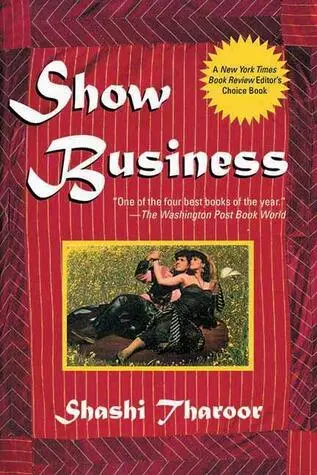
- Название:Show Business
- Автор:
- Издательство:Arcade Publishing
- Жанр:
- Год:2011
- ISBN:нет данных
- Рейтинг книги:3 / 5. Голосов: 1
-
Избранное:Добавить в избранное
- Отзывы:
-
Ваша оценка:
Show Business: краткое содержание, описание и аннотация
Предлагаем к чтению аннотацию, описание, краткое содержание или предисловие (зависит от того, что написал сам автор книги «Show Business»). Если вы не нашли необходимую информацию о книге — напишите в комментариях, мы постараемся отыскать её.
Show Business — читать онлайн бесплатно полную книгу (весь текст) целиком
Ниже представлен текст книги, разбитый по страницам. Система сохранения места последней прочитанной страницы, позволяет с удобством читать онлайн бесплатно книгу «Show Business», без необходимости каждый раз заново искать на чём Вы остановились. Поставьте закладку, и сможете в любой момент перейти на страницу, на которой закончили чтение.
Интервал:
Закладка:
I’ll try and explain myself to you, Ashok, to describe the gulf I felt between our worlds. My India is periodically torn apart in outbursts of communal and sectarian violence; but communal awareness only enters your films if the producer wants to obtain an entertainment-tax waiver for “promoting national integration.” Every hero, and for that matter every villain, in your films is casteless and unplaceable, an “Ashok” or a “Ramkumar” or a “Godambo,” whereas in my India you will never get anywhere with a man without knowing who he is, where he comes from, what his caste affiliations are. (In my constituency a man’s surname alone can frequently tell you which way he will vote, but in your films hardly anyone of consequence in the script has a surname.) In my India poverty means distended bellies and eyes without hope, whereas in your films the poor change costumes for each verse of their songs and always have enough strength to beat up the villains. In your films evil is easily personalized — a wicked zamindar, a cruel smuggler — but in my India I see that evil pervades an entire social and economic system that your films do nothing to challenge, a system that indeed places the likes of your own producers among the grubby cluster at its pyramid.
So smugglers are villains? Fine. Why do they smuggle? Because people, Indians, want goods from abroad that our laws don’t allow into India. Why don’t our laws allow these goods? Leaving the intricacies of foreign exchange balances aside, it is primarily to protect Indian industrialists who make inferior versions of the same goods, often at higher prices, and want to unload them on the hapless Indian consumer without the fear of foreign competition. These worthy nationalists safeguard the indefinite continuance of their highly profitable inefficiency by pouring some of their easily gotten gains into the coffers of the leading political parties, which parties, of course, then reaffirm the policy of protection. Can you make a virtue out of that? Yet some of the most stirring patriotic speeches in your films are made against smugglers, who after all are merely meeting a need, helping the common man to beat the vested interests.
But the ironies don’t stop there, since in our country even challenging a vested interest becomes a vested interest. So smugglers are antinational? Very well, but Bombay’s most successful smuggler is avidly sought after for campaign contributions by every party, including mine, and his endorsement is highly valued for the bloc of votes it delivers from his community. So basically the same class of people pass the protectionist laws, get support from both the beneficiaries and the violators of these laws at election time, buy goods from the smugglers, and denounce them in their films. You sort out the various conflicts of interest there if you want to, but don’t tell me it’s a simple case of good versus evil.
I told my Prime Minister once that we would solve half the crime in this country by not passing laws that everyone felt it necessary to break. She looked down her patrician nose at me in that way she has, her eyebrows almost meeting in a disapproving exclamation mark just below her streak of white hair. I later learned that she had been thinking of putting me in the Home Ministry, but she concluded my attitude was not the right one for someone who would have to supervise the police.
In politics we are always looking behind and between the lines, tracing hidden agendas, seeing into the motivations for any position that is taken, understanding that what is said is not necessarily what is meant and that what is meant is not necessarily intended to mean the same thing for all time. In your Hindi films there is nothing beyond the surface; everything is meant to be exactly what it is shown to be. There are no hidden meanings, no inner feelings, no second layer to life. All is big, clear, simple, and exaggerated. Life is black and white, in technicolor.
And yet I suppose our worlds are not that far apart after all. You function amid fantasies, playing your assigned role in a make-believe India that has never existed and can never exist. As a politician I too play a role in a world of make-believe, a world in which I pretend that the ideas and principles and values that brought me into politics can still make a difference. Perhaps I too am performing, Ashok, in an India that has never really existed and can never exist.
I joined politics in the days of the nationalist struggle, in the Quit India movement. You know that, I suppose, yet how strange it is that I should be sitting here today and telling you these things that you have never asked me to tell you or never shown much curiosity about. I was a good student, and my teachers had high hopes for me, but like so many others in those heady, futile days of 1942, I felt I had to heed the Mahatma’s call to take to the streets to clamor for the British to leave. It was all quite pointless, of course, because the British weren’t going to “quit,” especially in the middle of a war, just because a few lakhs of us shouted in the streets that they must. So we ended up getting a few bones broken by police lathis and spending our classroom hours in jails. It destroyed a few people, though of course imprisonment during 1942 was a most useful credential for political advancement after Independence. But it changed very little politically. It is interesting how, in so many countries, national myths are built around events of little historical significance — the Boston Tea Party, the evacuation of Dunkirk, the Quit India movement — while the events that really changed the course of a nation’s destiny never seem to linger as long in the popular imagination.
Anyway, I was luckier than most, because I spent a few days in jail and then my father used his connections with the British — who had given him the grand title of Rao Bahadur just the previous year for his contributions as a businessman to the war effort — to get me out and send me up to Cambridge. So nationalism got me a British degree instead of the Indian one I had been enrolled for and kept me out of trouble — and the war. I finished my studies in time to come back and join the Congress party in my home district before Independence. There aren’t too many of us from that generation with qualifications like that — Shankar Dayal Sharma, some of the Bengal Communists, a mere handful in all, who were always in the right places at the right times and can claim that our academic and nationalist credentials are both impeccable. The Communist fellows, of course, went and blotted their copybook by opposing the Quit India movement, not on the sensible grounds that it wouldn’t work, but because they didn’t want to weaken the British war effort that was so important to Stalin’s survival. They betrayed nationalism in India to protect communism in the Soviet Union, and though they continue to bray that history vindicated their choice, the Indian electorate never forgave them for it.
So I embarked on the only career I’ve really had, political office, and for the first twenty years I almost didn’t have to think about getting elected because we were the party that had won the country its freedom, and in an overwhelming majority of constituencies that was all the voters needed to know. I rose steadily, if unspectacularly, up the political ladder, holding state office, then national portfolios as a deputy minister and a Minister of State. I suppose if I had been just a little more willing to keep some of my more unconventional opinions to myself, if I had shown just a little more patience with the arrant nonsense spouted by our in-house socialist ideologues, I might be a cabinet minister today, or at least have spent some of my Minister of State days in a more important ministry like Home. Instead I have gone from party hack to party elder statesman without the usual intervening phase of senior government responsibility.
Читать дальшеИнтервал:
Закладка:
Похожие книги на «Show Business»
Представляем Вашему вниманию похожие книги на «Show Business» списком для выбора. Мы отобрали схожую по названию и смыслу литературу в надежде предоставить читателям больше вариантов отыскать новые, интересные, ещё непрочитанные произведения.








Обсуждение, отзывы о книге «Show Business» и просто собственные мнения читателей. Оставьте ваши комментарии, напишите, что Вы думаете о произведении, его смысле или главных героях. Укажите что конкретно понравилось, а что нет, и почему Вы так считаете.