Shashi Tharoor - Show Business
Здесь есть возможность читать онлайн «Shashi Tharoor - Show Business» весь текст электронной книги совершенно бесплатно (целиком полную версию без сокращений). В некоторых случаях можно слушать аудио, скачать через торрент в формате fb2 и присутствует краткое содержание. Год выпуска: 2011, Издательство: Arcade Publishing, Жанр: Современная проза, на английском языке. Описание произведения, (предисловие) а так же отзывы посетителей доступны на портале библиотеки ЛибКат.
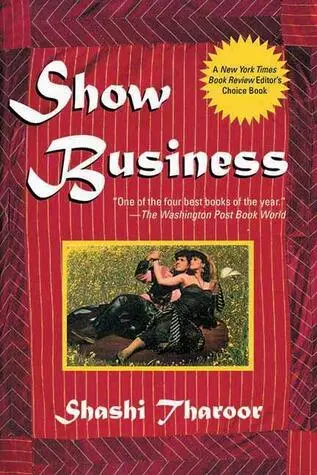
- Название:Show Business
- Автор:
- Издательство:Arcade Publishing
- Жанр:
- Год:2011
- ISBN:нет данных
- Рейтинг книги:3 / 5. Голосов: 1
-
Избранное:Добавить в избранное
- Отзывы:
-
Ваша оценка:
Show Business: краткое содержание, описание и аннотация
Предлагаем к чтению аннотацию, описание, краткое содержание или предисловие (зависит от того, что написал сам автор книги «Show Business»). Если вы не нашли необходимую информацию о книге — напишите в комментариях, мы постараемся отыскать её.
Show Business — читать онлайн бесплатно полную книгу (весь текст) целиком
Ниже представлен текст книги, разбитый по страницам. Система сохранения места последней прочитанной страницы, позволяет с удобством читать онлайн бесплатно книгу «Show Business», без необходимости каждый раз заново искать на чём Вы остановились. Поставьте закладку, и сможете в любой момент перейти на страницу, на которой закончили чтение.
Интервал:
Закладка:
TAKE THREE

Interior: Night
I can’t believe I’m doing this.
Me, Ashok Banjara, undisputed Number One at the national box office, the man for whom the filmi press has just invented the term megastar, the hero who earns in a day what the president of India makes in a year, not to mention lord and occasional master of the pulchritudinous Mehnaz Elahi, chucking my little triplets under their shapeless one-year-old chins, lip-synching the juvenile inanities that their fond mother addresses them from the other side of the cot. But it is me, it’s my mouth that’s puckering in an inaudible kitchy-koo, it’s my finger that Leela, or is it Sheela, or even blue-faced Neela, stretches out to grab in her chortling little grip. Me, Ashok Banjara, proud father, a role that sits uneasily on my expensively padded shoulders. But I am happy to play it, at least for a few takes. I stroke each of my daughters’ chubby cheeks in farewell, and they gurgle in response; the Banjara magic appeals to females of every generation. My eyes meet Maya’s over the cot, and we exchange a complicitous smile.
“Do you have to go, Ashok?” she asks, as the ayah begins to change the diapers and we move away from the babies.
“You know I do,” I reply reasonably. After all, it is my profession.
“You spend so little time with the girls,” she says.
What she really means, of course, is that I spend so little time with her. “They’ve got you, my love,” I point out. “That’s the whole idea, isn’t it? One of us must be with them as much as possible. I’ve got to go out and earn the daal and chawal .”
“But you don’t need to work so hard anymore, Ashok,” she says. “We can afford all the daal and chawal we can possibly want, and more. You told me yourself you didn’t know what to do with all the black money that’s been pouring in.”
What she really means is, you don’t have to do so many films with Mehnaz Elahi. She’s heard the rumors, like everyone else. But she never asks about her. Never even mentions Mehnaz’s name. Proud woman, my wife. I like that about her: her pride.
“Sweetheart, it’s a treadmill,” I explain, a slight note of impatience entering my voice. “I can’t get off it. Not without serious injury. There’s a special responsibility to being at the top, you know. I’ve got to maintain my position. And the only way I can do that is by making more and bigger hits. The best scripts keep being offered to me because I’m Number One. I do them, so I stay Number One. The moment I say no to a sure-fire property, somebody else will snap it up and producers will begin to believe that Ashok Banjara is duplicable. Then no one will want to pay for the original article anymore.”
“So what?” she asks. “You’ve achieved everything there is to achieve in the industry. Why should you have to keep on struggling?”
“I’m not struggling, Maya,” I snap. “I’m working. Now you’ve got to be reasonable. Please.” I walk to the door.
“Ashok.” There is a catch in her voice. I remember, almost in wonder, how the slightest hint of tears in Maya’s tone would melt my heart. Not it is all I can do to control my irritation. “Ashok, don’t go today. Please. For my sake.”
“Maya, sometimes I don’t understand you at all.” I do not attempt to dampen the asperity in my response. “People are waiting for me. There is a whole studio gearing up for a shoot. How can I not go?”
“You won’t be the first actor who’s failed to turn up for a shooting,” she says. “You could be ill. I could be ill.”
“But you’re not,” I reply. “And I’m not. Maya, look, if there were a good enough reason, of course I could tell the studio I can’t make it. But just like that?”
“So my asking you isn’t a good enough reason,” she says, averting her face.
I can’t take any more of this. “Look, I’ve got to go,” I growl. I shut the door harder than I intended. But I don’t have the time to go back and apologize.
What has come over Maya these days? Some postnatal emotional instability, I suppose. It’s not as if the triplets are driving her around the bend; with an ayah and two servants, she doesn’t have to do much more than occasionally hold the bottle. Maybe it’s too easy, maybe she needs a more demanding style of motherhood. She seems happy enough sometimes, but then suddenly she goes all teary and irrational with me, like today. I’m glad her mother is coming next week. That’ll take the pressure off me. It would have been even better if she’d gone to her mother for the birth, of course, but then Bhopal’s facilities can’t match Breach Candy’s. So I suggested Maya’s mother come here instead for the delivery, but Maya had some sort of silly determination to start parenthood alone, with just me around. She said it would bring us closer together. She even wanted me to be in the delivery room, for Christ’s sake. The hospital smartly put a stop to that idea, but it was a reflection of the way in which Maya seems to be grabbing for me all the time these days. Through the triplets she’s reminding me all the time that I’m not just Ashok Banjara, megastar; I’m also part — hell, I’m the head — of a unit of five. Paternal responsibility’s the role, and I guess I know the script.
It’s not that I mind all that much. I keep telling Maya I’m happy to see myself that way: Ashok Banjara, husband and father. What the hell, I’ve certainly not shied away from that image in the media. Cyrus Sponerwalla played the births for all they were worth. Filmfare had a double-page spread of Maya and me holding the triplets up to our beaming faces. Star and Style did a whole feature entitled “NEW! Ashok Banjara’s Favorite Costars.” Even Radha Sabnis, whose tone is getting slightly bitchy again since I’ve failed to make a habit of pouring her champagne and submitting to rape, mentioned it in her Cheetah column: “Darlings, Ashok Banjara may not be able to teach Dustin Hoffman much as an actor, but he has certainly turned out to be a pretty good producer, eh? Triplets, and all girls at that! Well, the Hungry Young Man would never be satisfied with just one woman in his life, would he? Grrrowl …”
But now the excitement is fading, and Maya’s brief return to the pages of the film magazines seems to be over. I’m getting on with my life, but she doesn’t seem to know what she wants. Apart from me, that is. All to herself, all the time. Well, she can’t have that. I can’t afford to give it to her.
At the studio they want me to do another song picturization, a duet with Mehnaz. Mehnaz is a big name now; it hasn’t hurt that she’s unusually willing, for a star, to wear what the film industry euphemistically calls “modern dress,” garments so skimpy they make obvious what “traditional” dress used to leave to the imagination. “Modern” is the adjective most commonly applied to Mehnaz, but “willing” is the one I prefer. She’s always willing: on the set, with the dance director, and (why be coy about it?) in bed. Everyone looks forward to working with her. Especially me.
Old Mohanlal is our director today and he’s as anxious as ever, his creased brow revealing nerves as frayed as his cuffs. It looks as if seven has become his standard place on the Mohanlal Scale of High Anxiety. But things have changed. The dance director is a more adventurous soul than was old Gopi Master. He’s a Goan called Lawrence who actually has new ideas, in tune with the new music that is sweeping our sound tracks. The traditional techniques of the Gopi Masters have passed away along with the illustrious, semiclassical composer duos who dominated the film world for decades, chubby men with oily hair who thought the violin the last word in modernity. The principles of classical Indian dance don’t apply anymore to the snazzy rhythms our popular music directors are now unashamedly plagiarizing from the West. Both the beat and the spirit of the films call for a fresh choreographical approach, and Lawrence is the one who provides the fancy footwork for it. Mohanlal just watches, his face lined in worry and incomprehension.
Читать дальшеИнтервал:
Закладка:
Похожие книги на «Show Business»
Представляем Вашему вниманию похожие книги на «Show Business» списком для выбора. Мы отобрали схожую по названию и смыслу литературу в надежде предоставить читателям больше вариантов отыскать новые, интересные, ещё непрочитанные произведения.









Обсуждение, отзывы о книге «Show Business» и просто собственные мнения читателей. Оставьте ваши комментарии, напишите, что Вы думаете о произведении, его смысле или главных героях. Укажите что конкретно понравилось, а что нет, и почему Вы так считаете.