Shashi Tharoor - Show Business
Здесь есть возможность читать онлайн «Shashi Tharoor - Show Business» весь текст электронной книги совершенно бесплатно (целиком полную версию без сокращений). В некоторых случаях можно слушать аудио, скачать через торрент в формате fb2 и присутствует краткое содержание. Год выпуска: 2011, Издательство: Arcade Publishing, Жанр: Современная проза, на английском языке. Описание произведения, (предисловие) а так же отзывы посетителей доступны на портале библиотеки ЛибКат.
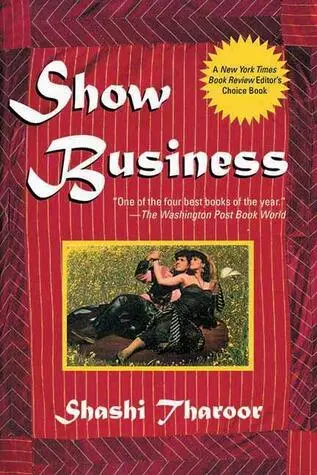
- Название:Show Business
- Автор:
- Издательство:Arcade Publishing
- Жанр:
- Год:2011
- ISBN:нет данных
- Рейтинг книги:3 / 5. Голосов: 1
-
Избранное:Добавить в избранное
- Отзывы:
-
Ваша оценка:
Show Business: краткое содержание, описание и аннотация
Предлагаем к чтению аннотацию, описание, краткое содержание или предисловие (зависит от того, что написал сам автор книги «Show Business»). Если вы не нашли необходимую информацию о книге — напишите в комментариях, мы постараемся отыскать её.
Show Business — читать онлайн бесплатно полную книгу (весь текст) целиком
Ниже представлен текст книги, разбитый по страницам. Система сохранения места последней прочитанной страницы, позволяет с удобством читать онлайн бесплатно книгу «Show Business», без необходимости каждый раз заново искать на чём Вы остановились. Поставьте закладку, и сможете в любой момент перейти на страницу, на которой закончили чтение.
Интервал:
Закладка:
Lawrence must be fifty if he’s a day, a wizened and wiry little man with more energy than Radha Sabnis after champagne. He wears a sleeveless T-shirt, tight corduroy trousers, and smooth-soled dancing shoes specially made for his tiny feet by a Chinese cobbler in Calcutta. Lawrence doesn’t just direct, he dances all the routines himself, my bits and Mehnaz’s, explaining every step and repeating every action till we’ve got it right and his T-shirt is soaked in sweat. Through it all Mohanlal pulls threads off his white cotton shirt and gray hairs off his now more sparsely covered head. A feature of Lawrence’s dancing style for me is the use of martial gestures: feet kicked high and strong, hands slashing through the air karate-style, assertive thumps of leather boots. Thanks to Lawrence I can dance and still retain my macho image; nor is my lack of fluid bharata natyam grace any longer a handicap. But Lawrence also comes up with the hip wiggles and pelvic gyrations that have pushed Mehnaz Elahi so rapidly to stardom. I stand and watch this quinquagenarian gnome, all lean dark skin and sinew, stretch and swivel and grind his nonexistent curves for Mehnaz to imitate, and I resist the urge to laugh. No one else, not even Mohanlal, seems to find anything incongruous in the movements of this fisherman’s son, whose style nets him more dance direction assignments than he can have had chicken dinners throughout his entire childhood.
But today’s scene is a curious mélange: a traditional, even hackneyed, girl-and-boy-get-amorous-in-the-rain song, with traditional, definitely hackneyed lyrics, being picturized to Lawrence’s untraditional, jack-kneed dance movements. While Mehnaz changes into the chiffon sari and skimpy blouse she is supposed to get wet in this scene — the kind of costume that would have made poor Abha’s deception impossible, but which heroines have only been called upon to don in these bolder times — Mohanlal spends fifteen anxious minutes discussing the picturization with Lawrence and me. Mehnaz has to be coy and revealing at the same time, and Lawrence has no doubt which he prefers. It is largely thanks to him that this daughter of an aristocratic Hyderabadi family has become the barest exponent of Bollywood’s brave new whirl.
Mohanlal no longer speaks to me in Hinglish: I’ve been mouthing Salim-Javed dialogues for too long now to need that concession to my Anglophone background. Lawrence’s Hindi has never been too strong, though, and it is soon apparent that his planned moves for Mehnaz completely contradict the reticence of her lyrics. Mohanlal, his anxiety climbing to a nine, feels the dance has to be altered to conform to the song. Lawrence is volubly outraged. “Change the lyrics,” I suggest jokingly. “We can’t,” Mohanlal replies in all seriousness, his pitch ascending to a ten, “the song’s already been recorded.” Of course I know that, but my point is that no one is going to care about the lyrics anyway; they’re just going to want to see Mehnaz succumbing to me on screen, and the words she’s mouthing will seem incidental. I take Lawrence’s side in the debate. Voices are raised. Mohanlal’s voice and nerves both threaten to snap, but finally he gives in. Things have changed since Musafir. I don’t lose too many arguments on the studio floor.
Mehnaz enters at last, a vision in blue georgette on creamy flesh, and Lawrence, appropriately enough, blows a shrill whistle. He is not expressing admiration, merely signaling to the idlers that their time has come to be usefully engaged. The hubbub in the studio dies down. Mohanlal collapses on a chair. We are ready to begin.
“Lights! Camera! Action!”
The tape starts, but the rain doesn’t. We try again. This time the rain does, but the tape doesn’t. Mehnaz and I are prematurely wet and growing increasingly exasperated. “It doesn’t matter,” says Mohanlal, uncharacteristically calm. “We’ll show it raining before the song starts, so you can be wet already. OK? Ready, Ashok?” This last is because I have been staring somewhat obliviously at Mehnaz in the first flush of her wetness. I have seen her without anything on in the privacy of her bedroom, and yet when I watch her fully dressed in public it is as if I am seeing her for the first time.
“Ready,” I reply, though I feel anything but. The tape starts, and I pretend to sing:
Let me shelter you from the rain,
Keep you safe from all pain,
Kiss you again and again,
Let me hide you from the eyes of the world.
Kisses aren’t legal yet with our censors, so Mehnaz evades my offered lips and escapes my clutches, dancing away. But I catch hold of one end of her sari pallav, which unravels, so as I flamenco toward her she is forced to pirouette back to me, pleading:
Let me slip away, my dear,
And overcome my fear,
Please don’t come so very near,
Let me hide before my modesty’s unfurled.
“Cut!” Rarely have I so resented a directorial intrusion. “Now what’s the matter?” Mehnaz asks. Mohanlal’s anxiety is compounded with embarrassment: it turns out her bra strap’s showing. “What do you expect, with this blouse your tailors given me?” she flashes with spirit. “There’s more cloth on one of Ashok’s handkerchiefs.”
I would have preferred her not to reveal so much familiarity with the contents of my pockets, but the point is taken. There is a hasty consultation: actress, director, costume designer, wardrobe attendant, and (since I have nothing better to do) me. Alternative blouses are brought out for inspection and discarded, for a variety of reasons, as inappropriate. The final solution, I have to admit, comes from me: she could wear the same blouse, but without a bra.
Mehnaz looks at me expressively, and I move my hands in a Can you think of anything better? gesture. She retreats to her dressing room while the cameraman calls unnecessarily for a baby — not one of my triplets, thank God, but a small spotlight — and the makeup man powders my glistening nose. When she returns, my heart skips a beat. Little has now been left even to my satiated imagination.
“Go easy on the close-ups,” Mohanlal mutters to the cameraman in less-than-chaste Punjabi. “Keep her you-know-whats out of the frame. I don’t want the censors cutting the entire bloody song.” The cameraman raises a blasé eyebrow and nods elliptically.
We start again. The first couple of verses go without incident.
ME:
Let me shelter you from the rain,
Keep you safe from all pain,
Kiss you again and again,
Let me hide you from the eyes of the world.
MEHNAZ:
Let me slip away, my dear,
And overcome my fear,
Please don’t come so very near,
Let me hide before my modesty’s unfurled.
I pull her to me, drop the end of the pallav, and hug her, as we dance in a circle. She has only the thin blue strip of the blouse between her neck and her navel, and I am strongly aroused:
Let me hold you ’gainst my chest,
Feel the pressure of your breast,
Hug, caress you and the rest —
“Cut!” We hear the dance director’s whistle before the actual word. This time it is Lawrence who is unhappy. We aren’t going around fast enough in the circle and we’re holding each other too close (no surprise there). He summons an assistant, a thin, sallow man in glasses, grips him at the elbows, shows us where his heels are, and demonstrates the way he wants us to dance. Mehnaz studies them attentively, but when I stare at these two middle-aged men solemnly going around in circles, I cannot help breaking into a broad grin. Lawrence is not amused. “Let’s see you do it now!” he says, blowing his whistle.
Читать дальшеИнтервал:
Закладка:
Похожие книги на «Show Business»
Представляем Вашему вниманию похожие книги на «Show Business» списком для выбора. Мы отобрали схожую по названию и смыслу литературу в надежде предоставить читателям больше вариантов отыскать новые, интересные, ещё непрочитанные произведения.










Обсуждение, отзывы о книге «Show Business» и просто собственные мнения читателей. Оставьте ваши комментарии, напишите, что Вы думаете о произведении, его смысле или главных героях. Укажите что конкретно понравилось, а что нет, и почему Вы так считаете.