Shashi Tharoor - Show Business
Здесь есть возможность читать онлайн «Shashi Tharoor - Show Business» весь текст электронной книги совершенно бесплатно (целиком полную версию без сокращений). В некоторых случаях можно слушать аудио, скачать через торрент в формате fb2 и присутствует краткое содержание. Год выпуска: 2011, Издательство: Arcade Publishing, Жанр: Современная проза, на английском языке. Описание произведения, (предисловие) а так же отзывы посетителей доступны на портале библиотеки ЛибКат.
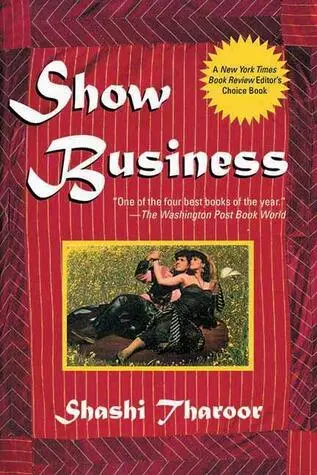
- Название:Show Business
- Автор:
- Издательство:Arcade Publishing
- Жанр:
- Год:2011
- ISBN:нет данных
- Рейтинг книги:3 / 5. Голосов: 1
-
Избранное:Добавить в избранное
- Отзывы:
-
Ваша оценка:
Show Business: краткое содержание, описание и аннотация
Предлагаем к чтению аннотацию, описание, краткое содержание или предисловие (зависит от того, что написал сам автор книги «Show Business»). Если вы не нашли необходимую информацию о книге — напишите в комментариях, мы постараемся отыскать её.
Show Business — читать онлайн бесплатно полную книгу (весь текст) целиком
Ниже представлен текст книги, разбитый по страницам. Система сохранения места последней прочитанной страницы, позволяет с удобством читать онлайн бесплатно книгу «Show Business», без необходимости каждый раз заново искать на чём Вы остановились. Поставьте закладку, и сможете в любой момент перейти на страницу, на которой закончили чтение.
Интервал:
Закладка:
Don’t tell me to leave, my master,
With you my heart beats faster,
My palms perspire
With nameless desire,
Don’t tell me to leave, my master.
I am drawn to you like a moth to a candle,
Your heat is more than I can handle,
I am lost,and without shame,
I singe myself in your flame
And fall at your feet like a sandal.
Don’t tell me to leave, my master,
This soul isn’tmade of plaster,
It throbs with the need
Tobe strung like a bead —
Don’t tell me toleave, my master.
(Unnoticed by the besotted Pranay and the ill-begotten Kalia, Ramkumar has slipped discreetly away on an errand of his own. The cinema audience sees this, but the dance goes on.)
Don’t tell me to leave, my master,
If you do it’ll bea disaster,
Like a house with no roof,
I’d be warpwithout woof,
Don’t tell me to leave, my master.
Mehnaz dances to these words as so many Indian actresses have done, with a demure grace completely unrelated to the content of the lyrics. At the song’s end Pranay, bleary-eyed from many swigs out of his bottle, beckons the girl with a crook of his finger.
“Come here, my dear,” he slurs poetically.
Mehnaz looks at Ashok, who nods. She walks to the Thakur, kneels suggestively before him — and in a flash pulls out a gleaming dagger from inside the folds of her skirt and holds it to his throat.
“Don’t anybody move,” says Ashok, pulling a knife on Kalia. He grins at the goggling Pranay. “Hello, uncle,” he says.
Upstairs, Ramkumar rummages through papers in a drawer. At last he finds what he is looking for and holds it up to the light with a gleam of triumph in his eyes. “I’ve got it,” he breathes. “The will!”
He runs into the hall, brandishing the document. “The game is up, Pranay,” he declaims, dramatically sweeping off his turban. “You thought you had got rid of me forever. Now I have the proof that this zamindari really belongs to Abha and me.”
“Not so fast, Ramkumar,” Pranay has regained his evil composure. “Your entitlement only derives from your marriage to my sister. With Abha dead, I am the legal heir. Let me see you fight that in a court of law.”
“There will be no need for a court of law,” says a quiet voice. Abha has entered the hall! Pranay’s consternation is real. “But — I thought —” He staggers to his feet. “Kalia, you told me —” He takes two steps forward, unimpeded. It is a clever maneuver. Before Mehnaz catches on to what is happening, Pranay wheels around, grabs her wrist, and takes possession of the dagger. He now holds it to Mehnaz s throat.
“Drop your knife, nephew,” he snarls.
Ashok does as he is told. Kalia, relaxing, bends to pick it up. Suddenly there is a blur of motion as a brown, furry object jumps in through a high window and alights on the chandelier. It is Thakur, the monkey, his tail aloft like a soldiers proud standard. As Pranay cries out in alarm, the monkey loops his tail around the chain of the chandelier and swings from it, rocking the fixture dangerously to and fro.
“Watch out!” cries Ramkumar. He, Ashok, and Abha step back. The monkey swings defiantly one last time and then releases his tail. As he leaps through the air, straight for Pranay, the chandelier comes crashing down on the bald head of the bending Kalia.
The monkey knocks the dagger out of Pranay’s hand with an emphatic swipe. Mehnaz runs to the others. Pranay, cursing, lunges at the monkey, who leaps out of harm’s way.
“It’s all over, Pranay,” says Ramkumar. “My sons have all the proof they need of your evil doings. You’re going to jail for a long, long time.”
“Not without a fight,” says Pranay, who knows what the audience wants. He pulls a ceremonial sword off the wall and charges toward them.
Ashok parries his first thrust with a cushion, then sidesteps to the wall and pulls down a sword also. As the others watch helplessly, the two clash and thrust and parry, knocking over furniture and lamps, slashing bolsters and paintings, and considerably reducing the value of Abha’s inheritance (while enhancing the producer’s tax write-offs).
At last, with neither having the upper hand, Ashok leaps toward a door. “Come and get me, Pranay,” he mocks. Pranay steps forward, an evil grin of pursuit on his face, when a voice from the opposite door stops him.
“I’m here, Thakur,” says Inspector Ashok, standing at one door. Pranay looks at him aghast, then back to the other Ashok, by the other door.
“No, I’m here, Thakur,” says Ashok the monkey-man.
As Pranay remains motionless, disoriented by the twin apparitions, the brothers leap simultaneously at him. This time the fight is an unequal one. Pranay is overpowered, and Ashok the monkey-man stands poised to strike him with the dagger when Ramkumar speaks.
“No, son,” he says. “We will not treat him the way he treated us. He must face the full justice of the law, and pay for his crimes in prison.”
Ashok looks regretfully at his father. Then, obediently, he lowers his dagger. Inspector Ashok produces handcuffs instead, which are quickly applied to Pranay’s wrists.
“In the name of the police,” Ashok says solemnly in a procedure unknown to the authorities, “I place you under arrest, Pranay Thakur.”
Ramkumar and Abha smile at each other in parental pride. The monkey applauds.
“There is one thing that remains to be done,” Ashok the monkey-man says.
“Oh, and what is that?” asks Mehnaz.
“Before Chacha, your father, died, he asked me to do something very important,” Ashok recalls.
Mehnaz s pretty brow puckers. “And what was that, Bhaiya?” she asks.
Ashok takes her hand. “To marry you,” he says mischievously, “to someone just like myself.”
He pulls her by the hand to Inspector Ashok, who looks as if, under all that makeup, he just might be blushing. And he joins both their hands together. Laughing, the three embrace. Ramkumar and Abha exchange yet another look of parental pride. And the monkey, not to be outdone, leaps onto the trio and tries to embrace them all in his long thin arms.
The sound track fills with a fast, joyful rendition of “We must go on seeking” as the screen announces THE END.
[The Usual Note: this time we have omitted only two songs in the condensation, but a couple of fight sequences toward the end, three separate scenes of Pranay tyrannizing his tenants on horseback, one rape, a set of flashbacks about the murder for which Ramkumar was framed, and a pair of subplots involving Raju the faithful retainer and Shahji the chawl friend have also been excised in the interests of brevity — which, as we all know, is the soul of It.]
Monologue: Night
KULBHUSHAN BANJARA
Yes, its true I always disapproved of you. Can you blame me? You were serious about nothing, Ashok, even as a boy. You had a gift for acting as a child, though we really thought of it as pretending — you were a very good pretender. But while you could be anyone you wanted with a few simple props, you never wanted to be what I wanted you to be. Oh, I know that sounds like the typical complaint of every father with ambitions for his son, but was I wrong to harbor such ambitions? You were worthy of them: you had the looks, the charm, the style, the glib tongue. And I could have opened doors for you, brought you into the party the right way, got you to move up from the grass roots where only I could have planted you. But you didn’t want it. Your brother, Ashwin, with half the natural talent for politics that you had, followed me because I told him I needed a political heir — but not you. First, you preferred that stupid job selling detergent powder to middle-class housewives, and then you went off to Bombay to become, of all things, a film actor. Of course I disapproved.
Читать дальшеИнтервал:
Закладка:
Похожие книги на «Show Business»
Представляем Вашему вниманию похожие книги на «Show Business» списком для выбора. Мы отобрали схожую по названию и смыслу литературу в надежде предоставить читателям больше вариантов отыскать новые, интересные, ещё непрочитанные произведения.








Обсуждение, отзывы о книге «Show Business» и просто собственные мнения читателей. Оставьте ваши комментарии, напишите, что Вы думаете о произведении, его смысле или главных героях. Укажите что конкретно понравилось, а что нет, и почему Вы так считаете.