Shashi Tharoor - Show Business
Здесь есть возможность читать онлайн «Shashi Tharoor - Show Business» весь текст электронной книги совершенно бесплатно (целиком полную версию без сокращений). В некоторых случаях можно слушать аудио, скачать через торрент в формате fb2 и присутствует краткое содержание. Год выпуска: 2011, Издательство: Arcade Publishing, Жанр: Современная проза, на английском языке. Описание произведения, (предисловие) а так же отзывы посетителей доступны на портале библиотеки ЛибКат.
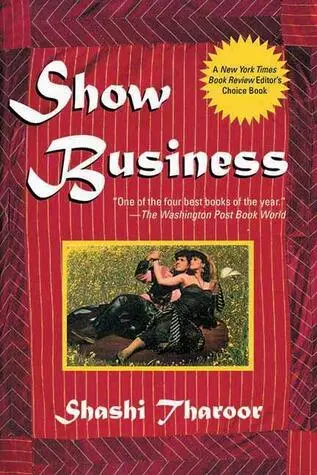
- Название:Show Business
- Автор:
- Издательство:Arcade Publishing
- Жанр:
- Год:2011
- ISBN:нет данных
- Рейтинг книги:3 / 5. Голосов: 1
-
Избранное:Добавить в избранное
- Отзывы:
-
Ваша оценка:
Show Business: краткое содержание, описание и аннотация
Предлагаем к чтению аннотацию, описание, краткое содержание или предисловие (зависит от того, что написал сам автор книги «Show Business»). Если вы не нашли необходимую информацию о книге — напишите в комментариях, мы постараемся отыскать её.
Show Business — читать онлайн бесплатно полную книгу (весь текст) целиком
Ниже представлен текст книги, разбитый по страницам. Система сохранения места последней прочитанной страницы, позволяет с удобством читать онлайн бесплатно книгу «Show Business», без необходимости каждый раз заново искать на чём Вы остановились. Поставьте закладку, и сможете в любой момент перейти на страницу, на которой закончили чтение.
Интервал:
Закладка:
“I’m beginning,” Ashok mutters, “to wonder myself.”
“And who are you?” asks the prison officer dubiously.
“I am his wife,” replies Abha.
“And I am his son,” adds Ashok, monkeyless for the occasion.
The prison officer is not impressed. “He has been in this jail for twenty-two years,” he says pointedly, “and there is no record of a wife and son. In fact, it says here” — he picks up a yellowing folder held together with dangling string and leafs through dusty pages — “wife deceased. Next of kin, Pranay Thakur.” He looks up at them. “Now you go and get a letter from Pranay Thakur to confirm that you are who you say you are, and I will see what I can do. But I can’t promise anything.”
They protest, they plead, but the iron wall of prison bureaucracy, at least as interpreted in Bombay, is not moved. “Oh, and one more thing,” the official adds. “Even if you get such a letter, please remember that visiting days are Thursdays only. This is not a hotel, that you can come in and see people when you like.”
When the devastated pair leaves, the prison official turns to a colleague on an adjoining desk. “Strange, this sudden burst of interest in Ramkumar,” he observes. “For twenty-two years not a soul wants to see him, and now suddenly three people this week. Remember the police inspector the other day? I wonder if I shouldn’t send word to Pranay Thakur.”
Outside, Ashok is grimly determined. “We tried it your way, Ma,” he says through gritted teeth, “and you saw how they treated us. If there was any justice my father wouldn’t be in prison at all, and now we’re not even allowed to see him! Fine, at least we know he’s there. Now you leave it to me and my friends. We’ll have him out very soon, Ma — and then we’ll turn our attention to your adopted brother.”
“All right, my son,” Abha sighs. “But be careful.”
It is dark, but Ashok’s face is clearly visible in the moonlight as he stands at the foot of a tree outside the prison walls, a stout length of hemp in his hands. He puts one end of the rope over his monkey’s shoulder. “Go, Thakur,” he says.
The monkey holds the rope in his thin fingers and leaps onto the tree.
“Shabash” says Shahji, one of the two men accompanying Ashok. Both are familiar faces from the first scene at the chawl, people whom Ashok had greeted cheerily as he walked in with his day’s pickings.
The monkey scurries along the thin branch that overhangs the prison courtyard. He leaps down and runs to a drainpipe, which he ascends nimbly. Reaching a barred window, the monkey loops his end of the rope around a bar, then proceeds to tie it into a knot. (The audience in the front rows of the movie theater applaud, cheer, and whistle at this: the improbable is far more fun than the credible.)
When the monkey has returned, mission accomplished, to his habitual perch on his master’s shoulder, Ashok tugs at the rope to test it. It is firm. Quickly, he ties the other end to the tree trunk. The rope looks taut and strong.
“Let’s go, brothers,” he breathes.
One by one, the heroes of the chawl clamber up the rope, over the prison wall, and reach the window. Ashok, the first, uses a steel file he has been holding in his teeth to saw rapidly through two of the bars. He jumps in, and the other two follow.
Whispered words are uttered, and the men fan out. The action is swift. A sleepy guard is surprised by Shahji and his friend is knocked out, his bunch of keys taken. Another looks up from his plate to find a knife at his throat and a grinning monkey on his table. Ashok raises a menacing finger to his lips. “One word,” he whispers, “let alone a scream, and —” He mimes the act of drawing the knife across the guard’s neck. The man chokes. Ashok puts a hand over his mouth and gestures with the knife. “Ramkumar?” he asks. “Don’t tell me — just point.” The terrified guard, extending a shaking finger, leads Ashok to Ramkumar’s cell. The monkey cheerfully helps himself to the abandoned dinner.
“Open it,” Ashok commands at the cell door. As the guard fumbles with the purloined keys Shahji gives him, Ramkumar looks up, astonished.
“Ashok!” he exclaims.
“You recognized me?” Ashok asks in disbelief.
“But of course,” Ramkumar says. “Though your disguise is pretty good.”
“Disguise?” asks Ashok.
“I didn’t expect you to do it this way,” Ramkumar says.
“It’s the only way,” Ashok replies as the cell door swings open.
“Thank you,” whispers Shahji politely, administering a swift blow with his flashlight to the back of the guard’s head. Both guard and hero descend to the floor, Ashok in order to touch his newfound father’s feet. (If one were ever in doubt as to the North Indian conservatism of the makers of Hindi films, one need look no further than the number of times the characters touch each other’s feet. Some of the producers expect the same of their supplicants, and they don’t always stop at the feet, either.)
“Come with us, Father,” says Ashok, leading him to the rope at the window. “Do you think you can do this?”
“I have broken rocks for twenty years, my son,” Ramkumar replies in a gruff voice. “I can do it.”
They clamber out to freedom. Once on the other side of the wall, Ashok unties the rope from the tree trunk, knots the bunch of keys to it, and flings it back in a sweeping parabola through the open window.
“Let them figure that out by themselves,” he chuckles, the monkey applauding his efforts. “Come on, Father, let’s go. Ma is waiting for you.”
“Ma?” Ramkumar’s bewilderment is complete. “I thought you told me she was dead.”
“When could I have told you that, Father?” Ashok asks in surprise.
They get into a waiting Tempo, with Shahji at the wheel, and drive off into the night. The camera catches a glimpse of Ramkumar. Hope, fear, confusion, and excitement are reflected simultaneously on the character actor’s face.
The sounds of music and the twinkling of lights strung on trees indicate that a party is taking place, but for those in any doubt, outside the entrance there is also a red banner that announces in large, white letters: WOMEN’S COLLEGE, FANCY DRESS PARTY, IN AID OF POLICEMAN’S BENEVOLENT FUND. (Had anyone suggested to the scriptwriter that no women’s college in its right mind would be associated with such an event, and that even if it were, it would not have called the function a “fancy dress party” or misspelled “policemen’s,” the objector would have been given a lecture on the creative necessity of artistic license. The misspelling, however, would have been attributed, not to the sign writer at Himalaya Studios, but to a conscious, realistic attention to detail — for which there is always a time and place in the Hindi film.)
Inside the college overdressed extras laugh and whirl with a gaiety rarely seen in any social event at a real women’s college in India. Mehnaz is in full evening gown, complete with sash and fake tiara: she makes a convincing beauty queen (her sash proclaims her to be “Miss Alternative Universe 1975”). As she sips a respectably nonalcoholic drink and laughs with a group of girls, a man in a kathakali mask sidles up to her.
“Remember me?” asks Inspector Ashok, lifting his mask briefly to grin at her.
“Ashok!” squeals Mehnaz. “But what are you doing here?”
“This is a policemen’s ball, and I’m a policeman,” replies the man in the mask.
“Ha-ha, big joke. I thought you were going to prison tonight.” In Hindi, one cannot distinguish between “prison” and “the prison” as one might in the language of the banner writer, so Ashok’s surprise is understandable.
Читать дальшеИнтервал:
Закладка:
Похожие книги на «Show Business»
Представляем Вашему вниманию похожие книги на «Show Business» списком для выбора. Мы отобрали схожую по названию и смыслу литературу в надежде предоставить читателям больше вариантов отыскать новые, интересные, ещё непрочитанные произведения.








Обсуждение, отзывы о книге «Show Business» и просто собственные мнения читателей. Оставьте ваши комментарии, напишите, что Вы думаете о произведении, его смысле или главных героях. Укажите что конкретно понравилось, а что нет, и почему Вы так считаете.