Shashi Tharoor - Show Business
Здесь есть возможность читать онлайн «Shashi Tharoor - Show Business» весь текст электронной книги совершенно бесплатно (целиком полную версию без сокращений). В некоторых случаях можно слушать аудио, скачать через торрент в формате fb2 и присутствует краткое содержание. Год выпуска: 2011, Издательство: Arcade Publishing, Жанр: Современная проза, на английском языке. Описание произведения, (предисловие) а так же отзывы посетителей доступны на портале библиотеки ЛибКат.
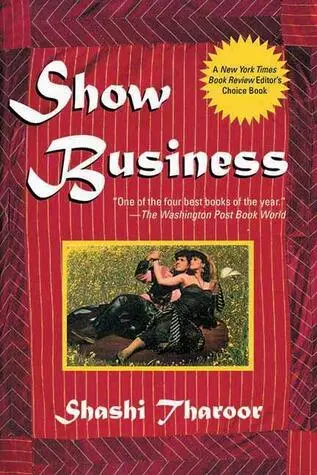
- Название:Show Business
- Автор:
- Издательство:Arcade Publishing
- Жанр:
- Год:2011
- ISBN:нет данных
- Рейтинг книги:3 / 5. Голосов: 1
-
Избранное:Добавить в избранное
- Отзывы:
-
Ваша оценка:
Show Business: краткое содержание, описание и аннотация
Предлагаем к чтению аннотацию, описание, краткое содержание или предисловие (зависит от того, что написал сам автор книги «Show Business»). Если вы не нашли необходимую информацию о книге — напишите в комментариях, мы постараемся отыскать её.
Show Business — читать онлайн бесплатно полную книгу (весь текст) целиком
Ниже представлен текст книги, разбитый по страницам. Система сохранения места последней прочитанной страницы, позволяет с удобством читать онлайн бесплатно книгу «Show Business», без необходимости каждый раз заново искать на чём Вы остановились. Поставьте закладку, и сможете в любой момент перейти на страницу, на которой закончили чтение.
Интервал:
Закладка:
“Arré Ashok, is it you?” the sick man rasps.
“Don’t strain yourself, Chacha,” our hero replies. “Look, I have brought some money for your medicine. You will be well soon.” He holds out a sheaf of notes to the girl, who looks embarrassed.
“Go on, take it, Mehnaz,” Ashok says. “Your father needs the medicine. If I could read and write I’d have got it myself.”
“You’re so kind, Bhaiya” Mehnaz replies. “I don’t know what we’d do without you. But you work so hard for this money — it isn’t right, somehow.”
“Don’t be silly,” Ashok retorts. “Isn’t Chacha like a father to me? Take it.”
The old man coughs again. “What’s the use?” he asks wearily. “I am not for this world much longer.”
Ashok sits on the bed and takes the old man’s hand in his. “Don’t talk like that, Chacha,” he pleads earnestly. “You will be well soon, once we get the medicines.”
“No,” the invalid coughs. “Son, I cannot last. There are two things I must tell you before it is too late.” His voice weakens, and Ashok has to bend low to hear him. “I know you have always thought you were the son of Pitlu the monkey-man. The truth is he had no son. He found you one day by the riverside, where he had gone to collect twigs for the fire. You were in a little basket, caught up in some brambles at the water’s edge. You were a tiny newborn baby, and he took you as a gift from God. Of course everyone in the chawl helped look after the baby, and my wife, your Chachi, God rest her soul, treated you like the son we had never had. You were brought up by all of us, by the entire chawl, though of course you belonged to the monkey-man, who said he needed a little boy to help him. And you seemed so happy with him, and with his monkey, no one was surprised when you took over from him in the end.” The old man, exhausted by his effort, stops, coughing. His daughter gives him a sip of water.
“Then who is my real father?” Ashok asks urgently. “How do I find him?”
“I have no idea. There was no name on the blanket you were wrapped in, and the basket has long since gone. But there is one clue.”
“Yes?”
“The talisman you wear on your wrist. That was with you the day you were found.” Ashok looks at it intensely, his only connection to an unknown world. “When you were little the string went around your wrist several times, but now I see it is as tight as a bracelet. Find out where that came from, and you might learn your origins.”
“I always thought it was my father’s — Pitlu’s,” Ashok says. “But whenever I asked him what it meant, he would always say he didn’t know, that I had had it since birth and that I should always wear it.”
“It is your most precious inheritance, Ashok,” the old man gasps.
“Chacha!” Ashok sees the life ebbing out of his mentor, and his voice is almost a cry. “And the second thing you wanted to tell me?”
“Look after Mehnaz,” the old man whispers. “She is not of an age to be alone in this world. You are like a brother to her. With her mother and aunt dead, she has no one.”
“She will always have me,” Ashok vows.
“Good,” Chacha says. “Find her — find her a husband just like you.” And with this shifting of paternal responsibility, the spark of dialogue that has kept him going so far fades out. His expression slackens, his eyes stare. He has gone to the great rerecording studio in the sky.
“Abba!” wails Mehnaz. “Chacha!” cries Ashok. They fall on the inert form of the extra, who struggles to keep still. Then, in an apocalyptic moment, they look up at each other and fall into a mutually consolatory — and, of course, purely fraternal — embrace.
Ashok — another Ashok, but the audience doesn’t know this immediately — walks proudly into a small house in his new uniform. He wears the pale khaki garb and starry epaulettes of an inspector of the Bollywood CID.
“Ashok!” A gray figure rises from a cloth-and-wood easy chair to greet him. Despite the generous application of whitener on his hair, the figure is recognizably Abha’s faithful old retainer, Raju. “You have done it! Congratulations!’’
“Yes, Father. As of today, you may call me Inspector Ashok.”
“This is a proud day for me, son. If only your mother could see you now.” Raju wipes a sentimental tear from his eye. “If for all these years I have instilled in you the ambition to become a police officer, it has been only for her.” He clasps Ashok in a paternal hug, then stands back, one hand on the young man’s shoulder, and looks at him with wet eyes. “Son, the time has at last come when I must tell you something very important. For all these years, I held my tongue, out of fear that the truth could expose you and us to danger at a time when we could do nothing about it. But now, Inspector Ashok, you can do something about it.”
“Father, I don’t understand what you’re talking about.”
“Sit down, son, and I shall tell you.” And he does: in staccato flashback images the story spills out: Thakur, Kalia, talisman, everything. By the end Ashok sits shaken.
“So you are not really my father, Father?”
“No, son. Your father is not a humble lathe operator in a factory who skimped and saved to send you to college and made an officer out of you. Your father is a fine man of good family who was condemned to rot in prison for a murder, a murder for which he was undoubtedly framed by Pranay Thakur’s thugs.”
“But he might be a free man now! I must find him!”
Raju shakes his head sadly. “In our country, Inspector Ashok, life imprisonment is really for life — unless death comes sooner. If your poor fine father survived the rigors of jail, rigors for which he was completely unsuited, he is probably still in jail now, twenty-two years later. As a police officer, perhaps you can trace him and get justice done.”
(The judicial system of India is one about which our filmmakers are blissfully ignorant, which is perhaps why it features so frequently in our cinematic life.)
“Do you know which jail he is in?”
“What does a poor servant know of such things? But you — as a police officer you can probably find out.”
“You have been a good father to me, Father — I mean Raju-ji. Whatever happens, I shall never forget all that you have done for me. But now I must set out to find my real father and avenge the tragic deaths of my mother and brother.” Ashok looks at the black string on his wrist. “By this sacred token of my mother’s love,” he vows, “I swear to avenge her.”
“Ashok,” cautions the old man, “no hasty actions. Pranay Thakur is a powerful man. An angry youth will prove no match for him. You must use your strengths — your new position, the law — to track him down. That is why I have waited so long to tell you. Do not make me feel I have waited in vain.”
Ashok turns to him soberly. “You are right, Father,” he says. “I must be patient. I must research the facts, build up a case. And then
I shall get him.
He won’t escape.
I won’t let him
Stay in one shape.
I shall hang and draw and quarter him,
Bury and plough and water him,
Do everything I ought to him —
Then turn him in to the forces of the law.
I shall catch him
By surprise.
I shall match him
Size for size.
I shall flog and tar and feather him,
Whip and lash and tether him,
Tie his hands together (hmm!)
And turn him in to the forces of the law.
Scene: Ashok the monkey-man and Mehnaz the recent orphan scour a bazaar. They go to silversmiths, shopkeepers, jewelers, fakirs, showing the talisman on its string. Each person they approach shakes his head, unable to identify it. One offers to buy it. The monkey perched on Ashok’s shoulder turns the offer down on his behalf.
Читать дальшеИнтервал:
Закладка:
Похожие книги на «Show Business»
Представляем Вашему вниманию похожие книги на «Show Business» списком для выбора. Мы отобрали схожую по названию и смыслу литературу в надежде предоставить читателям больше вариантов отыскать новые, интересные, ещё непрочитанные произведения.







Обсуждение, отзывы о книге «Show Business» и просто собственные мнения читателей. Оставьте ваши комментарии, напишите, что Вы думаете о произведении, его смысле или главных героях. Укажите что конкретно понравилось, а что нет, и почему Вы так считаете.